North Korea is quietly constructing a surface fleet capable of carrying tactical nuclear weapons into the Pacific Ocean, shifting away from its traditional reliance on land-based ballistic missiles.
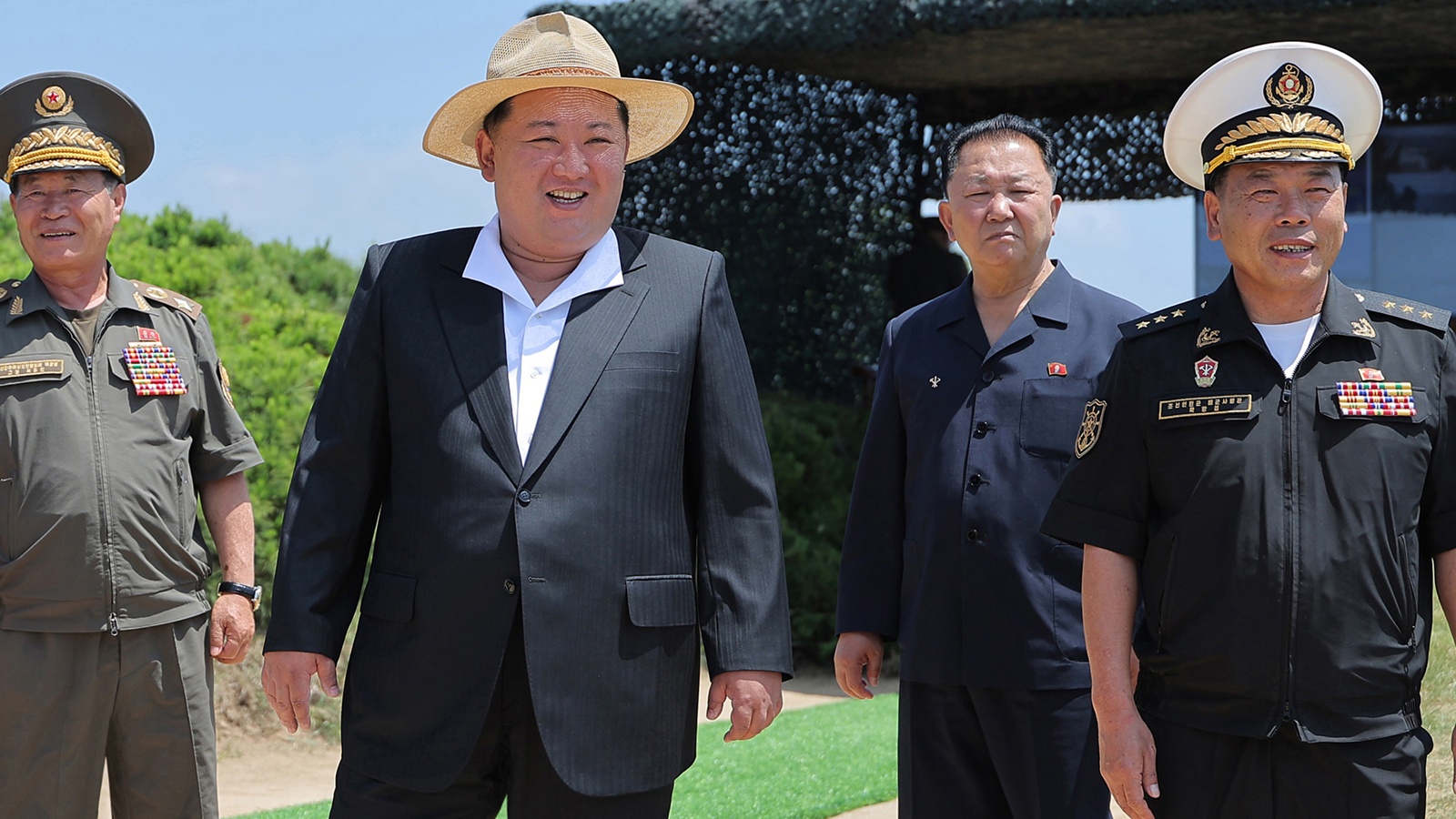
The strategy materialized clearly on July 3, 2026, when Kim Jong Un stood on a coastal observation point to watch the test-firing of an Arrow-series strategic cruise missile from the newly repaired, 5,000-ton destroyer Kang Kon. State media quickly broadcasted images of the blue-camouflaged missile tearing into the East Sea, framing the event as a triumph of domestic engineering. If you liked this piece, you should check out: this related article.
But the official imagery hides a deeper, far uglier reality of industrial desperation and severe structural flaws.
Just over a year ago, the Kang Kon was an international embarrassment for Pyongyang. During its initial launch ceremony in May 2025 at the northern port of Chongjin, the massive warship tipped over and partially capsized right in front of Kim, crushing sections of the hull and leaving the bow stranded on the slipway. A furious Kim publicly labeled the disaster a criminal act born of absolute carelessness and irresponsibility across multiple state institutions. That a capital ship could capsize at its own christening exposes the frantic, corner-cutting nature of the North Korean military procurement system. For another look on this story, check out the recent coverage from The Guardian.
Now, after fourteen months of rushed repairs, the Kang Kon has been pushed back into the water, with Kim demanding its formal entry into active naval service within two months.
This breakneck pace is not driven by confidence. It is driven by geopolitical panic.
The Reality Behind the 5,000 Ton Illusion
Pyongyang has historically operated a brown-water navy. For decades, its maritime strategy relied on aging Soviet-era submarines, small patrol boats, and coastal artillery designed to inflict asymmetric damage close to shore. The Choe Hyon-class destroyers represent a massive leap in displacement and ambition.
South Korean and American intelligence agencies are currently analyzing the specifications of the July 3 test, focusing on the integration of the vessel’s target-detection and electronic warfare systems. The ship is reportedly outfitted with anti-aircraft guns, automatic cannons, and specialized launchers meant for nuclear-capable cruise missiles.
Before this naval buildup, the largest operational surface combatant in the North Korean inventory was a modest 1,500-ton frigate. Jumping directly to a 5,000-ton destroyer platform requires complex naval architecture, sophisticated propulsion systems, and advanced metallurgical techniques that North Korea has historically lacked.
The math behind the manufacturing raises serious engineering questions. Under the current five-year defense plan established at the Workers’ Party congress, Kim has ordered the domestic production of two 5,000-ton warships every year, alongside blueprints for an even larger 10,000-ton cruiser.
Building modern warships at this speed is nearly impossible for an isolated economy under crushing international sanctions. The sudden appearance of these hulls suggests that the manufacturing pipeline is heavily subsidized from the outside.
The Kremlin Connection in the East Sea
Western maritime analysts argue that the Choe Hyon and the Kang Kon could not have been built, repaired, and armed so quickly without direct foreign intervention.
The timeline points directly toward Moscow. Following the deepening military cooperation between Kim Jong Un and Vladimir Putin, Russia has increasingly traded advanced sensitive technologies for North Korean artillery shells and short-range ballistic missiles. While global attention focused on the transfer of satellite technology and fighter aircraft, the transfer of naval architecture secrets and advanced marine propulsion systems went largely unnoticed.
Russian blueprints and technical advisors likely provided the exact engineering solutions needed to salvage the capsized Kang Kon. The blue camouflage paint observed on the Arrow-series cruise missile launched during Friday's test also mirrors maritime concealment tactics studied by Soviet-era naval theorists.
This relationship transforms the regional threat profile. Instead of a localized coastal threat, the North Korean navy is gaining the technical capacity to project power further into the Sea of Japan, complicating defensive calculations for both Seoul and Tokyo.
A Flawed Doctrine of Maritime Nuclear Deterrence
The strategic logic of putting nuclear weapons on a 5,000-ton North Korean destroyer is highly questionable.
In a conventional conflict, these large surface vessels would be incredibly vulnerable. The United States Navy and the South Korean fleet possess overwhelming acoustic, satellite, and aerial surveillance superiority. A 5,000-ton destroyer built with rushed repairs and questionable radar-evading capabilities would be tracked from the moment its engines started, turning it into a massive target for Western attack submarines and anti-ship missiles.
Why place invaluable nuclear-capable cruise missiles on a platform that can be easily sunk within the opening hours of a war?
The answer lies in peacetime extortion rather than wartime utility. Kim views these visible, heavily armed surface ships as potent tools for political signaling. Unlike a submarine that hides underwater, a large destroyer firing cruise missiles provides immediate, undeniable footage for international media, forcing neighboring democracies to react.
The risk of a catastrophic accident remains high. The 2025 capsizing of the Kang Kon proved that North Korea’s naval shipyards are operating under immense psychological pressure to meet unrealistic political deadlines, a environment where engineering safety protocols are routinely ignored. Forcing a hastily repaired warship carrying nuclear-armed cruise missiles into active service within sixty days invites mechanical or structural failure at sea.
The Shrinking Window for Maritime Containment
The international community's current strategy for monitoring North Korea is failing to keep pace with its naval shipyards.
Existing maritime sanctions focus primarily on stopping the illicit ship-to-ship transfer of refined petroleum and luxury goods. They are completely unsuited for stopping the transfer of digital engineering data, naval software, and specialized radar components moving across the land border between Russia and North Korea.
A third Choe Hyon-class destroyer is already under construction at the Nampo shipyard on the country's western coast, with state media indicating a planned completion date around the Workers' Party founding anniversary in October.
The Western response has been dangerously slow. Washington and its regional allies must pivot from tracking land-based mobile missile launchers to establishing a permanent, aggressive maritime tracking network focused on Pyongyang’s new shipyards.
The rapid rollout of these warships indicates that the traditional buffer provided by North Korea's industrial backwardness has evaporated. If the Kang Kon enters active duty by September as ordered, the waters of Northeast Asia will become permanently more dangerous, occupied by a nuclear-armed fleet built on a foundation of foreign assistance and desperate domestic engineering.