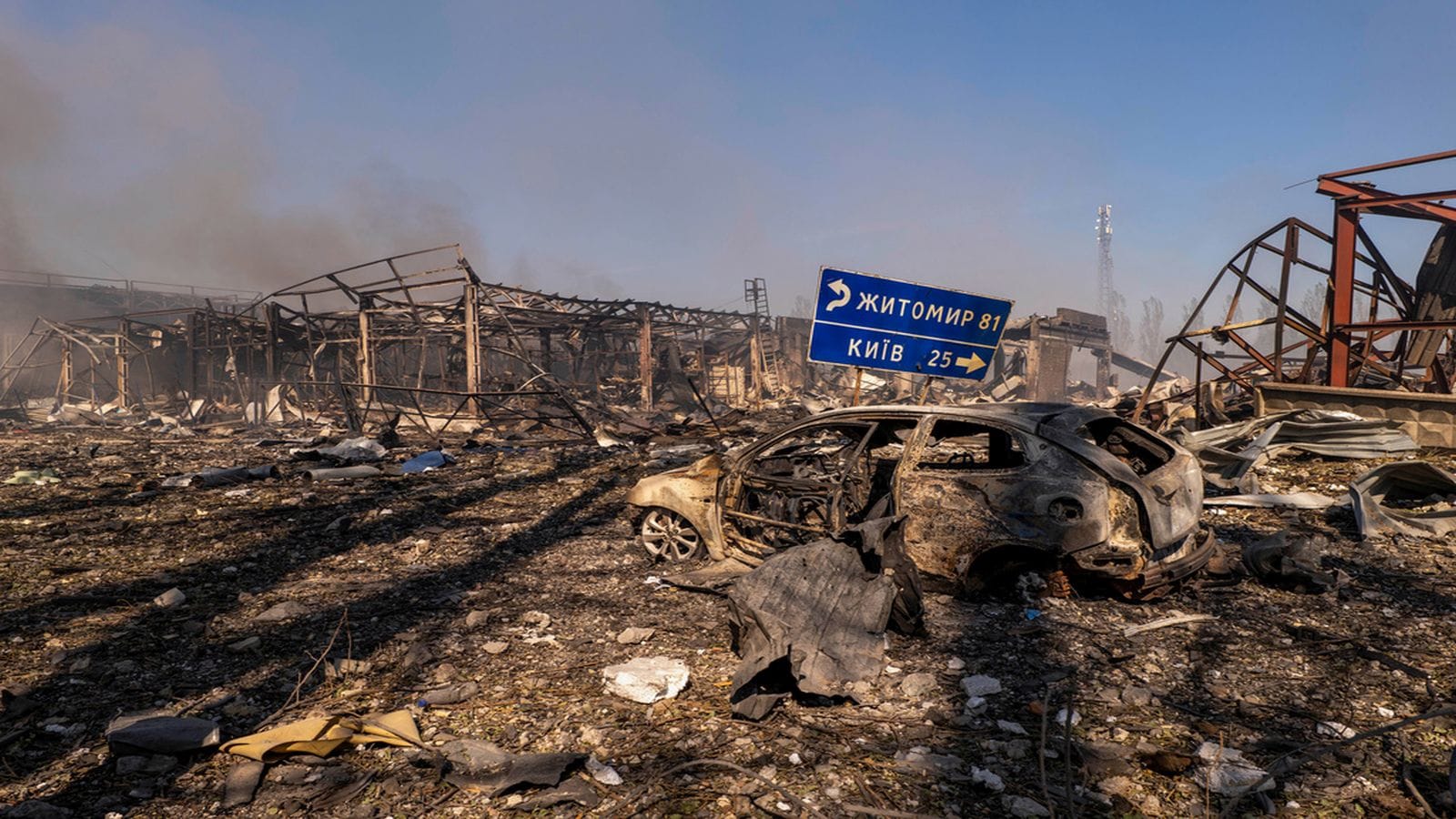
The deadliest attack on Ukraine this year did not begin with a tactical breakthrough by Moscow, but with a catastrophic chain reaction of domestic administrative failure. In the village of Myla, located in the Bucha district west of Kyiv, a Russian drone strike on a local warehouse triggered secondary detonations that flattened nearby residential structures and killed at least 38 people. Yet the immediate horror of the blast obscures an uncomfortable reality confronting Ukrainian military and political leadership. Munitions and defense equipment were stockpiled inside a populated zone, directly violating statutory safety parameters.
When the smoke cleared over the charred remains of nearly fifty residential buildings, state officials faced an angry public. President Volodymyr Zelenskyy publicly condemned the placement of high-explosive ordnance near civilian areas, labeling the decision a product of severe operational negligence. Criminal investigations are underway, but the incident highlights systemic vulnerabilities that stretch far beyond a single compromised facility. For a different perspective, see: this related article.
Anatomy of a Secondary Catastrophe
Military logistics in a protracted warzone are notoriously difficult. Warehousing space near major urban hubs is sparse, heavily contested, and expensive to secure. However, housing shells, mines, and drone components inside distribution centers abutting residential neighborhoods and care facilities crosses a dangerous line.
When the incoming projectile hit the Myla storage site, the primary blast was quickly eclipsed by the secondary detonation of stored military hardware. This secondary wave of energy leveled neighboring structures. Among the hardest hit was a local residence for elderly and disabled individuals, accounting for the vast majority of the fatalities. Further analysis on this matter has been published by NBC News.
Prime Minister Serhii Koretskyi pointedly noted that this disaster followed a terrifyingly similar playbook to an earlier strike in July in the Kyiv suburb of Vyshneve, where an ammunition depot detonation similarly destroyed adjacent civilian homes. Repeating these fatal errors after four and a half years of full-scale conflict points to a chronic breakdown in military-civilian zoning enforcement. Local commanders and logistics officers under pressure to move inventory quickly are bypassing safety protocols, betting that incoming air defense will hold. That gamble cost dozens of civilian lives in an instant.
The Escalating Cost of Air Defense Fatigue
The Myla tragedy unfolded during a grueling three-day barrage of near-constant Russian drone and missile incursions aimed at exhausting Ukrainian interception capacity. Moscow has adapted its tactics, relying heavily on clustered waves of munitions designed to overwhelm fixed radar nets and deplete interceptor stocks.
Compounding the problem is the evolving threat profile of aerial weapons. Ukrainian defense officials have acknowledged a troubling rise in the deployment of fast jet-powered drones by Russian forces. These platforms compress the decision-making window for air defense units. Traditional counter-drone measures struggle to match the speed and trajectory of these newer systems, forcing Kyiv to search for expensive electronic warfare adaptations and specialized interceptor technologies.
As air defense corridors strain under the sheer volume of incoming threats, the margin for error narrows. When an aerial asset slips past interception layers, the presence of concentrated munitions near civilian dwellings transforms a localized military strike into a community-wide massacre.
Accountability Amid a Shifting Political Landscape
The disaster arrives at a politically delicate moment for Kyiv. The defense apparatus is navigating a leadership transition following recent structural changes within the ministry and ongoing financial pressures to close a massive defense funding gap. Public patience is wearing thin, not only with external aggressors, but with institutional blind spots that expose non-combatants to avoidable risks.
Demands for accountability are mounting across civil society. While military necessity dictates the decentralization of supplies to prevent single-point failures, dispersing material into populated administrative zones creates an unacceptable hazard. Investigators must determine who authorized the Myla storage site and why prior warnings from the Vyshneve incident failed to trigger a nationwide audit of regional supply depots.
True security requires defending against threats from the sky while enforcing strict internal discipline on the ground. Until the Ministry of Defense aligns its logistics footprint with basic human safety margins, the civilian population remains vulnerable to dangers originating from both sides of the frontline.