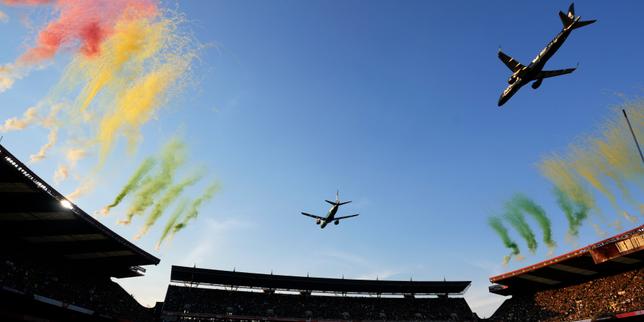
South Africa's aviation regulator initiated compliance verifications following a low-altitude passenger jet flypast over Cape Town's DHL Stadium ahead of a high-profile rugby test match between the Springboks and the All Blacks. Flight tracking data indicated the lead aircraft skimmed roughly 12 to 14 meters above the stadium's highest architectural structure, triggering intense public backlash regarding safety margins and regulatory oversight during commercial sports spectacles.
The controversy erupted after two custom-liveried Airlink passenger jets executed a synchronized low-level pass over a crowd of approximately 58,000 spectators. While stadium crowds roared at the visual spectacle, digital aviation forums lit up with criticism. Observers questioned the wisdom of flying commercial twin-engine regional jets at such altitudes over densely packed urban structures. The maneuver was part of a promotional series tied to the ongoing Rugby's Greatest Rivalry fixtures, positioning commercial aviation directly into the theatrical buildup of international test rugby. Read more on a connected issue: this related article.
Regulatory bodies move slowly, but public pressure accelerates timelines. The South African Civil Aviation Authority (SACAA) announced a formal review of the maneuver. Investigators began pulling flight data recordings, radar logs, and operational approvals. Yet, the regulator initially noted that the airline had completed standard preparatory procedures, including simulator run-throughs.
The tension highlights a growing friction between corporate marketing departments and public safety advocates. Modern sports entertainment relies heavily on shock and awe. Organizers push boundaries to secure viral moments, utilizing massive physical assets like commercial airliners to amplify brand visibility. When those assets brush against statutory boundaries, the defense invariably defaults to technical compliance. Additional analysis by NBC Sports delves into similar perspectives on this issue.
Airlink strongly rejected allegations of recklessness. The carrier maintained that safety remained the primary focus at every operational phase, emphasizing that the aircraft were under the direct control of crews comprising three senior captains. Furthermore, the airline offered to share precise onboard telemetry data to counter interpretations derived from consumer flight tracking apps.
Precision flying requires navigating narrow margins between calculated risk and public perception. Professional flight crews undergo rigorous training for non-standard profiles, but executing low-level passes above urban stadiums introduces variables that simulators cannot fully replicate. Wind shear off nearby coastal landforms, structural thermal drafts, and unexpected localized turbulence can alter a heavy aircraft's trajectory within seconds.
Public anxiety forced an immediate operational retreat. A planned repeat performance ahead of the subsequent test match in Johannesburg was scrapped. Publicly, the cancellation was attributed to unfavorable weather forecasts. Practically, the decision offered a convenient off-ramp from a mounting public relations storm that threatened to overshadow the sporting contest itself.
Sponsorship integration within elite rugby has evolved past jersey logos and stadium billboards. Brands seek total atmospheric dominance. Airlink serves as an official partner for the test series, treating the skies above the pitch as prime advertising real estate. That commercial imperative transforms standard transport aircraft into temporary stunt platforms, blurring the line between routine commercial aviation and exhibition flying.
Examining the mechanics of low-level flypast approvals reveals a complex web of stakeholders. Municipal authorities, stadium management, air traffic control, and national civil aviation regulators must all sign off on route clearances. Each entity evaluates risk through a different lens. Municipalities look at crowd density and economic impact. Air traffic controllers manage slot integration and separation minima. Regulators examine statutory compliance. None of them are explicitly designed to weigh the psychological comfort of a stadium audience witnessing a wide-body or regional jet roaring past the upper tier.
The incident forces a reckoning within sports marketing divisions across the globe. Spectators want drama, yet trust in institutional safety protocols remains fragile. When a commercial carrier becomes a lightning rod for safety debates, the corporate calculus shifts rapidly. The value of a ten-second aerial photo opportunity diminishes sharply when weighed against regulatory investigations and public censure.
Civil aviation authorities face mounting pressure to tighten rules governing non-standard low-altitude operations over populated areas. Current frameworks often leave room for interpretation when dealing with promotional displays conducted by commercial operators. Closing those loopholes will likely require stricter altitude floors and independent safety audits for any event taking place inside urban stadiums.
The fallout from the Cape Town flypast extends beyond a single cancelled display. It exposes the delicate equilibrium sustaining modern sports entertainment. When marketing ambitions outpace public trust, the apparatus designed to thrill audiences can quickly become a liability. Aviation and elite sport share a reliance on absolute precision. When one compromises, the other feels the turbulence.
As the regulatory review proceeds, the airline industry and sports promoters will quietly recalibrate their playbook. The era of casual acceptance for low-level stadium stunts is closing. Future fixtures will likely rely on ground-based pyrotechnics and augmented reality rather than twin-engine jets pushing the limits of vertical clearance. The skies above the pitch are returning to their primary purpose, leaving sports marketers to find new ways to capture attention without rewriting the rules of flight safety.

.png?width=1200&auto=webp&trim=0%2C0%2C0%2C0)