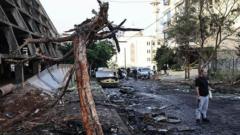
The smoke rising from the hills of Mount Lebanon this week isn't coming from the usual tactical flashpoints. For decades, the script of the Israel-Hezbollah conflict was written in the Shia-majority south and the concrete labyrinths of south Beirut. That script has been shredded. As of April 1, 2026, the Israel Defense Forces (IDF) have fundamentally altered their targeting logic, striking deep into Christian, Sunni, and Druze heartlands—areas historically insulated from the "Resistance Axis" crossfire.
More than 1.2 million people, roughly one-fifth of Lebanon’s population, are now adrift. While the world watches the familiar footage of the Dahiyeh skyline collapsing, a more calculated and quiet catastrophe is unfolding. Israel is no longer just hunting missile launchers; it is systematically dismantling the geography of Lebanon to create a "permanent security buffer" that extends to the Litani River and beyond. This isn't a temporary incursion. It is the architectural redesign of a nation’s borders by force.
The Strategy of Sectarian Pressure
The most striking development in this spring offensive is the deliberate targeting of villages like Rmeish and towns in the Baalbek region that do not fit the traditional profile of Hezbollah strongholds. For years, Lebanese sectarian geography acted as a shield for many. If you lived in a Maronite Christian village or a Sunni coastal town, you were largely a spectator to the wars in the south.
That immunity has evaporated. The IDF’s current doctrine appears to be one of "compellence." By striking infrastructure and residential blocks in non-Hezbollah areas, the military objective is to force the broader Lebanese population to turn against the militia.
- Selective Displacement: In Maronite border villages, the IDF has reportedly made direct phone calls to municipal leaders, offering a grim bargain: ensure no Hezbollah presence, or face the same fate as the south.
- Infrastructure Isolation: The destruction of the Dallafa and Qasmiyeh bridges isn't just about stopping weapons convoys. It is about severing the south from the rest of the country, effectively turning the region below the Litani into a "fire zone" where anything that moves is a target.
The Buffer Zone Fallacy
Prime Minister Benjamin Netanyahu and Defense Minister Yoav Gallant have been explicit about their goal: a permanent security buffer. The logic is that by clearing a 10 to 15-kilometer strip of all human habitation and "terror infrastructure," northern Israeli residents can finally return to their homes.
However, veteran analysts and humanitarian observers on the ground in Beirut see a different reality. You cannot "sanitize" a landscape that is home to hundreds of thousands of people without committing what international law defines as forced displacement.
Unlike the 1982-2000 occupation, where Israel attempted to govern through the South Lebanon Army (SLA), the 2026 strategy is one of high-tech absenteeism. Using AI-driven surveillance and automated turret systems along the new "security line," the IDF aims to maintain control without a massive, vulnerable troop presence. But this assumes Hezbollah is a static target. It isn't. The group has already pivoted to a decentralized, mobile command structure, launching Scud-D ballistic missiles from deep within the rugged interior—far beyond any buffer zone's reach.
A State on the Brink of Internal Collapse
The humanitarian toll is staggering, yet the numbers—1,247 dead and 3,680 wounded—barely scratch the surface of the social erosion. Lebanon was already a failed state before the first bombs fell on March 2. The currency is worthless, and the central government in Beirut exists only on paper.
The sudden influx of 1.1 million internally displaced persons (IDPs) into schools, churches, and public parks in Beirut and the north has created a pressure cooker of sectarian tension. In Christian neighborhoods of East Beirut, residents who initially welcomed the displaced are now growing wary. Rumors of Hezbollah operatives hiding among civilian refugees have led to localized clashes and "neighborhood watch" militias springing up overnight.
"They are trying to turn us against each other," says a local volunteer in a makeshift shelter in Tripoli. "When the bombs hit a Sunni building because one person might be affiliated with the resistance, it doesn't just kill that person. It kills the neighborhood's willingness to help."
The Geopolitical Endgame
While the IDF grinds forward, the diplomatic vacuum is being filled by more dangerous actors. Iran has effectively assumed de facto control of Hezbollah’s military wing following the degradation of its middle-management layers. This "Iranization" of the conflict means that decisions about Lebanese lives are no longer being made in Beirut, but in Tehran.
The United States and European powers like France have issued the usual condemnations, but their leverage is non-existent. Israel views this as an existential cleanup operation, emboldened by a global community that has grown numb to the "Gaza model" of urban warfare.
The reality is that there is no "after" for this war. Even if a ceasefire were signed tomorrow, the "security buffer" in the south remains occupied. The bridges are gone. The schools are shelters. The social contract between Lebanon’s disparate sects is frayed beyond repair. Israel may succeed in pushing Hezbollah’s physical launchers back five miles, but in doing so, it has ensured that the next generation of Lebanese—from every sect—will see the southern border not as a line of defense, but as an open wound.
The "buffer" isn't just made of concrete and wire. It is a psychological chasm that has transformed Lebanon from a sovereign state into a collection of besieged enclaves.
Stay focused on the map. As the IDF pushes toward the Zahrani River, the definition of "Hezbollah territory" will continue to expand until the entire country is considered a legitimate target.


