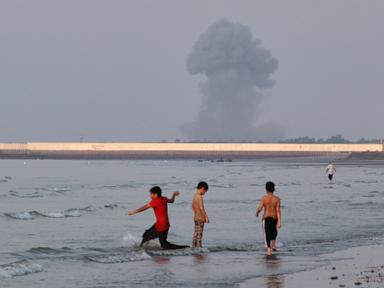
The United States has dramatically escalated its military campaign in the Middle East by expanding airstrikes deep into northern Iran and disabling a commercial oil tanker attempting to breach its newly reinstated naval blockade. Early Thursday morning, American aircraft struck military installations surrounding the capital city of Tehran and ballistic missile facilities in Semnan province, signaling a dangerous expansion of the conflict well beyond the southern coastline. This aggressive surge follows a direct confrontation in the Persian Gulf, where a U.S. military aircraft fired a missile into the smokestack of the Curacao-flagged tanker Belma as it sailed toward Iran's primary oil export terminal at Kharg Island.
Tehran responded before dawn with a wave of retaliatory missile and drone salvos targeting U.S. military installations in Bahrain, Kuwait, and Jordan. The sudden flare-up effectively shreds the fragile interim peace agreement established under the Islamabad memorandum, threatening to plunge the global energy market into chaos. While Washington aims to choke off Iranian revenue, the tactical shift exposes a severe structural miscalculation: instead of forcing open the vital Strait of Hormuz, the aggressive enforcement mechanism is driving the region toward a total war that the global economy cannot afford.
The Failure of the Reopened Strait Strategy
When the war commenced on February 28, Iran quickly utilized its geographic advantage to restrict commercial shipping through the Strait of Hormuz, a narrow maritime chokepoint through which one-fifth of global energy supplies flow. The resulting spikes in oil, gas, and fertilizer prices immediately threatened western economies. Washington’s initial attempts to establish a secure transit route outside Iranian territorial waters near Oman crumbled after sustained Iranian attacks on commercial vessels.
Faced with failing alternatives, the White House reimposed the absolute naval blockade. Yet, blockading Iran is a fundamentally different task than previous maritime containments against weaker states.
Iran possesses a highly developed, dispersed domestic defense industry and a sprawling geography. Disabling a single merchant ship like the Belma demonstrates tactical precision, but it does little to solve the core problem. The move has instead provoked the Islamic Revolutionary Guard Corps to issue a stark ultimatum: energy exports from the Middle East will now be for everyone, or they will be for no one.
Moving the Crosshairs North
By striking Semnan province and the outskirts of Tehran, the Pentagon is no longer just targeting coastal defense radars or fast attack boats in the Persian Gulf. The target list has shifted toward the institutional heart of Iran's ballistic missile and space programs.
This geographical expansion aims to degrade the long-range weapons systems that threaten U.S. bases across the region. However, deep-penetration strikes carry extreme escalation risks. Targeting facilities near highly populated areas or deeply fortified mountain installations significantly reduces the diplomatic off-ramps available to negotiators in Tehran. Iran’s parliament speaker, Mohammad Bagher Qalibaf, made it clear that the state is prepared for full-scale military confrontation rather than submission under fire.
A parallel strike on the 388th Mechanized Infantry Brigade in the southeastern Sistan and Baluchestan province, which reportedly killed seven soldiers, reveals a systemic campaign to pin down Iranian ground forces. The sheer volume of munitions utilized—including 13 missiles in a single localized engagement—underscores an intensity that resembles the opening salvos of an entirely new theater of war rather than a policing action for global shipping.
The Economic Mirage of Energy Containment
The immediate political pressure driving the U.S. strategy is obvious. The administration faces an upcoming congressional election cycle in November, and high energy prices are poison at the ballot box. By strangling Iranian exports entirely, policymakers hope to force a quick capitulation.
Yet, history suggests that total blockades against deeply ideological regimes rarely yield swift surrenders. Instead, they trigger desperate, asymmetric responses.
If Iran successfully executes its threat to disrupt broader regional energy supplies via drone swarms or sea mines, the economic fallout will extend far beyond the borders of the Islamic Republic. Neighboring Gulf states are already feeling the heat. Recent unacknowledged strikes on Iranian ports like Bushehr indicate that regional players may be taking quiet, unsanctioned retaliatory actions of their own, further muddying the geopolitical waters and widening the circle of conflict.
Reopening the Strait of Hormuz by brute force remains an elusive goal. Maritime experts agree that establishing absolute control over the waterway would require an armada far larger than the current deployment, alongside tens of thousands of ground troops to secure the coastlines. Airstrikes and disabled tankers create powerful headlines, but they cannot rewrite the rigid laws of geography. Washington is attempting to solve a deeply rooted political and territorial crisis through escalating air power, a strategy that historically achieves little more than ensuring the next round of retaliation is deadlier than the last.