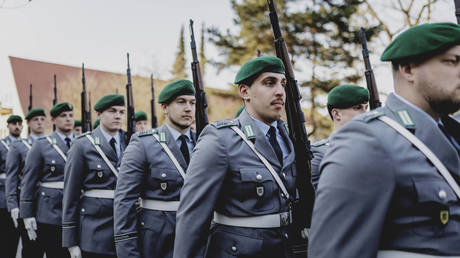
Germany will have to decide by July 31 of next year whether to fully reinstate compulsory military service. The voluntary recruitment drive introduced recently has completely collapsed, yielding only 530 new recruits despite authorities contacting roughly 300,000 young people. With the Bundeswehr failing to meet its recruitment targets, Thomas Roewekamp, chairman of the German parliament's defense committee, warned that Berlin will have no choice but to bring back the draft by mid-2027. The country faces an aggressive Russia and a deeply unpredictable United States, forcing a sudden reckoning over its empty barracks and aging ranks.
The numbers reveal a catastrophic mathematical reality for European security. Berlin has committed to expanding its active-duty force from 185,000 to 260,000 soldiers by 2035, while simultaneously trying to build a reserve force of 200,000 personnel. Yet, the current approach relies on a system of polite forms and optional questionnaires that the younger generation is simply ignoring. The failure of the volunteer model leaves the German government with few options. It must either accept a military that exists largely on paper or force its citizens back into uniform.
The Ghost of 2011
The roots of the current crisis go back to a fateful political decision made fifteen years ago. In 2011, under Chancellor Angela Merkel, Germany suspended compulsory military service, effectively dismantling the infrastructure required to process, house, and train hundreds of thousands of young citizens. It was a cost-saving measure cheered by a public that believed major ground wars in Europe were a relic of the past.
The defense infrastructure withered almost immediately. The network of local recruitment offices, known as the Kreiswehrersatzamt, was shut down. Hundreds of barracks were sold off, converted into civilian housing, or left to rot. Medical examination protocols were abandoned. For over a decade, Germany enjoyed what politicians called a peace dividend, slashing defense budgets and allowing the Bundeswehr to shrink into a specialized, expeditionary force rather than a territorial defense army.
Now, Defense Minister Boris Pistorius faces the monumental task of rebuilding that apparatus from scratch. The Ministry of Defense plans to construct 40 new barracks across the country. However, building physical structures is much easier than convincing a skeptical public to occupy them. A whole generation has grown up without ever discussing national defense, civic duty, or the raw mechanics of deterrence.
The political class bears much of the blame for this detachment. For decades, German leaders treated the armed forces as a bureaucratic line item rather than a fundamental element of statehood. The sudden shift in European security has caught both the public and the political establishment entirely unprepared.
The Secret Clauses and Public Backlash
As the government quietly realized that volunteer numbers would not suffice, it began implementing restrictive legal measures that caught the public by surprise. In early 2026, details emerged regarding the reactivation of Section 3 of the Wehrpflichtgesetz, the German military service law. This provision requires men between the ages of 17 and 45 to obtain explicit permission from the military authorities before leaving the country for any period exceeding three months.
The blowback was immediate. Thousands of young people took to the streets in cities like Koblenz and Berlin. Protesters carried signs accusing the government of preparing to use them as frontline sacrifices. The fact that this travel-approval authority was reactivated without widespread public debate fueled deep mistrust.
Students organized school strikes, arguing that a single day of missed classes was preferable to six months in a military camp. The government attempted to calm the waters by claiming that approval would be granted automatically as long as no immediate military need existed. This did little to ease the anxiety of a youth cohort that feels its personal freedom is being bargained away to fix decades of political neglect.
The bureaucratic reality of these travel restrictions is immense. Processing travel requests for millions of citizens under 45 requires an administrative workforce that the Bundeswehr currently lacks. The defense ministry has promised a streamlined digital approval process, but Germany's historical struggles with public-sector digitization make that promise highly suspect.
The Failure of the Questionnaire Strategy
The center-piece of the government's recent strategy was a mandatory questionnaire sent to young men turning 18. While women received the form on a voluntary basis, men were required by law to fill it out and return it, detailing their physical fitness and interest in serving. On paper, the response rate looked promising. Out of 150,000 young men contacted, over 95 percent returned the forms by the deadline.
The actual yield was pathetic. Filling out a form because the law mandates it is vastly different from volunteering to spend six months in the mud. The 530 actual enlistments resulting from this massive bureaucratic effort proved that goodwill alone cannot build a modern army.
The German defense apparatus is discovering that patriotism cannot be easily manufactured after being systematically discouraged for decades. In neighboring Poland or the Baltic states, the threat from the east feels immediate and existential, driving high volunteer rates. In Germany, the threat still feels abstract to a significant portion of the population.
This disconnect creates a massive national security vulnerability. The Bundeswehr cannot operate its highly advanced hardware without long-term contracted personnel. While politicians focus on the total headcount, military insiders are terrified by the lack of career specialists.
The Technical Specialization Vacuum
A modern military does not merely require bodies; it requires highly specialized technical expertise. Operating a Patriot air defense battery, piloting a fighter jet, or navigating a naval frigate demands years of intensive, expensive training. Conscripts serving a standard six-month term cannot master these systems.
Thomas Roewekamp highlighted this exact issue during his recent warnings. The real fear is that if the overall size of the military continues to stagnate, there will not be a large enough pool of talent from which to recruit long-term technical specialists. The conscript pool acts as a vital pipeline for the career soldier corps. Without that pipeline, the entire structure collapses.
The crisis has already forced desperate adjustments within the military hierarchy. The defense ministry recently cancelled the F126 frigate project, which was intended to produce the navy's largest and most capable warships. The project was over budget and behind schedule, but the underlying, unacknowledged truth was that the navy lacked the specialized crew members to operate them even if they were delivered on time.
The military cannot compete with the private sector for technical talent. A software engineer or a heavy systems mechanic can earn significantly more in the German automotive or tech sectors without the physical hardships and restrictions of military life. Conscription is increasingly seen by the high command not as a way to gather infantry, but as a dragnet to capture tech-savvy youth who would otherwise never consider a military career.
The Parliamentary Cleavage
The debate has triggered a furious political battle within the governing structures of Berlin. Chancellor Friedrich Merz has pledged to build Europe's strongest conventional army, initially hoping to rely on voluntary incentives. His conservative bloc, however, remains deeply skeptical that volunteers will ever suffice, pushing for an automatic compulsory mechanism to be written directly into law.
The Social Democrats and their allies have resisted a hard return to the traditional draft. A compromise involving a lottery system, where a random selection of young men would be pressed into service if volunteer numbers fell short, was vetoed at the last minute. This political infighting has left the country's defense planning in a state of suspended animation.
The legal framework itself presents a major hurdle. Under the German constitution, only men can be conscripted into armed service. Altering this to include women would require a two-thirds majority in the Bundestag to amend the Basic Law. In the current fractured political climate, achieving such a consensus is nearly impossible.
This leaves Germany with an inherently unequal system if conscription returns. Only young men would face the disruption of their education and careers, a reality that civil liberties groups are already preparing to challenge in the constitutional court. The political risk for any party championing a male-only draft is extraordinary.
The Rising Tide of Objection
As the rhetoric from Berlin grows more urgent, young Germans are voting with their feet. The number of formal conscientious objector applications has skyrocketed. In the first quarter of this year alone, Germany recorded more than 2,500 applications, a massive surge that represents a significant portion of the total recorded during the entirety of the previous year.
Under German law, the right to refuse military service on moral or religious grounds is constitutionally protected. During the Cold War, those who objected performed civilian alternative service, known as Zivildienst, working in hospitals, nursing homes, and emergency services. This civilian service became an indispensable pillar of the German social welfare state.
Reinstating the military draft means the government must also recreate the entire civilian service infrastructure. This presents another bureaucratic nightmare. Hospitals and care facilities, already struggling with chronic underfunding and staff shortages, are not equipped to suddenly manage and train hundreds of thousands of unmotivated conscripts.
The surge in objections demonstrates that the younger generation is acutely aware of the shifting political winds. They see the legislative adjustments, they notice the reactivation of long-dormant travel laws, and they are taking preemptive legal steps to insulate themselves from the state's reach.
The window for a voluntary solution is closing rapidly. The defense committee's deadline of July 31 of next year is not an arbitrary date; it represents the point of no return for Germany's alliance commitments. If the volunteer numbers do not magically transform over the next twelve months, the return of the draft will cease to be a political debate and will instead become a structural necessity for the survival of the state.
The nation's allies are watching closely, aware that a Western Europe defended by an army that exists only on paper is an invitation for further geopolitical instability. Berlin has spent decades avoiding questions of war, peace, and the price of security. Those questions have now arrived, and the answers will be written in the law books by next summer.
To better understand the public response and the growing tension on the ground regarding these military reforms, you can watch this report on the surge of conscientious objectors in Germany. This video provides crucial on-the-scene context about the youth protests and the dramatic rise in legal objections following the implementation of the new military service legislation.