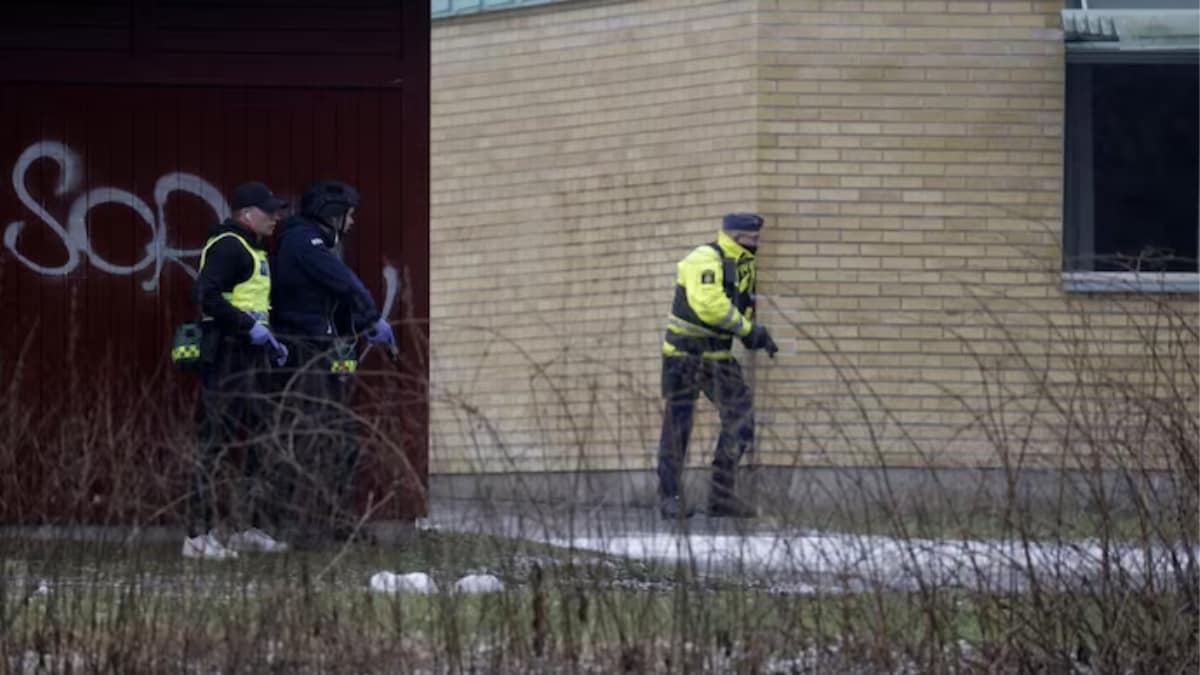
On a quiet Friday afternoon just as the summer break ended, the Brinell School in the central Swedish town of Fagersta transformed into a crime scene. An 18-year-old assailant armed with a sword breached the facility, leaving one person dead and multiple others severely injured before law enforcement shot and detained the suspect. For a nation that long viewed its schools as sanctuaries of safety, this tragedy is not an isolated anomaly. It is part of an alarming escalation of targeted violence forcing the Scandinavian welfare state to reckon with a harsh new reality.
Local police received the emergency call shortly after two in the afternoon, detailing ongoing deadly violence inside the upper secondary institution. First responders swarmed the premises in Fagersta, a municipality of roughly 12,000 residents. Ambulances, patrol cars, and a police helicopter converged on the area while surrounding schools and public buildings were thrust into emergency lockdowns. By the time the operation stabilized, regional health officials confirmed that victims, including teenagers, were rushed to hospitals with critical wounds, and one individual had succumbed to their injuries.
The immediate political fallout was swift. Prime Minister Ulf Kristersson took to social media to express grief and shock, acknowledging the profound vulnerability of educational spaces. Justice Minister Gunnar Strommer assured the public that the government remained in constant communication with law enforcement as forensic teams combed the school for evidence. Yet, expressions of national solidarity and sorrow feel increasingly repetitive in a country where public safety margins are visibly shrinking.
The Shattered Myth of Scandinavian Exceptionalism
For decades, international observers romanticized Sweden as a society insulated from the violent crime waves plaguing other industrialized nations. That idyllic framework has dissolved under the weight of empirical data collected over recent years. The Fagersta attack follows a catastrophic history of institutional violence, most notably the February 2025 massacre at an adult education center in Orebro, where a lone gunman took ten lives in the deadliest mass shooting in modern Swedish history.
Stabbing incidents in Malmo and other urban centers have similarly chipped away at the national psyche. When a school becomes the theater for lethal weapon assaults, the psychological contract between the state, parents, and children breaks down. Communities like Fagersta are built on trust, open access, and social cohesion. Introducing metal detectors, armed guards, or active-threat drills into these environments strips away the foundational openness that defines Nordic civic life.
Anatomy of an Institutional Blind Spot
Security analysts examining the Fagersta incident face a familiar set of frustrating variables. Initial reports indicate the perpetrator was an 18-year-old male, raising urgent questions about radicalization, social alienation, and the early identification of troubled youth. Schools are mandated learning environments, but they are rarely equipped to function as psychiatric triage centers or intelligence outposts.
When institutional systems fail to catch severe behavioral degradation before it manifests as physical violence, society relies entirely on the reactive speed of police intervention. While the quick deployment of Swedish law enforcement in Fagersta undoubtedly prevented a higher death toll, post-incident containment is a poor substitute for structural prevention. The investigation will undoubtedly scrutinize whether warning signs were missed by social services, mental health networks, or the educational facility itself.
The Ripple Effect on National Politics
This tragedy lands at a delicate political juncture. Opposition leaders have voiced grief while national debates intensify over public safety, law enforcement resources, and immigration or integration policies depending on the political spectrum. Crime and public order have steadily climbed to the top of voter priorities ahead of upcoming parliamentary cycles.
Citizens are no longer willing to write off these incidents as statistical aberrations. Every time a high schooler is targeted by a blade or a firearm, the pressure mounts on lawmakers to enact sweeping legislative changes. Proposals often range from harsher mandatory sentencing for weapon possession to increased funding for school psychological support structures. However, bridging the gap between political rhetoric and tangible safety inside a classroom remains an elusive challenge.
Living With the Aftermath
As the investigative dust settles in Västmanland county, the human cost remains staggering. Makeshift memorials will appear outside the Brinell School gates. Municipal crisis centers established in nearby sports halls will counsel grieving students, families, and faculty members.
Sweden is forced to look in the mirror and accept that its vulnerability to targeted mass violence is no longer theoretical. The illusion of absolute domestic safety is gone, replaced by an anxious vigilance that will forever alter how a new generation experiences the simple act of going to class.