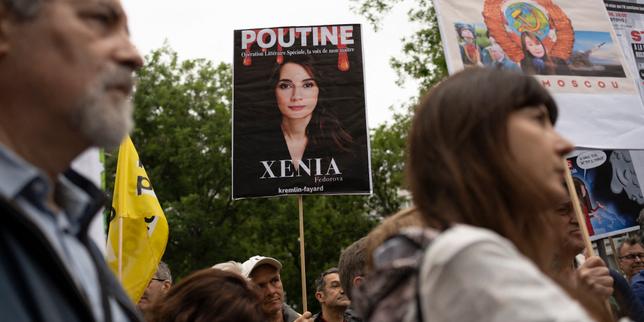
Xenia Fedorova, the former head of RT France, has managed to evade the European Union's individual sanctions list despite leading an empire explicitly designated by Brussels as a weapon of Kremlin disinformation. While the network she built was stripped of its broadcasting license across EU member states following the 2022 invasion of Ukraine, Fedorova herself remains unpunished by personal financial asset freezes or travel bans. This glaring omission exposes a structural flaw in how Western powers target foreign propaganda networks, prioritizing corporate bans while allowing the executives who architected those operations to slip through legal cracks.
The failure to restrict Fedorova is not an oversight. It is a symptom of a bureaucratic apparatus that fundamentally misunderstands the mechanics of modern state-sponsored influence operations. Meanwhile, you can read related developments here: Why Thailand Cannot Hand Over Chinese Journalist Bai Zhaodong.
When the Council of the European Union suspended the distribution of RT—including its French, German, and English entities—the decision was celebrated in Brussels as a decisive strike against Russian soft power. Officials targeted the legal entities, blacklisting broadcast licenses and freezing corporate accounts. RT France was forced into liquidation after its bank accounts were frozen under EU economic measures aimed at its parent organization, Autonomous Non-Profit Organization (TV-Novosti).
Yet, as RT France dissolved, the human capital behind it remained untouched. To understand the full picture, we recommend the recent analysis by The Guardian.
Corporate Entities Die but Operatives Adapt
Sanctioning a network without sanctioning its director creates a hollow victory. Organizations are merely legal shells. The actual capacity to maneuver, build new proxy networks, move capital, and re-establish communications channels rests entirely with individuals.
Fedorova spent years at the helm of RT France, operating out of Boulogne-Billancourt just outside Paris. Under her leadership, the channel aggressively courted alternative political figures, amplified social movements like the Yellow Vests, and systematically challenged the legitimacy of French institutions. She was not a mere administrator following orders from Moscow; she was the strategic mind adapting Kremlin narratives to resonate specifically with French public grievances.
By leaving her off the EU list of sanctioned individuals, European authorities left her free to retain personal assets in Western banks, hold property, and travel freely across jurisdiction boundaries where European warrants do not apply. While prominent editors like Margarita Simonyan faced immediate, sweeping personal sanctions from the EU and its allies, figures operating directly on Western soil were somehow granted an effective immunity pass.
The Bureaucratic Trap of Intent versus Evidence
Why did Brussels freeze RT France while leaving its chief executive unrestricted? The answer lies in the legal threshold required to defend sanction decisions in the General Court of the European Union.
To place an individual on the EU restrictive measures list, diplomats must assemble an airtight evidentiary dossier proving that the person is directly responsible for actions that undermine or threaten the territorial integrity, sovereignty, and independence of Ukraine. Target an individual on shaky legal grounds, and EU courts will annul the decision upon appeal—a humiliation the European External Action Service (EEAS) tries desperately to avoid.
Sanctioning an executive for managing a propaganda outlet presents an unexpected legal challenge. Defense lawyers easily argue that executive roles fall under professional employment rather than political decision-making, or that targeting a media figure breaches international standards regarding freedom of expression.
Diplomats in Brussels faced a choice. They could pursue the rapid, ironclad path of banning corporate entities based on state-ownership records, or they could engage in months of complex legal gathering to prove Fedorova’s direct personal liability. They chose the path of least resistance.
That choice was a strategic error.
The Phantom Infrastructure of Modern Disinformation
Targeting corporations while sparing directors ignores how Russian influence apparatuses actually function today. They do not operate like traditional Western broadcasting companies with rigid, immovable physical infrastructure. They operate like agile, distributed networks.
When RT France collapsed legally, its operational playbook did not vanish. The contacts, the producer networks, the technical workflows, and the strategic knowledge remained intact in the minds of its leadership.
Without personal sanctions, former executives can easily transition into new roles. They set up independent production companies. They launch "alternative" digital platforms registered in neutral jurisdictions like Dubai or Serbia. They hire former staff and continue feeding content into the European digital ecosystem through Telegram channels, mirror websites, and unbranded social media hubs.
The EU shut down the main pipe. They left the plumber with full access to the toolkit.
Consider how content from RT France migrated after the official ban. Within weeks of the broadcasting suspension, snippets of RT-produced videos stripped of logos flooded TikTok, X, and Rumble. The narratives were identical, the editing style remained unchanged, and the target audience was precisely the same. The channel was dead, but the campaign was alive.
The Double Standard in European Enforcement
The failure to restrict Fedorova highlights an unsettling inconsistency in how Western nations apply pressure to state actors.
The United States, through the Department of the Treasury’s Office of Foreign Assets Control (OFAC), has repeatedly shown a willingness to target both the parent entity and the individual officers running media operations linked to foreign intelligence. Washington recognized early on that individuals hold the key relationships required to bypass economic hurdles.
Europe, conversely, remains bogged down by member-state consensus requirements. Adding a single name to the EU sanctions list requires unanimity among all member states. It takes only one hesitant government—worried about legal pushback, diplomatic retaliation, or local political fallout—to quietly stall a nomination.
This internal friction creates blind spots. While politicians stand at podiums in Brussels declaring that Russian propaganda has no place on European soil, executives who led those exact operations move through legal gray zones without fear of asset seizures or travel bans.
What a True Containment Strategy Demands
If Western coalition partners are serious about neutralizing state-directed narrative warfare, the framework for restrictive measures must evolve past outdated 20th-century paradigms.
First, the criteria for individual sanctions must explicitly account for executive leadership in designated state-media entities. Anyone holding a C-suite or editorial director position at a banned state apparatus should automatically trigger an investigation for personal restrictions.
Second, legal teams must stop treating media executives as traditional journalists protected by editorial immunity. When an organization’s primary mandate is state-directed warfare designed to destabilize foreign political systems, its executives are operational actors in a conflict, not reporters covering it.
Third, intelligence sharing between EU member states regarding foreign influence operatives must streamline the creation of sanction dossiers. The current system relies on piecemeal contributions, allowing targets to exploit jurisdictional delays between national capitals.
Xenia Fedorova’s legal immunity is a case study in Western policy fragmentation. Banning a television channel while leaving its chief operative completely unencumbered is not a strategy; it is political theater that mistakes administrative paperwork for real containment.