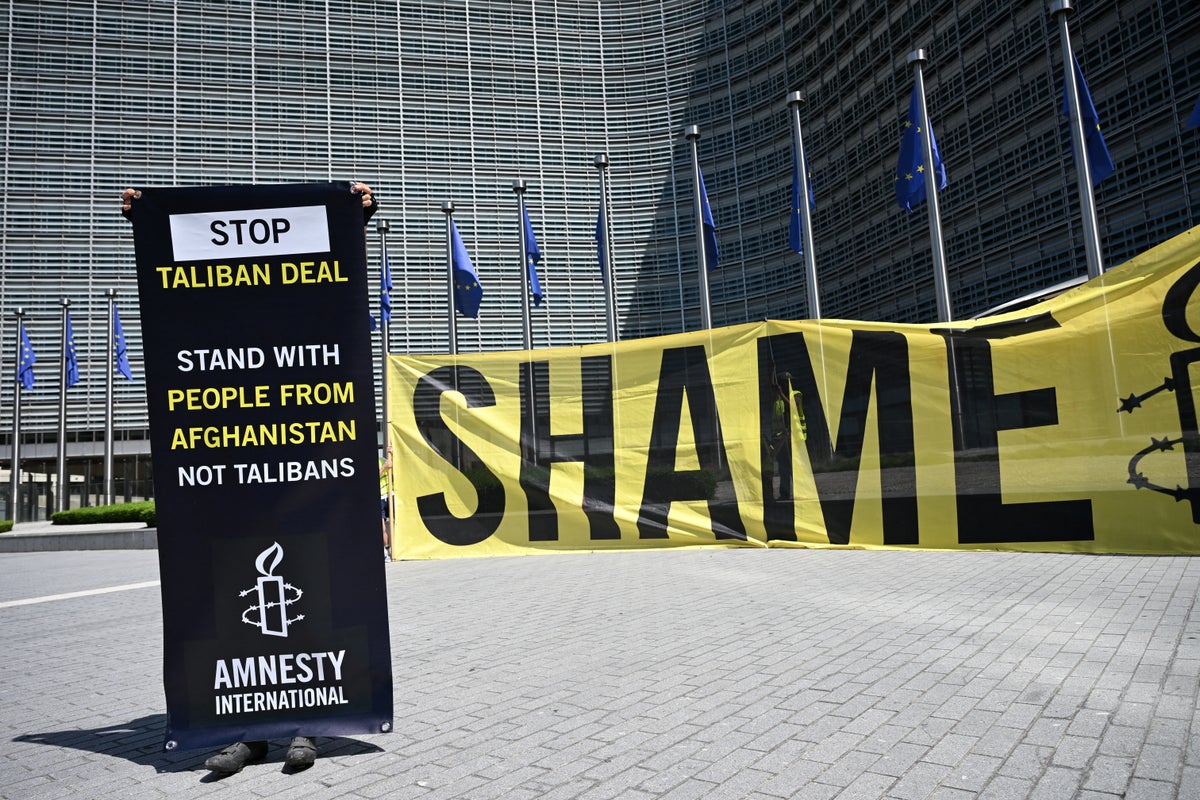
The European Union is reeling from intense political blowback following an unannounced visit by a high-ranking Taliban delegation to Brussels. Officially, the EU maintains a strict policy of non-recognition toward the regime in Kabul. However, behind closed doors, European officials have engaged in direct talks with Taliban representatives, ostensibly to negotiate humanitarian access and discuss regional security. This diplomatic double-standard has ignited a fierce rebellion among member states, human rights organizations, and European Parliament lawmakers who argue that providing a platform to the regime undermines Western moral authority and betrays the millions of Afghan women currently stripped of basic rights.
The backlash was immediate. It was also entirely predictable. By opening the doors of Brussels to a regime that remains heavily sanctioned under international law, European diplomats have crossed a red line that transforms standard geopolitical engagement into a crisis of institutional credibility.
The Backroom Strategy That Backfired
European foreign policy has long operated on a dual track of public condemnation and private pragmatism. In the years following the 2021 withdrawal of Western forces from Afghanistan, the European External Action Service—the EU’s diplomatic corps—has quietly maintained that total isolation of the Taliban would only exacerbate the humanitarian catastrophe inside the country. Diplomats argued that lines of communication had to remain open to facilitate the distribution of aid and to monitor counter-terrorism commitments.
That argument collapsed the moment the Taliban delegation stepped onto European soil.
The strategy failed because it misjudged how the Taliban would utilize the visit. For Kabul, the Brussels meetings were never about rewriting human rights policies or compromising on regional security. They were an exercise in optics. The regime immediately broadcasted images of its officials inside European administrative buildings, framing the visit to internal and regional audiences as a massive stride toward international legitimacy.
By allowing these meetings to take place in the heart of the European capital, Brussels handed the Taliban a significant propaganda victory. European negotiators believed they could micro-manage the narrative by keeping the press away and labeling the talks as "technical discussions." Instead, they discovered that in modern geopolitics, the mere fact of an invitation is a concession in itself.
A Fractured European Front
The fallout from the visit has exposed deep divisions within the European Union, breaking along lines of geographical security and political ideology. Several member states, particularly those with hawkish foreign policy stances, have openly revolted against the central diplomatic apparatus in Brussels. Foreign ministries in capitals like Paris and Stockholm quickly distanced themselves from the meetings, demanding a full accounting of who authorized the visas and what specific promises were made during the sessions.
This internal rebellion highlights a structural flaw in how the EU handles high-stakes foreign policy. While individual member states retain ultimate sovereignty over their foreign relations, the central bureaucracy in Brussels frequently pushes the boundaries of its mandate under the guise of humanitarian necessity.
The Security Versus Principles Dilemma
The official justification presented by defenders of the meetings centers on two main pillars.
- Migration Control: European officials are deeply terrified of a massive, unchecked wave of migration from Central Asia. They believe that maintaining a working relationship with the de facto authorities in Kabul is essential to preventing total economic collapse in Afghanistan, which would inevitably trigger a massive refugee crisis on Europe's borders.
- Counter-Terrorism Tracking: With groups like ISIS-K operating in the region, Western intelligence agencies require ground-level data. Diplomats argue that cutting off the Taliban completely blinds European security services to emerging threats that could target European cities.
Critics argue this logic is fundamentally flawed. History demonstrates that offering diplomatic concessions to authoritarian regimes in exchange for security guarantees rarely produces the desired results. Instead, it signals weakness, showing that European principles are flexible when subjected to geopolitical pressure.
The Human Rights Betrayal
For human rights advocates and Afghan activists living in exile across Europe, the Brussels meetings represent a profound betrayal. Since regaining power, the Taliban has systematically dismantled the legal and social status of women, banning them from secondary education, restricting their employment, and enforcing severe limitations on their freedom of movement.
European institutions frequently lecture the rest of the world on the importance of human rights and gender equality. Yet, by hosting the architects of this gender apartheid, Brussels has signaled that these values are negotiable.
EU Funding to Afghanistan (2021-2026)
======================================
Humanitarian Aid:    €1.2 Billion
Development Aid:     Suspended
Direct Regime Support: Zero (Official Policy)
The data reveals a stark reality. The European Union remains one of the largest financial donors to Afghanistan, funneling over one billion euros in humanitarian assistance through independent non-governmental organizations since 2021. This financial leverage should, in theory, give Brussels immense bargaining power. By failing to condition diplomatic access on concrete improvements in human rights, European negotiators have squandered their strongest asset.
The Legitimization Loop
The mechanism of international recognition is subtle. It does not happen overnight with a single treaty or a formal declaration. It occurs through a slow accretion of small, seemingly insignificant interactions. A technical meeting here, an aid coordination summit there, a low-level visa approval for a bureaucratic delegation.
Each of these steps acts as a brick in a wall of normalization. The Taliban understands this process perfectly. They do not need a formal embassy in Brussels today; they simply need to establish a pattern of regular contact that erodes the international consensus against their regime.
Shifting Geopolitical Alliances
The European Union's misstep in Brussels does not occur in a vacuum. It takes place against a backdrop of shifting alliances across Eurasia. While Western nations vacillate between isolation and backchannel engagement, regional powers have already made their moves.
Regional Diplomatic Footprint in Kabul
--------------------------------------------------
China:       Full Ambassador Accepted (2023)
Russia:      Active Embassy, Business Delegations
Iran:        Cross-Border Security Agreements
EU:          Minimal Technical Presence
This polarization leaves Europe in a difficult position. If it pulls back entirely, it leaves the field completely open to Beijing and Moscow, both of which are eager to exploit Afghanistan’s vast untapped mineral resources and strategic location. If it engages without preconditions, it destroys its own ethical framework.
The current crisis demonstrates that the middle ground chosen by Brussels—secretive, high-level engagement paired with public disavowals—is the worst possible option. It fails to secure real concessions from the Taliban while simultaneously alienating Europe's own citizens and allies.
The Cost of Diplomatic Amateurs
The handling of the Taliban visit points to a larger, systemic issue within the Brussels diplomatic bubble. Bureaucrats operating within the European External Action Service are insulated from electoral accountability. This insulation allows them to pursue theoretical strategies that ignore political realities on the ground.
A seasoned diplomat understands that you never give away an audience for free. In the high-stakes theater of international relations, an invitation to a Western capital is a premium currency. It is a reward for behavioral modification, not a tool for basic communication.
By treating the visit as a routine administrative meeting, the organizers showed a stunning lack of strategic foresight. They allowed themselves to be played by a regime that, despite its lack of formal education in Western diplomatic academies, possesses a sharp, ruthless understanding of political leverage and media manipulation.
The European Parliament is now moving to introduce strict oversight mechanisms that would require the diplomatic corps to notify lawmakers before any future contact with sanctioned regimes. Whether these measures will hold remains to be seen. The damage to Europe’s reputation as a principled global actor has already been done, and the images of Taliban officials walking the corridors of power in Brussels cannot be unmade. The regime in Kabul knows exactly how to exploit Western vulnerability, and they have just been handed a masterclass in European inconsistency.