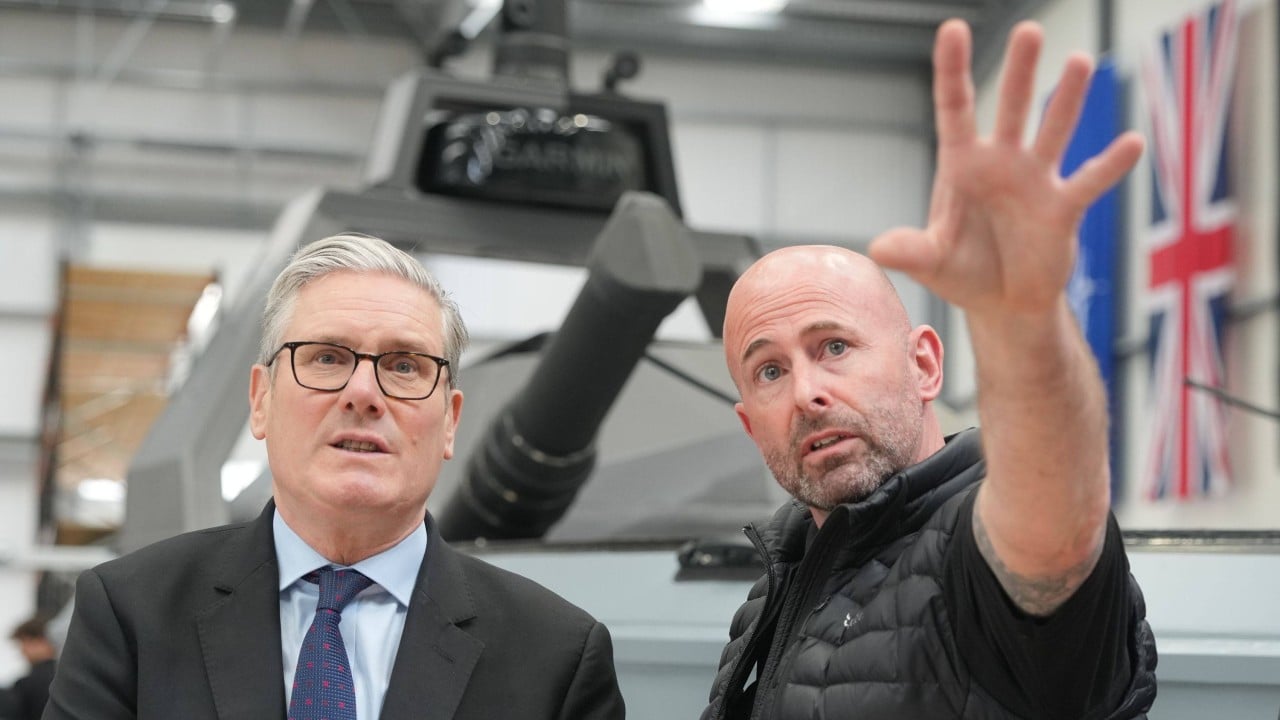
British Prime Minister Keir Starmer spent Friday morning at a drone manufacturing facility in southwest England, surrounded by the lightweight carbon-fiber frames of autonomous aircraft that have come to define modern warfare. The backdrop was deliberate. Standing alongside Air Chief Marshal Richard Knighton, Starmer issued an unsettling warning that western intelligence now points to a realistic prospect of a Russian military assault on NATO territory by 2030. The timeline has condensed dramatically. What was once discussed in the comfortable abstract of the mid-2030s is now framed as a concrete four-year countdown, forcing an uncomfortable assessment of Europe’s actual readiness for a high-intensity, industrial-scale war.
The immediate domestic objective of Starmer’s rhetoric is clear. He needs to justify a highly contentious, long-delayed defense investment plan that has been trapped in a bureaucratic tug-of-war between the Ministry of Defence and the Treasury over a reported £28 billion funding gap. By tying the publication of this plan directly to the upcoming NATO summit in Turkey, Starmer is attempting to use geopolitical anxiety to break a domestic financial deadlock.
Yet, looking past the immediate Westminster political maneuvering reveals a much deeper, more systemic crisis. The uncomfortable reality is that while political leaders across London, Warsaw, and Helsinki are rapidly escalating their rhetorical warnings, the continent’s underlying industrial base and strategic assumptions remain dangerously mismatched against the threat they claim to face. The problem is not merely a lack of money. It is a fundamental failure of imagination regarding what a modern war requires.
The Myth of the Four Year Window
The timeline of 2030 is misleading because it implies Europe has four years to prepare. It does not. In the realm of industrial defense procurement, four years is a single billing cycle. It takes longer to design, contract, and manufacture a modern air defense battery than the entire window Starmer has outlined.
The assumption that Russia will need until the end of the decade to rebuild its forces overlooks the speed with which Moscow has converted its economy to a total war footing. Russian factories are currently producing artillery shells, basic armor, and loitering munitions at a rate that outpaces the combined output of the entire western alliance. They are not waiting for a formal conclusion to the conflict in Ukraine to reconstitute their forces. They are adapting their doctrine in real-time based on blood-bought lessons from the battlefield.
Western defense planning, by contrast, remains tethered to peacetime procurement cycles. It is a system designed to build incredibly sophisticated, wildly expensive platforms over decades, rather than mass-producing affordable, attrition-ready hardware. If an adversary decides to test the collective defense guarantees of NATO, they will do so at a time of their choosing, utilizing the asymmetric industrial advantages they are building right now.
The Rearmament Friction
Nowhere is the disconnect between political ambition and industrial reality more glaring than in Germany. Following the strategic shock of 2022, Berlin announced a historic turning point in defense spending, backed by a massive special fund. Four years later, that initiative is bogged down in the exact structural inefficiencies it was meant to bypass.
Germany's defense strategy outlines an ambition to build the strongest conventional army in Europe by 2030. The math simply does not support this timeline. Consider the structural disparity:
| Nation | Combat-Ready Hardened Brigades |
|---|---|
| Ukraine | ~130 |
| Russia | ~130 |
| Germany | Fewer than 10 |
To bridge this chasm requires an aggressive embrace of unproven technologies, autonomous systems, and distributed manufacturing. Instead, the continental procurement apparatus continues to buy what it knows rather than what the modern battlefield demands. Procurement remains intensely protectionist. Germany directs a massive portion of its defense orders to domestic firms, largely bypassing collaborative European initiatives or rapid-production alternatives from alliance partners.
The resulting friction means that while billions are committed on paper, the physical delivery of capability is stalled. Air defense systems, heavy armor, and digital communication networks are trickling out of factories while the strategic clock ticks down.
The Shadow War is Already Occurring
While the public debates the likelihood of conventional tanks rolling across borders, a different kind of conflict is already underway. Air Chief Marshal Knighton noted that the current period is the most dangerous he has witnessed in a 35-year military career, specifically pointing to a campaign of gray-zone aggression that avoids triggering NATO’s Article 5 collective defense clause.
This is not a hypothetical future threat. It is an active operational reality. Western intelligence has tracked a sharp increase in reckless sabotage attempts, deniable cyberattacks on critical infrastructure, GPS jamming affecting commercial aviation across the Baltic region, and targeted assassination plots.
The Maritime Chokepoint
A prime example of this unconventional friction is the Russian shadow fleet. Over a thousand aging, under-insured tankers are currently operating globally, flying flags of convenience to bypass western oil sanctions and fund Moscow's war effort. These vessels are not just economic lifelines; they are deliberate environmental and logistical hazards tracking through tight European waterways.
[Baltic / North Sea Chokepoints]
       │
       ├─► Russian Shadow Fleet (1,000+ Sanction-Busting Tankers)
       │       │
       │       └─► Interception Risk / Environmental Hazard
       │
       ▼
[Joint Expeditionary Force (JEF) Response]
       │
       └─► Active boarding operations and asset seizures (UK/Finland/Sweden)
In response, Britain has altered its operational posture. During a recent Joint Expeditionary Force summit in Helsinki, Starmer authorized British forces to assist northern European allies in actively intercepting and seizing these shadow tankers. This marks a significant escalation. Sending military personnel to board commercial vessels in international or contested waters carries an inherent risk of miscalculation. One mistake, one panicked reaction from a crew, and a gray-zone enforcement action can instantly mutate into an overt international crisis.
The Tech Gap on the Front Line
The conflict in Ukraine has fundamentally altered the technological hierarchy of the battlefield. The era of relying solely on exquisite, multi-million-dollar legacy systems to guarantee security is over. Cheap, commercial off-the-shelf drones modified for military use have democratized precision strike capabilities.
During his factory visit, Starmer paid lip service to this shift, but the broader western military establishment has been slow to internalize the lessons. Western forces still place immense emphasis on heavy, centralized platforms that are highly vulnerable to cheap, distributed loitering munitions. The alliance is trying to fight an algorithmic, mass-driven drone war with an institutional mindset forged in the Cold War.
True readiness requires a massive shift toward software-defined warfare. This means integrating artificial-intelligence-supported reconnaissance, automated fire control, and resilient electronic warfare capabilities into every echelon of the military. It requires treating software updates with the same urgency as ammunition resupply. Until the procurement system allows a tech startup to secure a major defense contract with the same ease as a legacy aerospace giant, Europe will remain structurally unready for the speed of modern combat.
The Transatlantic Realignment
Hovering over this entire debate is the shifting political reality in Washington. The era of unquestioned American underwriting of European security is drawing to a close, regardless of who occupies the White House. The political pressure from the United States for Europe to shoulder its own defense burden is no longer a fringe opinion; it is a bipartisan consensus.
Starmer’s insistence that the UK’s new defense investment plan will be fully funded is a direct nod to this reality. The UK has committed to hitting 2.5 percent of GDP next year, with an ultimate target of three percent. But numbers on a ledger do not deter adversaries. Only combat-ready brigades, stockpiled munitions, and functional logistics chains do.
Europe cannot compensate for decades of defense underinvestment in forty-eight months. If the alliance genuinely believes an attack could manifest by the end of the decade, the current incremental approach is a form of collective negligence. Hard security cannot be outsourced, and it cannot be built on a standard peacetime schedule. The continent is rapidly running out of time to decide whether it wants to be a serious military power or an attractive target. The answer will be determined by what rolls off the production lines over the next twenty-four months, not by the speeches delivered at the next summit.