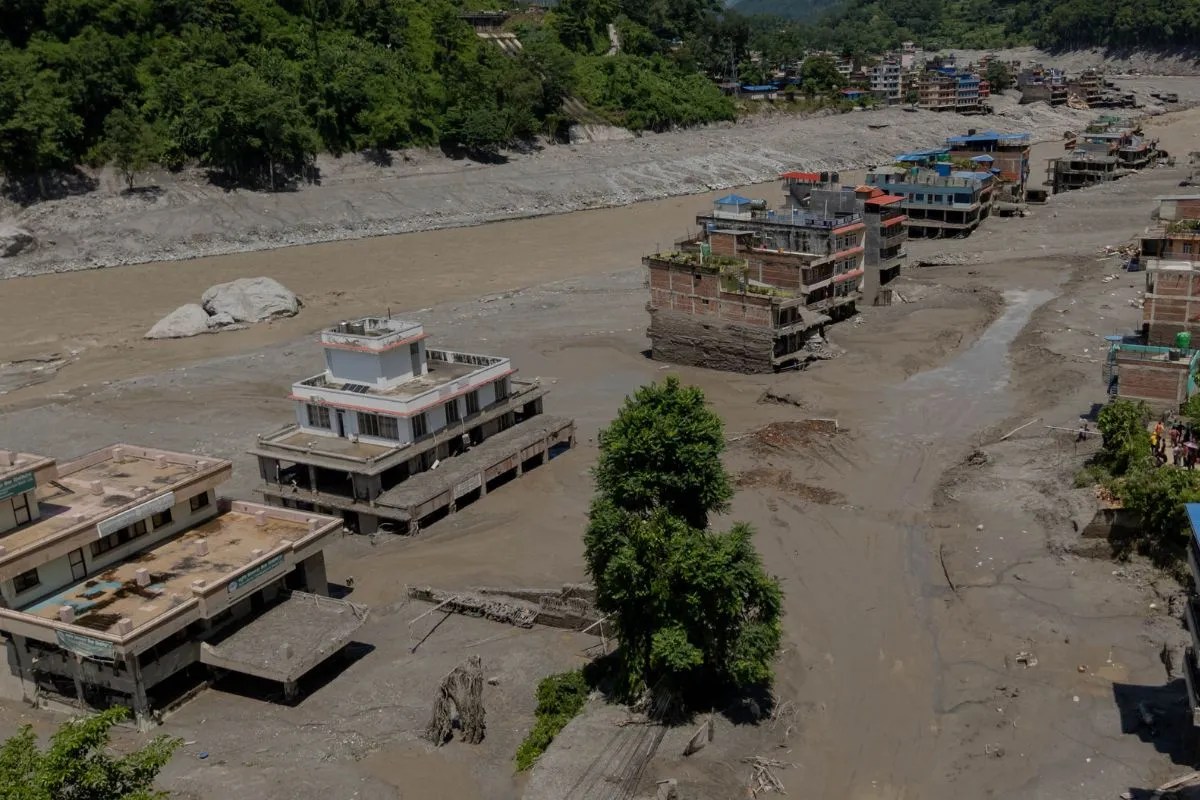
The phrase echoes across the valleys every monsoon season with grim predictability. Everything washed away in one stroke. Currently, 469 people are dead and over 900 are missing in the aftermath of Nepal's latest flash flood catastrophe. We treat these staggering numbers as sudden, unavoidable tragedies. They are not. These floods are the mathematical result of fragile Himalayan geology colliding head-on with unregulated construction, political apathy, and a rapidly warming climate.
The sheer scale of the devastation leaves entire communities wiped off the map in minutes. A wall of black mud, boulders, and uprooted trees obliterates bridges, schools, and homes. To understand why the death toll climbs so mercilessly every single year, you have to stop looking at the heavy rain and start looking at the ground.
The Anatomy of a Mountain Washout
Nepal is essentially a massive, fragmented staircase leading from the flat plains of the Terai to the highest peaks on Earth. This extreme topography creates steep, narrow river valleys. When monsoon rains hit, the water has nowhere to go but down, and it does so with terrifying velocity.
But water alone does not destroy a reinforced concrete bridge. Debris does.
The soil in the young fold mountains of the Himalayas is inherently unstable. It is loose, highly fractured, and prone to slipping. When a torrential downpour saturates this loose soil, the hillside loses its friction. Millions of tons of earth slide into the swollen rivers. The water then thickens into a dense, fast-moving slurry. This mixture of water, earth, and rock acts like liquid sandpaper. It grinds away riverbanks, undercuts highway foundations, and demolishes hydroelectric dams with horrifying efficiency.
We have known about this geological reality for centuries. Yet the damage is compounding at an unprecedented rate. The reason is openly visible to anyone driving through the Nepali countryside.
The Epidemic of Unregulated Excavators
Local political economy plays a massive role in the rising body count. Across rural Nepal, there is a pervasive and deadly phenomenon locally referred to as dozer terror.
Following political decentralization, local governments received substantial budgets for infrastructure development. The immediate priority for almost every municipality was road connectivity. Building roads in the Himalayas requires meticulous geological surveying, controlled blasting, extensive retaining walls, and proper drainage. That is the expensive way.
The cheap way involves a local contractor renting a heavy excavator, pointing it at a hillside, and carving out a dirt track. No engineers. No retaining walls. No drainage systems.
The conflict of interest is staggering. Frequently, the politicians approving the budgets are directly tied to the contractors renting out the heavy machinery. They gouge unengineered dirt roads across fragile slopes, essentially acting as deep cuts in the flesh of the mountain.
When the monsoon arrives, water pools in these haphazard tracks. They turn into unnatural streams that undercut the slopes above. A hillside that might have withstood heavy rain for another century suddenly collapses, sending a lethal landslide directly into a swollen river below. This creates a temporary dam. When that dam inevitably bursts a few hours later, the resulting flash flood destroys everything downstream.
You cannot continuously dynamite and gouge the base of a crumbling mountain range without paying a heavy price in human lives.
The Invisible Threat of Melting Ice
Further up the mountains, an entirely different kind of time bomb is ticking. Climate change is rewriting the map of the high Himalayas, shifting the threat from predictable monsoon rains to catastrophic glacial failure.
As global temperatures rise, glaciers retreat at an alarming pace. When a glacier melts, the runoff often forms a massive lake at the snout of the retreating ice. These high-altitude lakes are held back by natural dams made of moraine, which is just the loose rock, dirt, and debris left behind by the glacier.
These moraine dams are incredibly fragile. A large chunk of ice calving off the glacier, a sudden localized avalanche, or an unusually intense rainstorm can cause the lake to overtop or physically breach the moraine wall. When this happens, a Glacial Lake Outburst Flood tears down the valley.
A Glacial Lake Outburst Flood is arguably the most destructive force in the Himalayas. It carries massive boulders and glacial sediment, moving at highway speeds. Take a hypothetical village located fifty kilometers downstream. The residents might experience a sunny, clear day right up until the exact moment a twenty-foot wall of black sludge annihilates their homes.
According to recent satellite surveys, there are thousands of these glacial lakes forming across the region. Several dozen are classified as critically dangerous. The water volume in these lakes is increasing exponentially, while the structural integrity of the moraine dams weakens by the day. This is a terrifying equation.
Early Warning Systems That Ring Hollow
The immediate defense against flash floods is a functioning early warning system. On paper, these systems exist. International organizations and government agencies have spent millions installing river level sensors and establishing emergency protocols.
The reality on the ground is drastically different.
Data collection is highly centralized. A remote sensor detects a sudden drop in water level, a classic sign that a landslide has dammed the river upstream and a catastrophic flood is imminent. This data goes to a server in Kathmandu. Analysts review it, verify the threat, and issue an alert to local authorities in the district.
By the time the district police officer receives the message and attempts to contact the vulnerable village, the flood has already hit.
Furthermore, communication infrastructure is always the first casualty of severe weather. Cellular towers lose power or are physically destroyed by localized landslides. You cannot send an SMS evacuation warning to a valley that has lost all network coverage.
If a warning system requires human intermediaries and unbroken cellular networks during a massive storm, it is not a warning system. It is an autopsy report.
Real survival requires localized, autonomous technology. A simple wire strung across a river attached to a mechanical siren in the village square is vastly superior to a multi-million-dollar satellite system that routes data through a capital city hundreds of miles away.
The Hydroelectric Gamble
Nepal relies heavily on run-of-the-river hydroelectric projects for its power generation and economic growth. These power plants are built directly in the path of potential flash floods.
Investors pour billions into these projects, often relying on historical flood data to calculate risk and structural engineering requirements. But historical data is completely useless when climate change and unchecked upstream road construction are fundamentally altering the river dynamics every single year. We are building massive concrete structures based on the river behavior of 1990, not 2026.
When a major flood hits, these dams act as choke points. They trap massive trees and boulders until the pressure becomes unbearable. When the dam fails or the floodgates are overwhelmed, the sudden release of trapped water and debris exacerbates the flood wave.
If multiple dams are built on the same river system, a cascading failure occurs. Dam A fails, sending its water and debris into Dam B, which then fails and sends an unimaginable volume of destruction into Dam C. This multiplies the devastation for the communities downstream. The economic losses for the investors are staggering, but the human cost paid by the locals is unforgivable.
The Regional Ripple Effect
The devastation does not stop at the Nepali border. The major river systems of the Himalayas flow directly southward into the densely populated plains of India, specifically states like Bihar and Uttar Pradesh.
When a flash flood originates in the Nepali mountains, it transforms into a slow-moving, massive inundation by the time it reaches the Indian plains. Millions of hectares of agricultural land are submerged. The bilateral treaties governing water sharing and flood control between Kathmandu and New Delhi are antiquated and mired in political friction.
Instead of treating the river basin as a single, connected ecosystem requiring joint management, both nations engage in an annual blame game. India blames Nepal for failing to control the upland runoff and deforestation. Nepal blames India for building massive border embankments that prevent natural water drainage, causing rivers to back up and flood Nepali border towns. While the politicians argue over sovereignty and engineering designs, the villagers on both sides of the border drown.
Rebuilding in the Path of Destruction
Following every disaster, there is a predictable cycle of grief, international aid, and political promises. Helicopters eventually reach the stranded. Relief funds are distributed, and temporary shelters are erected over the mud.
Then, the most maddening part of the cycle occurs. People rebuild their homes on the exact same floodplains that were just decimated.
This is not born of ignorance. It is born of absolute economic desperation. The flat land near the river is fertile, accessible, and often the only piece of property these families legally own. Generational wealth for a rural Nepali family is tied entirely to their physical land and livestock. When a flood wipes that out, they have nothing left but the muddy plot itself.
Government relocation programs exist in theory, but they are notoriously slow and mired in bureaucratic red tape. When relocation is offered, the alternative land is often on steep, barren hillsides far from markets, schools, or arable soil. Forced to choose between slowly starving on a safe hilltop or risking the river for a viable livelihood, families invariably choose the river.
Strict zoning laws exist but are rarely enforced. Local officials turn a blind eye to illegal sand mining operations that drastically degrade the riverbanks and weaken natural defenses. Without strict enforcement of red zones where human habitation is legally prohibited, the body count will simply reset and climb again next monsoon.
The solution to the Himalayan flood crisis does not require unproven technology or endless international committees. It requires raw political will.
Stop funding unengineered rural roads that destabilize the mountains. Decentralize early warning systems so automated sirens trigger locally the exact second a sensor detects a surge, bypassing Kathmandu entirely. Provide immediate, economically viable land swaps for families living in high-risk zones before the water rises, not after they are homeless.
We have the satellite data. We know exactly which slopes will fail, which glacial lakes are expanding, and which rivers will surge. The continuing loss of life in Nepal is a deliberate choice made by a system that values cheap concrete and political expediency over human survival. Stop acting surprised when the mountain falls.