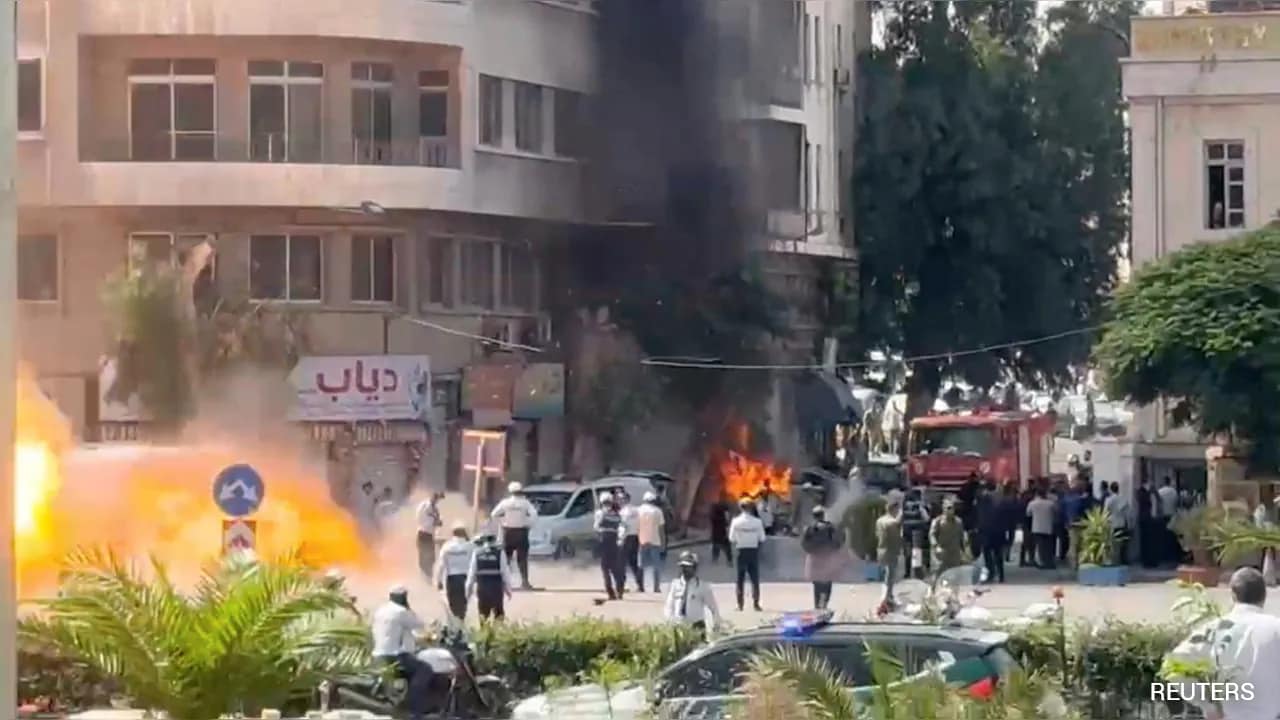
Two explosive devices detonated outside the Four Seasons Hotel in Damascus on Tuesday morning, wounding 18 people just minutes after French President Emmanuel Macron’s motorcade departed the premises. The blasts, which targeted a heavily fortified diplomatic hub in the heart of the Syrian capital, directly challenge the narrative of stabilization put forward by Syria’s new government under President Ahmed al-Sharaa. While the Élysée Palace confirmed that Macron was unharmed and proceeding with his itinerary, the security failure highlights the deep-seated volatility of a nation attempting a rapid geopolitical pivot while its domestic intelligence architecture remains fractured.
The incident occurred in a high-traffic zone between the Syrian Ministry of Tourism and the National Museum, an area heavily monitored by the state’s internal security forces. According to regional security sources, the first device was concealed within a trash receptacle, while the second was rigged to a vehicle parked nearby. The secondary blast detonated moments after emergency personnel and onlookers rushed to the scene, exploding near a deployed ambulance in a pattern consistent with asymmetric "double-tap" tactics designed to maximize casualties among first responders.
The Illusion of Stabilization
For months, the Sharaa administration has aggressively marketed a narrative of regional normalization. Having assumed power following the collapse of the Bashar al-Assad regime in late 2024, Sharaa—a former militant commander turned Western-aligned statesman—has sought to rebuild a shattered economy by attracting foreign capital and diplomatic recognition. Macron’s landmark visit, the first by a European Union head of state since the transition, was engineered to be the crowning achievement of this campaign.
Instead, the blasts expose a stark reality: the capital remains highly vulnerable to insurgent penetration.
The timing of the attack indicates sophisticated reconnaissance. The perpetrators managed to bypass multiple outer security cordons in a district ostensibly locked down for a foreign presidential delegation. This implies either a catastrophic failure of tactical screening or, more troubling, complicity within the local security apparatus. The newly integrated internal security forces, composed of former rebel factions, state holdovers, and regional militias, lack the institutional cohesion necessary to secure a high-profile diplomatic corridor.
Corporate Ambitions Versus Asymmetric Realities
Macron’s delegation arrived in Damascus with significant corporate backing. Executives from French industrial giants, including energy conglomerate TotalEnergies and shipping behemoth CMA CGM, accompanied the presidential party. The strategic objective was clear: secure early-stage concessions in Syria’s multi-billion-dollar reconstruction market, particularly in logistics, maritime infrastructure, and energy grid rehabilitation.
For international corporations, however, the primary metric for market entry is not diplomatic goodwill, but risk mitigation.
The Tuesday bombings, coupled with a cafe explosion last week near the Justice Palace that killed ten people, demonstrate that Damascus cannot yet guarantee basic operational security. Western corporations operating under strict compliance and duty-of-care protocols cannot easily deploy personnel or capital into an environment where diplomatic hotels are targeted with improvised explosive devices (IEDs).
The financial calculus for rebuilding Syria relies on stable transit corridors and secure urban centers. When those centers are compromised, insurance premiums skyrocket, supply chains freeze, and the cost of private security details eclipses local operating margins. This dynamic creates a paradox for the Sharaa government: it desperately needs foreign investment to fund the security apparatus required to stop these very attacks.
The Fragmented Insurgent Underbelly
No group immediately claimed responsibility for Tuesday's twin detonations, a silence that points toward two distinct operational possibilities.
The first is the Islamic State (IS), which announced a renewed operational phase against the Sharaa government earlier this year. The group has consistently utilized low-cost, high-impact IED tactics in urban settings to undermine the state's claims of legitimacy. By targeting a venue hosting a Western leader, the group signals to its global network that the new administration in Damascus is incapable of maintaining basic law and order.
The second possibility involves disgruntled internal factions. Sharaa’s transition from an insurgent commander to a Western-courted diplomat required significant political compromises, including promises to protect religious and ethnic minorities who were historically targeted by hardline rebel groups. This shift has alienated radical elements within the former insurgent coalition who view the administration's engagement with Western powers as a betrayal.
The Geopolitical Tightrope
The diplomatic fallout of the attack will test the resilience of the new Franco-Syrian bilateral framework. Macron’s decision to continue his meetings at the presidential palace suggests a refusal to let asymmetric actors dictate French foreign policy in the Levant. In a public statement issued via social media shortly after the blasts, Macron remarked that nothing could stifle the aspirations of the Syrian people to live in a secure, sovereign, and pluralistic state.
Behind the rhetoric lies a complicated security negotiation. France has reportedly issued firm warnings to Damascus regarding regional spillover, particularly demanding that Syria remain neutral relative to the ongoing instability in neighboring Lebanon. In return, Syria expects intelligence sharing and counterterrorism assistance to suppress urban insurgencies.
The failure to prevent detonations within shouting distance of a presidential motorcade, however, weakens Sharaa's leverage. It reveals that the state's intelligence collection is reactive rather than preventative.
Tactical Deficiencies in Urban Counterterrorism
The execution of the double-tap attack exposes specific deficiencies in the municipal security plan implemented for the visit:
- Failure of Electronic Countermeasures (ECM): Diplomatic convoys typically utilize signal-jamming technology to neutralize radio-controlled IEDs. The fact that the devices detonated immediately after the motorcade's departure indicates they were either precisely timed, manually detonated via hardwire, or that local security forces failed to establish an adequate ECM perimeter around the hotel itself.
- Inadequate Sanitization of the Route: Standard protective protocols for a visiting head of state require the physical sanitization and continuous monitoring of all public waste receptacles, parked vehicles, and blind spots along the transit corridor 24 to 48 hours prior to arrival.
- Crowd and First Responder Vulnerability: The secondary detonation targeted the immediate aftermath of the first incident, capitalizing on the predictable convergence of police, medical workers, and journalists. This reveals a lack of training among local first responders, who failed to establish an immediate secondary perimeter to screen for follow-on devices before rendering aid.
The transition from a wartime rebel command structure to a functioning bureaucratic state requires years of institutional professionalization. Sharaa has attempted to bypass this timeline by rebranding his administration through high-level diplomacy.
The smoke rising over the Damascus skyline on Tuesday offers a grim reminder that public relations cannot replace a functional domestic security architecture. Until the state can secure its own capital city, the international corporate investments and diplomatic partnerships championed by the government will remain hostage to the realities of a volatile, incomplete transition.