The fossil record rarely speaks in clear sentences. More often, it offers whispered fragments, crushed bones, and ambiguous impressions embedded in stone that require decades of debate to decode. But every so often, a specimen emerges that forces paleontologists to tear up their notes and rethink the mechanics of ancient ecosystems.
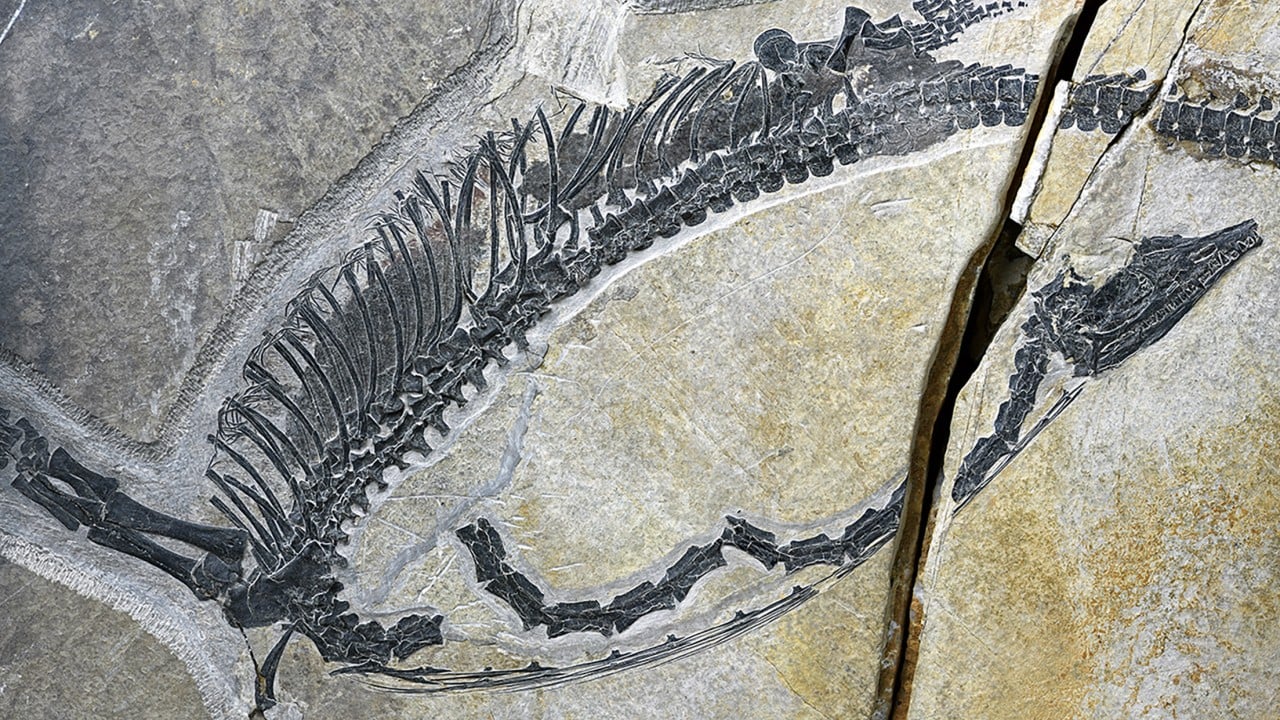
That rare threshold was crossed recently when researchers announced the discovery of a remarkably preserved Triassic reptile specimen from southwestern China. Packed inside its abdominal cavity lay an intact, articulated fish, providing an exceptionally rare snapshot of an ancient meal frozen in time. The reptile, identified as an archosauromorph named Trachelosaurus fischeri or a closely related marine predator, preserves soft-tissue and dietary evidence that shifts our understanding of how early predatory reptiles operated in Mesozoic aquatic environments.
For decades, reconstruction of ancient food webs relied heavily on indirect evidence. Teeth shapes suggest tearing or crushing functions. Coprolites offer messy, degraded hints of digested meals. Isotopic analysis tracks broad trophic levels. Finding actual stomach contents is the paleontology equivalent of striking gold. It bypasses interpretation and hands researchers the literal menu of a predator that hunted millions of years before the first dinosaur walked the Earth.
The Anatomy of a Primordial Ambush
To understand the weight of this discovery, you have to look past the initial headlines and examine the physical context of the fossil. The specimen originates from the Guanling Formation in Guizhou Province, a geological treasure trove renowned for its exceptional marine reptile preservation. The limestone layers here formed in a restricted basin or lagoon environment, where low oxygen levels and rapid sedimentation conspired to halt the usual decay cycle. Scavengers stayed away. Bacteria starved. Soft tissues mineralized before they could rot.
The predator itself possessed a distinct body plan characterized by an elongated neck and a compact, streamlined torso. For years, scientists debated the exact ecological niche of these early archosauromorphs. Were they active pursuers of fast-swimming prey, or did they cruise the shallows, waiting for clumsy organisms to drift within striking distance?
The stomach contents settle that debate with brutal clarity.
Tucked neatly inside the ribcage is a fossilized fish belonging to the genus Saurichthys or a similar slender-bodied ray-finned fish. Crucially, the prey item is positioned head-first, indicating that the reptile swallowed the animal whole. This detail matters immensely. Predators that tear apart their catch leave scattered debris and fragmented bones. Swallowing a fish whole requires specific biomechanical adaptations, including flexible jaw structures, powerful throat musculature, and a digestive tract capable of processing an intact, scaled vertebrate without rotting from the inside out.
The prey item was also remarkably large relative to the predator's body size. This is not the snack of a casual scavenger picking at leftover scraps. It represents a high-risk, high-reward predation event. The reptile targeted a creature that could actively fight back or escape, consumed it in a single fluid motion, and then met its end shortly afterward, sealing its final meal into the geological record for over 240 million years.
Reconstructing the Triassic Marine Collapse and Recovery
The timing of this fossil offers a wider lens on Earth history. We are looking at the aftermath of the Permo-Triassic extinction event, the most devastating ecological catastrophe in our planet's history. Up to ninety percent of marine species vanished in a geological blink. Marine ecosystems were shattered, leaving vacant niches and chaotic, simplified food webs.
During the early and middle Triassic, life was desperately trying to rebuild itself. New apex predators were experimenting with body plans. Marine reptiles, which had previously retreated to land or kept to shallow coastlines, began invading the open ocean in earnest.
This Chinese fossil acts as a diagnostic tool for that recovery phase. It demonstrates that complex predator-prey dynamics re-evolved with astonishing speed. Within millions of years of the greatest extinction the world had ever seen, vertebrate predators had already mastered the art of marine ambush hunting, targeting streamlined fish with pinpoint accuracy. The ecosystem was not just surviving; it was aggressively complexifying.
Traditional views of early Triassic life often paint a picture of sluggish, opportunistic creatures struggling in barren seas. Discoveries like this dismantle that narrative. The presence of a specialized piscivore with sophisticated swallowing mechanics proves that selective pressures were intense. Animals that failed to adapt their hunting strategies simply starved.
The Taphonomic Miracle
Finding a skeleton is hard. Finding a skeleton with soft tissue is exceptional. Finding a skeleton with an intact, digestible meal inside its stomach borders on statistical impossibility.
Taphonomy, the study of how organisms decay and become fossilized, usually works against this kind of discovery. Digestive acids destroy soft parts rapidly after death. Even if an animal dies immediately after eating, bloating gases and bacterial action inside the gut typically rupture the abdominal cavity before fossilization can begin.
How did this specimen escape the standard rules of decay?
The answer lies in the specific micro-environment of the Guanling depositional basin. The animal likely sank into anoxic, or oxygen-depleted, bottom waters shortly after its final meal. Without oxygen, aerobic bacteria could not multiply and break down the internal organs. Furthermore, rapid burial by fine-grained lime mud created an airtight seal, locking the stomach contents in place before digestive processes or scavengers could obliterate them.
This level of preservation allows modern researchers to apply non-destructive imaging techniques, such as high-resolution computed tomography scanning, to peer inside the fossil without damaging the stone. By mapping the density differentials between the host rock, the reptile bones, and the embedded fish skeleton, scientists can generate three-dimensional models of the digestive tract. These scans reveal spatial relationships that two-dimensional flat X-rays miss entirely. We can see the exact orientation of the fish vertebrae, the curvature of the ribcage, and the way the predator's stomach accommodated the bulk of its prey.
The Methodological Shift in Modern Paleontology
This discovery underscores a broader methodological shift in how we analyze ancient life. For generations, paleontology was treated as an act of collection and description. You find a bone, you name the species, you put it in a glass case, and you write a descriptive paper.
Today, that approach is obsolete. The discipline operates more like a forensic science lab.
When researchers examine a specimen like the Guizhou reptile, they are looking for biochemical signatures, micro-structural traces, and ecological context. They want to know what the animal ate, how it digested its food, what parasites it might have carried, and what environmental stressors it faced during its lifetime.
This interdisciplinary pressure has transformed fossil analysis into a collaborative venture involving geochemists, biomechanical engineers, marine biologists, and statisticians. The fish inside the reptile's stomach is not just an anatomical curiosity. It is a data point in a vast, global network of paleo-ecological research aimed at understanding how biological systems respond to systemic environmental shocks.
We live in an era of rapid environmental change, where modern marine ecosystems face severe stressors from acidification, warming, and overfishing. Studying how ancient marine life rebounded from the end-Permian extinction is not an academic exercise in ancient history. It is a baseline study in ecological resilience. By observing how predators adapted to shattered oceans 240 million years ago, we gain insight into how modern food webs might reorganize themselves in the centuries to come.
The Limits of Inference
Despite the excitement surrounding the find, responsible researchers remain cautious about overextrapolating from a single specimen. One fossil does not a complete behavioral profile make.
Did this specific reptile species specialize exclusively in fish, or was it an opportunistic generalist that occasionally caught swimming vertebrates when terrestrial prey was scarce? The presence of a single fish proves it could hunt marine prey; it does not prove it did so exclusively.
Furthermore, we must account for survivorship bias in the fossil record. We see the successful hunts—the moments where the predator caught the prey and both were preserved. We do not see the thousands of failed attempts, the fish that slipped away, or the injuries sustained from aggressive prey items fighting for survival in the murky Triassic shallows.
Science advances by acknowledging these blind spots rather than glossing over them. The Guizhou reptile gives us a brilliant, illuminated window into a vanished world, but the edges of that window remain shrouded in shadow.
The Permanent Record in Stone
The landscape of evolutionary history is littered with discarded theories and revised timelines. Every new excavation in places like southwestern China reminds us how little we actually know about the vast stretches of deep time that preceded human existence.
A single small reptile, swimming through a shallow lagoon during the early Triassic, swallowed a fish, died, and sank into the mud. It had no concept of legacy, no awareness that its final meal would be scrutinized by intelligent bipedal mammals 240 million years later using X-rays and digital algorithms. It was simply an organism trying to survive in a recovering world.
That survival strategy, captured in stunning detail by chance and chemistry, forces us to rewrite the chapters of vertebrate evolution. The ancient oceans were not quiet waiting rooms populated by clumsy survivors. They were dynamic, high-stakes arenas where advanced predation strategies emerged with astonishing speed, laying the groundwork for the modern biological world we inhabit today.