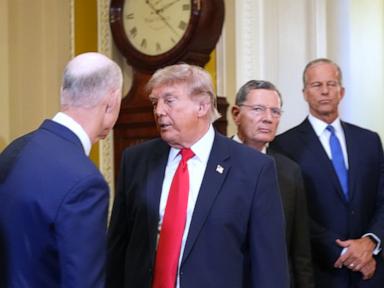
The United States Senate surrendered its constitutional authority over war making in less than twelve hours. On Wednesday night, a razor-thin Republican majority blocked a war powers resolution aimed at halting the four-month-old military campaign in Iran, completely reversing a historic bipartisan vote from the previous day. This sudden capitulation followed a closed-door Capitol luncheon where President Donald Trump systematically humiliated dissenting lawmakers, demonstrating that personal political survival completely eclipses constitutional duty in modern Washington. The swift reversal exposes a deeper institutional reality. The Senate is no longer an independent check on executive overreach, but an echo chamber managed by administrative coercion and raw political fear.
The Midday Meltdown Behind Closed Doors
The transformation began at a routine Wednesday lunch inside the Capitol. Invited by Florida Senator Rick Scott to rally support for an upcoming voting bill, Trump quickly discarded the official agenda to unleash a furious assault on the senators who had defied him. The previous day, four Republicans—Lisa Murkowski, Susan Collins, Rand Paul, and Bill Cassidy—had joined Democrats in a 50-48 vote to approve a war powers resolution. It was the first time in modern history that both chambers of Congress had unified to legally demand the termination of an unauthorized presidential conflict.
Trump did not hide his fury. He repeatedly called the dissenting lawmakers losers and targeted Louisiana Senator Bill Cassidy with particular venom. According to sources familiar with the private session, Trump ordered Cassidy to sit down and openly called him a lunatic in front of his peers.
Cassidy stood his ground during the lunch, matching Trump’s volume and pointing out that a conflict promised to last four weeks had stretched into four months without clear objectives. The tension in the room was suffocating. Most Republican senators remained entirely silent, watching their colleague bear the brunt of executive rage.
Publicly, the administration attempted to paper over the crack. Trump told reporters on his way out that the meeting was great, though he added a menacing caveat that he did not like a few people in the room. The true cleanup operation, however, was already underway behind the scenes.
The White House Pressure Campaign
The machinery of the executive branch moved rapidly to isolate the dissenters. Hours after the luncheon blowout, the administration dangling a classic combination of carrot and stick. Cassidy was abruptly invited to the White House for an emergency high-level briefing.
Vice President JD Vance and Special Envoy Steve Witkoff spent the afternoon presenting classified intelligence to the Louisiana senator. This was information the administration had previously withheld from the broader legislature. At the same time, the political implications were left unsaid but fully understood. The Pentagon is currently begging Congress for an eighty-billion-dollar emergency funding package to backfill munitions and stockpiles depleted by the Iran conflict. The administration could not afford a lingering congressional rebellion while trying to secure those funds.
The strategy worked perfectly. By Wednesday night, Cassidy returned to the Senate floor a changed man. He issued a statement thanking Vance and Witkoff for the thorough briefing and proceeded to vote against a separate, nearly identical war powers resolution.
Kentucky Senator Rand Paul fell in line as well. Paul, who has built an entire career on anti-interventionist rhetoric, chose to vote present instead of voting to halt the conflict. He claimed on social media that his decision was intended to give the president more space to negotiate a lasting peace.
Symbolism and the Reality of Capital Power
The final vote count on Wednesday night stood at 47-50-1, killing the measure just before the Senate emptied out for a two-week recess. Senate Majority Leader John Thune immediately called the president to report that the rebellion had been crushed. Trump celebrated the outcome on social media, explicitly noting that Cassidy and Paul had changed their positions.
This entire episode reveals the hollow nature of modern congressional resistance. Both the Tuesday victory and the Wednesday defeat were largely symbolic gestures because concurrent resolutions do not carry the full force of statutory law and do not require a presidential signature. Yet the administration fought the symbolic rebuke with absolute ferocity.
The institutional damage goes far beyond a single defense policy vote. To punish the legislature for its brief flash of independence, Trump had already threatened to delay signing a bipartisan housing affordability bill that lawmakers were desperately planning to showcase during the upcoming recess. By showing that he was willing to tank unrelated domestic policy achievements over a symbolic foreign policy vote, Trump forced Senate leadership to choose between their legislative records and absolute loyalty.
Congress possesses the sole constitutional power to declare war, a principle designed by the founders to ensure that the monumental decision to enter a conflict would never rest with a single individual. That principle has been steadily eroded by decades of executive overreach, but Wednesday’s events mark a different kind of decay. The erosion is no longer just a slow drift of bureaucratic authority. It is an active, ongoing capitulation driven by lawmakers who choose the safety of the party line over the defense of their own institutional powers.