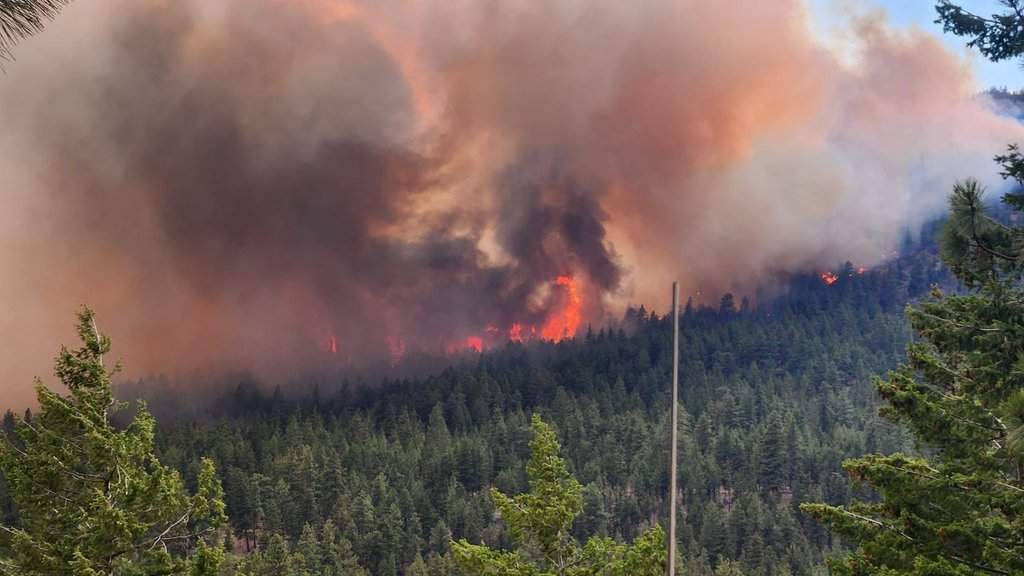
The air across the British Columbia Interior smells like a dying campfire that refuses to go out. Ash settles on windshields, porch railings, and lungs with impartial cruelty as the province confronts yet another punishing season of ecological unraveling. In response to the persistent blanket of particulate pollution, the Canadian Red Cross and federal authorities have begun distributing free N95 respirator masks to residents across the Interior Health region. It sounds like a humanitarian lifeline. It is also a glaring symptom of a reactive emergency strategy that arrives long after the smoke has crossed the threshold.
Free distribution points have popped up in places like Kamloops, Kelowna, and Ashcroft. Local organizations, business improvement associations, and university campuses are now serving as impromptu distribution hubs for personal protective equipment. Yet this band-aid measure exposes an uncomfortable truth about how public health systems manage climate disasters. Masks are necessary because structural mitigation has failed. Handing out respirators to citizens wading through hazardous air is the policy equivalent of offering a bucket to someone standing in a rising tide. Meanwhile, you can read similar developments here: Why Marjorie Taylor Greene Is Wrong About White House Nuclear Tactics.
The Anatomy of Particulate Danger
To understand why the distribution of N95 masks matters, one must look closely at what wildfire smoke actually carries. This is not wood smoke from a backyard fire pit. Modern mega-fires consume everything in their path, including residential structures, vehicles, commercial outbuildings, and electrical infrastructure.
The resulting atmospheric soup contains a complex mixture of gases and microscopic particulate matter known as PM2.5. These particles measure less than 2.5 micrometers in diameter. To put that scale in perspective, they are roughly thirty times smaller than the width of a human hair. To understand the full picture, we recommend the recent analysis by The New York Times.
When inhaled, PM2.5 does not stop in the upper airways. It bypasses the body's natural filtration systems, penetrates deep into the pulmonary alveoli, and crosses directly into the bloodstream. Once inside circulation, these toxins trigger systemic inflammation. Cardiovascular issues spike, emergency rooms fill with patients gasping for air, and long-term respiratory damage becomes a permanent baseline for vulnerable populations.
Standard cloth masks and surgical coverings offer virtually no protection against this microscopic threat. They lack the electrostatic charge and tight facial seal required to trap sub-micron particles. An N95 respirator, when fitted properly, creates a physical barrier that filters out at least 95 percent of airborne particles. Providing them for free across the Interior Health region is a medical necessity. But distributing safety gear at front desks and community centers shifts the burden of survival entirely onto the individual.
The Logistics of Distribution and Access
Logistics in a crisis reveal organizational priorities. The current rollout relies heavily on designated pickup windows at specific civic organizations, such as community futures offices and local business associations operating during standard weekday hours.
Consider the operational friction built into this model. A working-class resident laboring outdoors or an elderly person with limited mobility must travel to a designated urban center during restricted daytime hours to secure protection against the air they are forced to breathe. Rural and remote communities, often sitting closest to active burn zones, face even steeper hurdles.
Supply chains for crisis gear remain fragile. While the Canadian Red Cross acts as an efficient conduit for federal stockpiles, relying on voluntary distribution networks means supplies fluctuate wildly. Masks are available "while supplies last". That phrase should trigger alarm bells for anyone tracking public administration trends. In a climate-altered reality where smoke seasons are no longer anomalies but annual fixtures, essential respiratory protection should be as ubiquitous and accessible as clean drinking water. Treating N95 masks as a limited promotional handout rather than a fundamental public utility creates tiered safety. Those who can navigate bureaucratic pickup schedules get protected. Those who cannot absorb the full biological cost of the atmosphere.
The Policy Vacuum Beyond the Mask
Handing out respirators treats the smoke, but it ignores the systemic policy paralysis surrounding wildfire management, land use, and indoor air infrastructure. For years, public health messaging during smoke events has relied on boilerplate advice: stay indoors, keep windows closed, and run an air purifier.
That advice assumes every resident lives in a tightly sealed, modern dwelling equipped with advanced HVAC filtration. It ignores renters living in aging, poorly insulated apartments with degraded window seals and zero mechanical ventilation. It ignores low-income households that cannot afford commercial HEPA filters or the electricity required to run them continuously during an August heatwave.
When indoor spaces fail to provide refuge, people are forced to choose between heat exhaustion and smoke inhalation. Public cooling and clean-air centres exist on paper, but their activation is often sluggish, underfunded, and poorly communicated. The Ministry of Emergency Management and Climate Readiness offers reimbursement to communities for opening these spaces, yet local governments frequently struggle to absorb upfront operational costs or extend operating hours without straining municipal budgets.
Mask distribution programs act as a convenient political substitute for structural upgrades. Passing out boxes of respirators is visible, fast, and relatively inexpensive compared to retrofitting public housing stock, upgrading school ventilation systems, or overhauling forest management practices. It allows authorities to check a box indicating action has been taken, even as the foundational vulnerabilities remain untouched.
Shifting From Reaction to Resilience
The B.C. Interior is locked in a cyclical trial by fire and smoke. As long as mega-fires continue to scorch millions of hectares, smoke mitigation must evolve past emergency handouts and public service announcements.
True resilience requires treating indoor air quality as a core component of public health infrastructure. Building codes must mandate centralized filtration in multi-family residential buildings. Subsidies for high-efficiency air purifiers should target vulnerable households before fire season begins, rather than waiting for particulate counts to reach toxic levels.
Until structural reforms catch up to the reality of a burning landscape, the cardboard boxes of N95 respirators sitting on office counters in Kamloops and Kelowna will remain the primary line of defense. They save lungs today, but they testify to a society caught flat-footed by a predictable crisis, handing out paper thin shields while the horizon burns