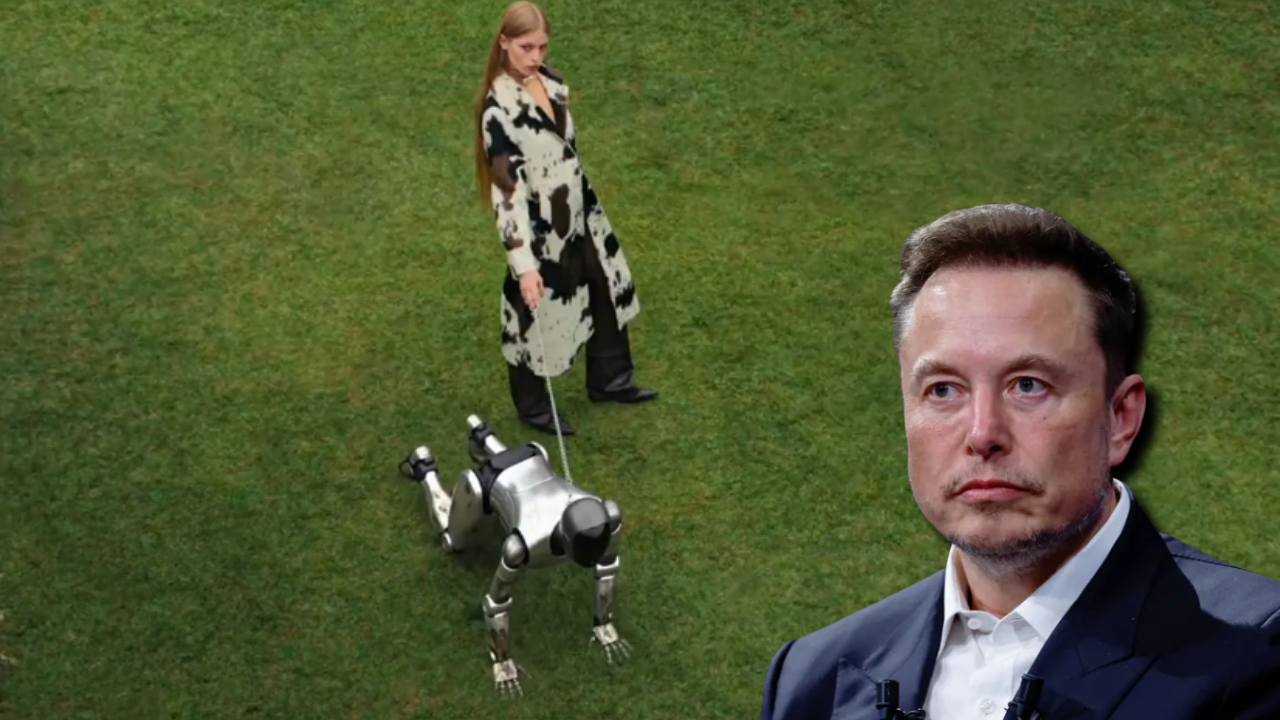
Commercial entities do not accidentally cast figures caught in high-profile familial fractures. When Spanish fashion brand Desigual selected Vivian Jenna Wilson as the focal point of its Fall 2026 campaign, titled Born to Disobey, the strategy bypassed traditional celebrity endorsement metrics. Instead, it capitalized on an intersection of industrial anxieties, public estrangement, and corporate positioning. The campaign features Wilson interacting with a malfunctioning humanoid robot named DESI84, deploying calculated symbolism that directly targets the automation and artificial intelligence paradigms championed by her estranged father, Elon Musk.
This dynamic reveals a calculated shift in how retail brands manufacture cultural relevance. Rather than relying on static product features, the marketing apparatus integrates real-world socio-technical friction. The juxtaposition of a billionaire-technologist father building autonomous systems and his estranged daughter mocking robot obedience on a fashion runway creates an optimized friction coefficient that traditional advertisements fail to generate.
The Architecture of Counter-Positioning
To understand the operational mechanics of the campaign, one must examine the structural elements that drive its market visibility. The messaging relies on three core variables: labor displacement economics, environmental externalities of compute infrastructure, and personal symbolism.
- Labor Substitution Costs: The creative industries face a margin compression threat as generative models absorb entry-level drafting, styling, and design tasks. Wilson’s public critique centers on the substitution of intentional human expression with probabilistic pixel generation.
- Ecological Externalities: Large-scale data centers demand substantial energy and water inputs. The campaign attempts to frame automated consumption as ecologically corrosive, contrasting machine utility with human resource restraint.
- The Obedience Paradigm: The tagline "He was designed to obey. Not me" serves a dual rhetorical function. It critiques deterministic machine logic while mapping cleanly onto the public narrative of familial autonomy and legal name changes that severed ties with deterministic lineage.
The Economics of Artificial Intelligence Skepticism in Retail
Fashion marketing historically relies on aspirational conformity. Desigual inverts this vector by branding non-conformity as a luxury good. By deploying a subject whose personal life represents a complete rejection of a technological patriarch’s authority, the brand secures unearned organic media distribution across global news outlets.
The economic return on investment for such campaigns does not stem from immediate apparel conversion rates alone. It functions as a brand repositioning exercise. High-street competitors struggle to differentiate commodity textiles. By anchoring its collection to the broader societal anxiety surrounding generative replacement, the brand converts a standard clothing rollout into a cultural commentary platform.
The inclusion of the DESI84 robot—widely interpreted as a thematic nod to Tesla’s Optimus humanoid project—demonstrates a sophisticated understanding of meme-economy distribution. The visual tropes of walking a robot on a leash or utilizing it as a golf tee lower the barrier for digital sharing. Algorithms favor conflict and irony, ensuring that the media ecosystem completes the distribution loop without requiring equivalent cash outlays in paid media impressions.
Operational Realities and Strategic Limits
Critiquing automation while operating within a globalized fast-fashion distribution network exposes a fundamental strategic contradiction. The textile industry remains resource-intensive, and marketing anti-industrial motifs through mass-produced garments highlights the tension between messaging and material reality.
When public figures critique machine learning for reducing artistic intent to statistical aggregation, they correctly identify the mechanics of large language and vision models. These systems optimize for maximum likelihood estimation based on historical corpuses rather than conscious emotional genesis. Yet, the commercial exploitation of this critique relies on the same digital distribution channels powered by data-hungry server farms and algorithmic targeting engines.
The long-term utility of weaponizing personal alienation for commercial gain remains bound by consumer fatigue cycles. Once the novelty of the subtext decays, the underlying product must sustain market share through traditional vectors of price, quality, and distribution velocity.
Analyze the structural lifecycle of contemporary brand campaigns by evaluating how closely their core message relies on external controversies versus intrinsic product innovation.