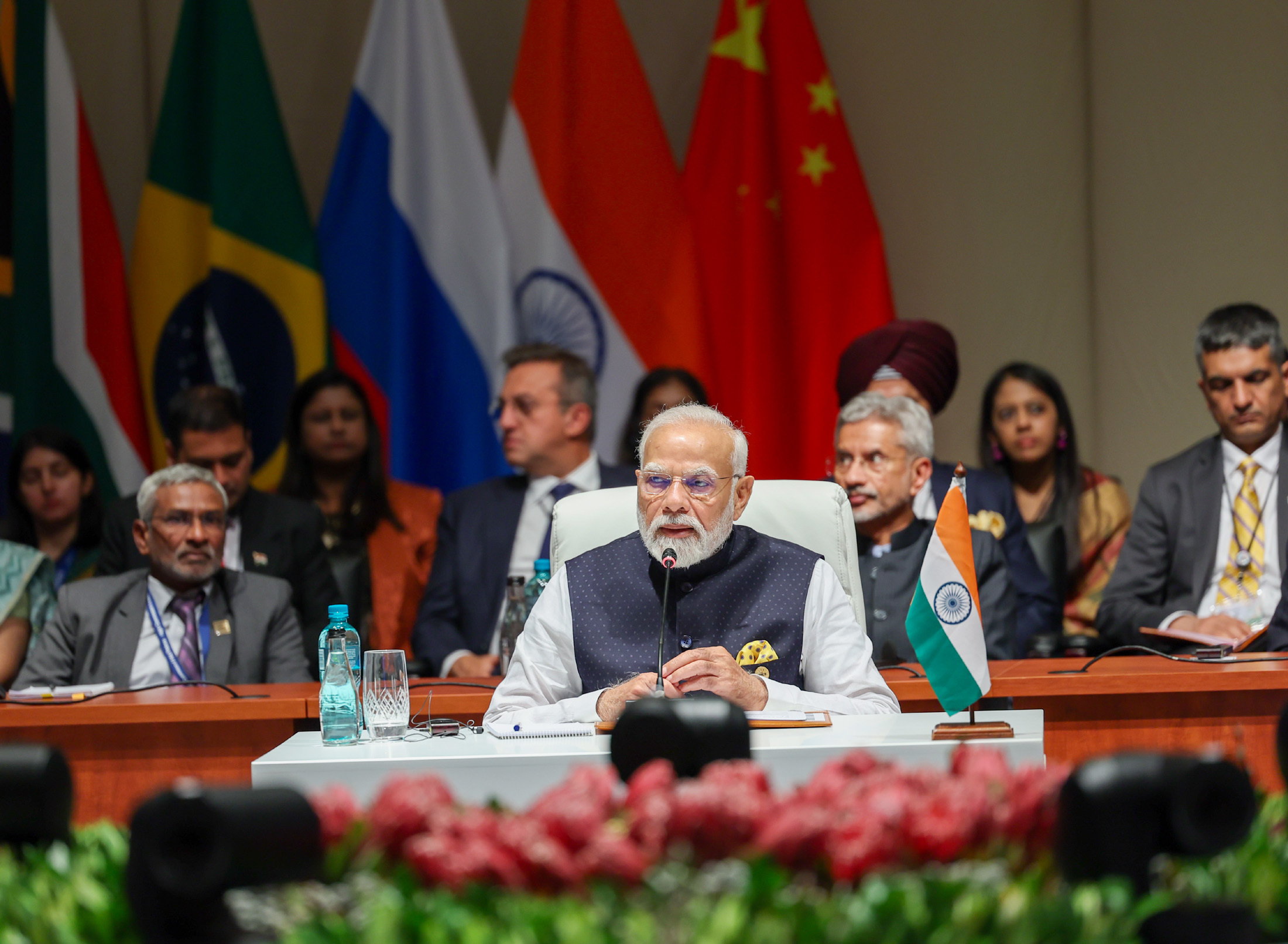
When the Iranian leadership publicly praises New Delhi for its "impartiality" during its tenure as BRICS chair, they aren't just engaging in diplomatic pleasantries. They are acknowledging a high-stakes balancing act that nearly buckled under the weight of global sanctions and regional rivalries. To understand why Tehran is tipping its hat to India, one must look past the press releases and into the brutal mechanics of how an emerging economic bloc actually functions when the world’s most sanctioned nations want a seat at the table.
India’s role as the gatekeeper of BRICS (Brazil, Russia, India, China, and South Africa) came at a moment of profound volatility. The bloc was transitioning from a talk shop of emerging markets into a serious geopolitical alternative to the G7. Iran, desperate to break its economic isolation, viewed BRICS membership as its primary escape hatch. The friction was immediate. While China pushed for rapid expansion to bolster its own sphere of influence, India played the role of the skeptical pragmatist. New Delhi insisted on strict criteria, ensuring that the bloc didn't become a mere echo chamber for anti-Western sentiment, but rather a functional economic cooperative.
The Friction of Expansion
The entry of Iran into BRICS wasn't a foregone conclusion. It was a diplomatic knife fight. For years, the core members argued over whether adding new states would dilute the group’s power or enhance it. India’s specific contribution was the creation of a "membership roadmap." This wasn't about blocking Iran; it was about ensuring that any new member could actually contribute to the New Development Bank (NDB) and the group’s shared financial goals without bringing the entire structure down under the weight of secondary sanctions.
Tehran’s appreciation stems from the fact that India did not use its chairmanship to veto Iranian ambitions despite New Delhi’s own growing strategic partnership with the United States. In the cynical world of international relations, "impartiality" is often code for "you didn't screw us over when you had the chance." India managed to maintain its "Strategic Autonomy," a term the Ministry of External Affairs loves to use, by treating Iran’s application with the same procedural rigor as that of the UAE or Egypt.
Energy Security and the Rupee-Rial Reality
Beyond the optics of summit photos, the real story lies in energy and infrastructure. Iran sits on some of the world’s largest gas and oil reserves, but its ability to monetize them is strangled by the SWIFT banking ban. India, a voracious consumer of energy, has a direct interest in seeing Iran integrated into a non-dollar payment system. However, doing so requires a level of financial engineering that most nations are too timid to attempt.
The Chahbahar Factor
You cannot discuss India-Iran relations without looking at the Chahbahar Port. This is India’s strategic answer to China’s Gwadar Port in Pakistan. It is the gateway to the International North-South Transport Corridor (INSTC). While the West looked on with concern, India negotiated a specific carve-out for Chahbahar, arguing its necessity for humanitarian aid to Afghanistan.
- Logistics: The port allows India to bypass Pakistan entirely to reach Central Asian markets.
- Finance: It serves as a testing ground for trade settled in local currencies, bypassing the US dollar.
- Defense: It provides a neutral maritime footprint in the Gulf of Oman.
During its BRICS chairmanship, India didn't just talk about "Global South cooperation." It actively pushed for the integration of these logistical corridors into the BRICS master plan. Iran saw this as a lifeline. By keeping the technical discussions focused on trade routes and energy logistics rather than ideological posturing, India gave Iran a path to legitimacy that didn't require a direct confrontation with Washington.
The Shadow of the Dragon
It is an open secret that BRICS is often a tug-of-war between Delhi and Beijing. China wants a large, sprawling organization that it can lead by virtue of its massive GDP. India wants a tight, effective group of equals. When Iran applied, the fear in some quarters was that Tehran would become a reliable vote for China’s interests within the bloc.
India’s "impartiality" was actually a very clever form of self-interest. By ensuring the expansion process was based on consensus and merit rather than patronage, India prevented BRICS from becoming a Chinese satellite. Iranian officials recognized that India’s insistence on "rules-based expansion" actually protected them. It meant that their membership was earned through a multi-lateral process, making it much harder for any single power to dictate terms to them later.
Why the Impartiality Label Matters Now
Iran is currently navigating a period of intense internal and external pressure. Being part of BRICS provides a layer of sovereign protection. When the Iranian Minister speaks of India's fairness, he is signaling to his own domestic audience—and to the West—that Iran has powerful friends who are willing to play fair.
India’s success as a chair was in its ability to separate bilateral friction from multilateral goals. India and Iran have had their share of disagreements, particularly regarding India’s occasional compliance with US oil sanctions. Yet, in the BRICS forum, India acted as the "adult in the room." It facilitated a space where Russia, China, and Iran could sit with democratic India and Brazil to discuss a world where the dollar isn't the only currency that matters.
The Mechanics of Non-Dollar Trade
The most hard-hitting aspect of this partnership is the quiet move toward de-dollarization. This isn't the radical, overnight collapse of the greenback that some pundits predict. It is a slow, methodical building of plumbing. India and Iran are working on a system that links India’s Unified Payments Interface (UPI) with Iran’s Shetab banking system.
During its chairmanship, India didn't shy away from these technical hurdles. They looked at how to settle trades when one currency is highly volatile and the other is a global heavyweight. This required "impartiality" because it meant India had to be willing to take a risk on the Iranian economy at a time when most of the world was divesting.
The Currency Conundrum
| Challenge | India's Approach | Iran's Benefit |
|---|---|---|
| Sanction Risk | Use of UCO Bank for "rupee-rial" trade | Access to essential medicines and food |
| Oil Volatility | Long-term infrastructure investment (Chahbahar) | Guaranteed off-taker for energy products |
| Geopolitical Bias | Pushed for "Consensus-based" expansion | Membership despite Western disapproval |
A Diplomatic Masterclass in Middle-Power Politics
The Iranian endorsement proves that India has mastered the art of being "multi-aligned." It is a member of the Quad (with the US, Japan, and Australia) while simultaneously being a cornerstone of BRICS. This should be impossible. Usually, a country has to pick a side. India’s chairmanship demonstrated that it is possible to lead a group containing the West's primary adversaries without burning bridges in Washington.
This wasn't about being "nice" to Iran. It was about India's realization that a stable, economically integrated Iran is better for regional security than a cornered, desperate one. India’s "impartiality" was a calculated move to ensure that the middle-east’s energy architecture remains diverse. If Iran were to fall completely into the Chinese orbit, India’s energy security would be permanently compromised. By facilitating Iran’s entry into BRICS with dignity and procedural fairness, New Delhi secured its own interests for the next decade.
The reality of modern diplomacy is that there are no permanent friends, only permanent interests. India’s interest was a functional BRICS that could act as a bridge between the West and the Global South. Iran was the ultimate test case. Had India fumbled this, or shown blatant bias against Tehran to please the US, BRICS would likely have fractured. Instead, it expanded.
The Iranian Minister’s comments are a rare moment of public credit for a job well done in the shadows of international statecraft. India didn't just show impartiality; it showed the world how to manage a room full of rivals without letting the roof cave in.
Investors and analysts should watch the next round of NDB project approvals. That is where the "impartiality" will be tested in hard currency. If Iranian infrastructure projects start receiving BRICS-backed funding, the shift in global power will no longer be a matter of debate—it will be a matter of record. The era of the single-pole world ended not with a bang, but with a series of consensus-based meetings in New Delhi.
Stop looking for a grand "clash of civilizations." The real action is in the clearinghouse and the port terminal. India understood this better than anyone else in the room. By treating Iran as a partner rather than a pariah, they didn't just help Tehran; they solidified India's position as the indispensable broker of the new world order. The "impartiality" Iran speaks of was simply the mask worn by a very effective, very cold-blooded pursuit of national interest.
Every nation in the Global South is now taking notes. They see that India can provide a seat at the table without demanding a change in government or a shift in ideology. That is the true power India exercised as BRICS chair. It provided a neutral platform in a world that is increasingly polarized, and in doing so, it made itself the most important player on the board.