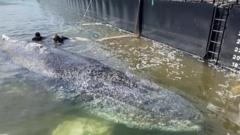
The bloated, decomposing carcass of a ten-meter humpback whale calf bobbing off the coast of the Danish island of Anholt is the precise answer to what happens when raw emotion and unchecked wealth override cold, hard biological reality.
Danish environmental officials recovered a malfunctioning satellite tracker from the dead mammal, confirming that the carcass belongs to Timmy. He was the juvenile whale that captivated Europe for two months while stranded in the shallow, low-salinity waters of Germany’s Baltic coast.
His death, discovered just two weeks after a highly publicized, privately funded 1.5 million euro rescue operation, was completely preventable. Not because the whale could have been saved, but because he should have been allowed to die in peace.
The tragedy of this failed intervention exposes a deep fracture in how modern society views wildlife conservation. On one side stand marine scientists, bound by data and an understanding of evolutionary trauma. On the other side is a public fueled by social media outrage and multi-millionaires who believe that any problem can be solved if you throw enough capital at it.
The result was a logistically impressive, ecologically disastrous spectacle that experts explicitly warned was nothing short of pure animal cruelty.
The Million Euro Illusion of Salvage
When Timmy first became trapped on a sandbank near Timmendorfer Beach in late March, the clock began ticking on a biological death sentence.
Humpback whales are built for the high seas. The Baltic Sea, with its shallow basins and drastically lower salinity levels compared to the open Atlantic, is a notoriously hostile environment for displaced marine giants.
Weeks of exposure to these conditions left the juvenile calf lethargic, weak, and covered in painful, blister-like skin blemishes. To worsen matters, sections of his mouth were entangled in discarded fishing nets.
As the animal’s organs slowly collapsed under the crushing weight of its own gravity—a standard consequence of prolonged stranding—German authorities made the agonizing, scientifically backed decision to halt rescue attempts. They recognized the inevitable. They chose comfort over intervention.
Then the billionaires stepped in.
Karin Walter-Mommert and Walter Gunz, the co-founder of a major European electronics retail chain, stepped forward with open checkbooks. They offered to fund a complex, privatized extraction mission.
The plan was a marvel of heavy engineering. A massive, water-filled transport barge named Fortuna B was brought in.
The weakened calf was corralled into the ship’s hold and towed from Wismar Bay, out through the Kattegat, and into deeper waters off the Danish coast, where he was released into the North Sea on May 2.
The images of the whale blowing through its blowhole and swimming away were broadcast as a triumph of human compassion. It was a perfect, feel-good narrative for an audience desperate for a happy ending.
It was also completely hollow.
When Philanthropy Ignores the Science
The International Whaling Commission and the specialists at the Oceanographic Museum in Stralsund had spent weeks pleading with the public and the financiers to stop. Burkard Baschek, the museum's director, was unsparing in his assessment, publicly labeling the entire enterprise as an exercise in cruelty.
Marine biologists knew what the public refused to accept. A whale that beaches itself multiple times is not just lost; it is profoundly, often terminally, compromised.
Transporting a juvenile, injured whale inside a metal barge is an intensely stressful ordeal. The noise of the tugboat engines, the confined space, and the ongoing internal trauma from the initial strandings created a toxic cocktail of physiological stress.
The act of releasing him into deeper water did not cure his systemic organ failure, his skin infections, or the starvation he had endured for weeks. It simply moved his final moments out of sight of the television cameras.
"There is a distinct difference between genuine conservation and performative salvation," says one veteran marine mammal stranding coordinator who observed the German operation from afar. "When you force an animal that is already dying through a grueling, multi-day transport just to say you 'returned it to the wild,' you aren't saving it. You are just ensuring it dies alone, exhausted, in deep water where people can't see it happen."
The immediate aftermath of the release quickly devolved into a finger-pointing exercise that mirrored the chaos of the operation itself. Shortly after the barge dropped Timmy into the sea, his satellite tracking device stopped working.
Realizing the public relations tide was turning, Walter-Mommert and Gunz issued a joint statement attempting to distance themselves from the execution of the mission. They pointed blame toward the vessel operators and crew of the Fortuna B and its support ships.
It was an extraordinary retreat. The financiers who had eagerly claimed the mantle of saviors were suddenly eager to displace accountability for the predictable, catastrophic outcome.
The Logistical Nightmare Left Behind in Denmark
Now, the burden of this failed German experiment rests squarely on the shoulders of Danish authorities. The carcass is currently drifting near Anholt, an island situated in the middle of the Kattegat strait.
The Danish Environmental Protection Agency has announced that it has no immediate plans to remove the body or conduct a necropsy. The logistics of towing a decomposing, multi-ton marine mammal away from a remote island are staggering and costly.
For now, the whale will remain where it is, left to decompose naturally, unless it drifts into critical shipping lanes or washes onto a public beach.
+-------------------------------------------------------------+
|               CHRONOLOGY OF A PREDICTABLE CRITICAL FAILURE  |
+-------------------------------------------------------------+
| March 23 | Whale first spotted stranded on German sandbank  |
| April    | Health deteriorates; German officials halt rescue|
| Late Apr | Private donors pledge €1.5M for barge transport |
| May 2    | Timmy released into the North Sea; tracker fails |
| May 14   | Carcass discovered near Anholt Island, Denmark   |
| May 16   | Danish authorities confirm identity, warn public |
+-------------------------------------------------------------+
The Danish government has issued stern warnings to locals and tourists to stay far away from the site. The hazards are practical and dangerous.
A decomposing whale carcass is a breeding ground for virulent, zoonotic pathogens that can easily jump to humans who get too close. Then there is the more spectacular danger.
As internal organs rot, the buildup of trapped methane gas turns the whale into a volatile pressure vessel. The risk of a sudden, explosive rupture is incredibly high.
It is a grim, undignified end for an animal that became a pawn in a battle between sentimentality and science.
The Growing Trend of Anthropomorphic Overreach
The tragedy of Timmy is not an isolated incident. It highlights a growing, troubling trend where public pressure forces environmental ministries to act against their own scientific consensus.
We live in an culture that struggles to accept the harsh realities of natural mortality. When a large, charismatic mammal is in distress, the collective instinct is to demand a rescue at any cost, treating a wild predator with the same emotional framework one would apply to a stranded domestic pet.
This is not the first time the region has faced the brutal realities of large-scale marine strandings. Earlier this year, a group of male juvenile sperm whales died after beaching themselves in the shallow waters surrounding the Danish island of Fanø.
In that instance, Danish authorities held their ground against public outcry. They recognized that euthanizing or moving animals of that size in shallow water was logistically impossible and ethically indefensible. They chose to cordon off the beaches, manage the crowd, and let nature take its course.
It was an agonizing process to watch, but it was grounded in scientific integrity and respect for the animal's natural end.
The German intervention with Timmy represents the dangerous alternative. It proves that enough money can purchase the right to bypass scientific protocols, creating a precedent where wealthy individuals can dictate wildlife management policies based on emotion rather than ecology. Till Backhaus, the environment minister for the German region of Mecklenburg-West Pomerania, noted that this disaster must force a hard reassessment of how private initiatives interact with state-level conservation.
Nature is often brutal, and extinction or death is a fundamental component of the ecosystem. By treating a dying whale as a public relations crisis that can be engineered away, the rescue initiative prolonged an animal's suffering to appease a human desire for heroism.
The true lesson floating off the shores of Anholt is that true compassion sometimes requires the restraint to stand down, accept our limitations, and let an animal die with dignity.