The paper made no sound when it slid under the door.
Angela Perryman found it resting on the linoleum of her room at the National Quarantine Unit in Nebraska. It was Monday afternoon. The document bore the signature of Robert F. Kennedy Jr., the Secretary of Health and Human Services. It informed Perryman, a forty-seven-year-old retiree who simply wanted to return to her home in Florida, that she would remain confined inside the facility for another week. Meanwhile, you can find other stories here: The Gravity of Who We Love.
She had committed no crime. She had tested positive for no disease. None of the other seventeen Americans evacuated alongside her from a South Atlantic cruise ship had shown a single symptom. Yet, the official decree locked her in place, stripping away her right to walk outside, to feel the grass under her feet, or to see a human face undisguised by a plastic shield and a rubber mask.
The irony was heavy enough to crush. Kennedy had built his entire modern political identity on the absolute sanctity of medical freedom. He had marched against lockdowns. He had filed lawsuits against vaccine mandates. He had repeatedly warned the American public that government health agencies were weaponizing fear to steal individual liberties. To explore the full picture, check out the detailed report by Everyday Health.
Then, with a single stroke of a pen, he did the exact opposite.
He overruled his own federal medical reviewers, disregarded the official guidance of the Centers for Disease Control and Prevention, and ignored a broad consensus of public health scientists to keep a private citizen locked in an industrial isolation ward against her will.
Consider how this looks from inside the room. Perryman describes her existence as a simulation of a generic airport hotel, if that hotel were also a maximum-security prison. Twenty-three hours a day are spent staring at the same walls. Twice a day, healthcare workers in full biohazard gear slide trays of food through the threshold. Once a day, she is permitted to ascend to the facility roof for sixty minutes of outdoor air.
Even there, she is not alone. Armed guards stand watch, tracking her movements against the flat midwestern sky.
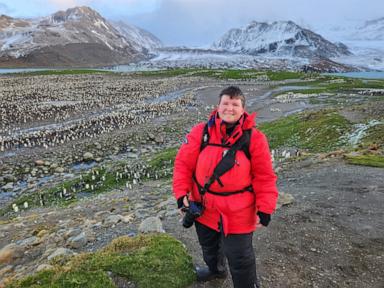
The nightmare began at sea. Perryman was a passenger on the MV Hondius, an adventure vessel navigating the remote waters of the South Atlantic. It was supposed to be a journey dedicated to wildlife photography and untamed nature. Instead, the ship became the host of an exceedingly rare, terrifying pathogen: Andes hantavirus.
Unlike the North American strains of hantavirus, which humans typically contract by inhaling dust contaminated with rodent droppings, the Andes variety possesses a sinister trait. It can spread directly from human to human. It causes a rapid, devastating respiratory failure. Of the roughly one hundred and fifty souls aboard the vessel, thirteen became infected. Three of them died.
When the ship docked, the American government moved swiftly. On May 11, federal authorities evacuated eighteen American passengers to the specialized containment facility at the University of Nebraska Medical Center.
At first, the arrangement was a partnership. Medical officials did not order the passengers to stay; they asked them to. Perryman agreed. She understood the stakes. She knew that the virus was lethal, and she was willing to surrender her immediate comfort for the safety of her community. She consented to stay through the critical three-week window when the vast majority of infections manifest.
But viruses have timelines that do not care about human patience. The maximum known incubation period for Andes hantavirus is forty-two days. To ensure absolute safety, the official observation window had to extend until midnight on June 21.
As the days bled into weeks, the psychological toll of deep isolation deepened. Perryman wanted to complete her remaining quarantine days at home in Florida. Her attorneys argued that she could easily check her own temperature twice a day, report her status to local officials, and remain isolated in her private residence.
The CDC agreed. Dr. Michael Bell, a veteran quarantine reviewer for the agency, conducted a formal medical assessment of her case. He looked at the data. He looked at her compliance. On June 11, he issued a clear recommendation: Perryman should be allowed to go home. He wrote that a less restrictive alternative would perfectly protect the public while respecting her constitutional rights.
But the federal government imposed a poison pill. White House officials insisted that if Perryman returned to Florida, local authorities had to deploy round-the-clock law enforcement surveillance. Armed guards would have to stand outside her private house twenty-four hours a day.
Florida Surgeon General Joseph Ladopo looked at the federal demands and recoiled. He called the requirements an absurd waste of public resources and a massive overreach of police power. Florida flatly refused to station guards at her doorstep, proposing the standard, scientifically validated routine of daily temperature monitoring instead.
Because Florida refused to build a domestic fortress around her, the federal government used the state’s defiance as an excuse to keep her locked in Nebraska.
Legal scholars have watched the escalation with profound alarm. Lawrence Gostin, a leading authority on global health law at Georgetown University who helped author modern federal quarantine protocols, called the Secretary's intervention a flagrant violation of due process. He pointed out that American citizens cannot be deprived of their liberty based on political friction or bureaucratic spite.
The system ran the clock down. By the time any federal court could hear an emergency appeal, the June 21 deadline would pass, rendering her legal battle moot.
The true danger of this moment extends far beyond a single room in Omaha. When a government official uses the massive, coercive apparatus of public health quarantine to detain a healthy citizen against the explicit advice of medical experts, the entire foundation of public trust dissolves.
For years, critics warned that the state would use health emergencies to normalize arbitrary detention. The man who echoed those warnings loudest is now the person enforcing the lock.
The door remains shut. The nurses will arrive tomorrow morning in their shields and gloves. Perryman will wait out her final hours, listening to the hum of the facility’s air filtration system, remembering a time when she believed that medical freedom applied to everyone.