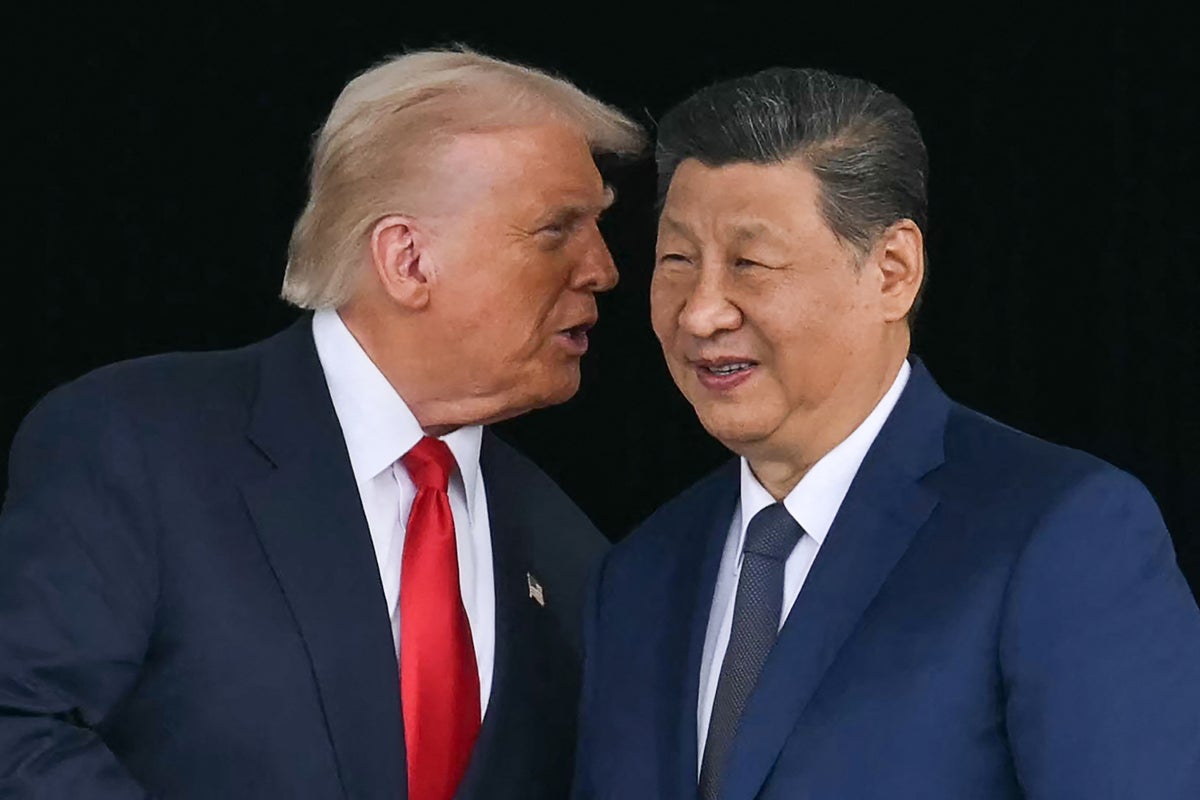
President Donald Trump has formally requested to delay his high-stakes summit with Chinese President Xi Jinping, originally scheduled for late March 2026. While the White House frames the postponement as a necessary tactical pause to oversee Operation Epic Fury—the ongoing U.S.-Israeli military campaign in Iran—the reality is far more transactional.
This isn't just about a commander-in-chief staying close to his "War Room." It is about a desperate attempt to force Beijing’s hand in the Strait of Hormuz.
For three weeks, the global energy market has been held hostage by a war that began with the decapitation of Iran’s leadership. With the Strait of Hormuz effectively paralyzed, oil prices are climbing toward levels that threaten the American consumer. Trump’s message to Xi is blunt: if China wants a seat at the table to discuss the "trade truce" and the future of global tariffs, it must first use its navy to help the U.S. break the Iranian blockade.
The Strategy of the Empty Chair
The planned visit to Beijing, slated for March 31 to April 2, was meant to be the crowning achievement of Trump’s second-term diplomacy. It followed a fragile ceasefire in the U.S.-China trade war brokered in South Korea last October. Now, that momentum has stalled.
Publicly, Treasury Secretary Scott Bessent claims the delay is purely "logistical." He told reporters in Paris that "traveling abroad at a time like this may not be optimal." But the timeline tells a different story. Just 24 hours before the delay was announced, Trump told the Financial Times that he might postpone the meeting if China didn't help unblock the Strait.
By staying in Washington, Trump is practicing the ultimate art of the deal. He is withholding the one thing Xi Jinping needs most—predictability in the Pacific—until China provides the one thing Trump needs most—stability in the Persian Gulf.
A War of Attrition on the Water
The conflict, which the U.S. dubbed Operation Epic Fury, was intended to be a swift surgical strike. Instead, it has morphed into a maritime nightmare. While U.S. and Israeli forces successfully eliminated Supreme Leader Ali Khamenei and much of the Iranian command structure on February 28, the remnants of the IRGC have retreated to a strategy of asymmetric sea denial.
Iran has deployed waves of low-cost drones and shore-to-ship missiles to throttle the world’s most critical oil artery. The results are devastating:
- One-fifth of the world's oil supply is currently stuck or rerouted.
- Global shipping insurance has tripled in cost for vessels entering the Gulf.
- Asian economies, specifically Japan and South Korea, are facing immediate energy shortages.
Trump’s gamble rests on a simple calculation. China is the world's largest importer of crude oil, and it gets roughly half of that supply through the very Strait that Iran has closed. Trump is essentially asking Xi why the U.S. Navy should bear the cost and risk of protecting Chinese energy interests while Beijing remains on the sidelines.
Beijing’s Impossible Choice
In the halls of the Zhongnanhai, the American request for Chinese warships is being viewed as a trap. China hasn't fought a major naval engagement in the modern era. To send the People's Liberation Army Navy (PLAN) into a live combat zone alongside U.S. and Israeli forces would be a radical departure from its "non-interference" doctrine.
Lin Jian, a spokesperson for the Chinese Foreign Ministry, has been characteristically vague, stating only that the two sides are "maintaining communication." Behind the scenes, however, Chinese officials are reportedly furious. They see the Iran war as a mess created by Washington that they are now being asked to clean up.
The Leverage of the New Tariffs
Adding another layer of complexity is the recent U.S. Supreme Court ruling that struck down the administration's broad use of the 1977 International Emergency Economic Powers Act to impose universal tariffs. This left the Trump administration scrambling for a new legal framework to maintain pressure on China.
Treasury Secretary Bessent and Trade Representative Jamieson Greer have been in Paris trying to sell a new "reciprocity" mechanism to their Chinese counterparts. Without the March summit, these negotiations are in limbo. China wants the tariffs gone; Trump wants the Strait open. The summit is the only currency left to trade.
The Risks of a Prolonged Vacuum
The danger of delaying the Xi-Trump meeting by "a month or so" is that momentum in international relations rarely survives a vacuum. In the three weeks since the Iran war began, several regional factors have shifted:
- Russian Opportunism: While the U.S. is bogged down in the Middle East, Moscow has stabilized its own oil revenues, benefiting from the price surge.
- European Hesitation: NATO allies like France and the UK have been reluctant to join a naval coalition that lacks a clear UN mandate.
- Domestic Pressure: In the U.S., the "rally 'round the flag" effect is already beginning to fray as gas prices rise at the pump.
If the war in Iran drags into April, a one-month delay could easily become an indefinite postponement.
The Military Reality of Epic Fury
To understand the delay, one must understand the chaos on the ground. Operation Epic Fury has seen nearly 900 strikes in the first few weeks alone. While the U.S. claims to have destroyed 190 ballistic missile launchers, the Iranian response has been surprisingly resilient. Retaliatory drones have struck U.S. sites in Bahrain and Jordan, making the logistics of a presidential trip to Asia—which requires massive military support and attention—a genuine burden on the Pentagon.
The conflict has also bled into Lebanon, where Israel is engaged in a parallel front against Hezbollah. The sheer scale of the displacement—nearly 800,000 people in Lebanon alone—has created a humanitarian crisis that the White House can no longer ignore. Trump’s advisors are likely telling him that a "victory lap" in Beijing would look tone-deaf while the Middle East is in flames and the American economy is teetering on a war-induced recession.
Beyond the Logistics
The "logistics" excuse offered by Bessent is a thin veil for a deeper strategic realignment. Trump is testing whether the "America First" doctrine can survive a two-front geopolitical crisis. He is betting that Xi Jinping’s need for the American market is greater than his desire to stay out of the Middle East conflict.
It is a high-stakes game of chicken played with aircraft carriers and oil tankers. If Xi refuses to send ships, Trump may find himself forced to go to Beijing anyway, his leverage weakened by the very war he hoped would demonstrate American dominance. If Xi yields, it would mark the first time the U.S. has successfully "outsourced" the security of global commons to its primary rival.
The coming weeks will determine if this delay was a masterstroke of coercive diplomacy or the moment the administration’s foreign policy finally overreached. For now, the world waits as the price of oil climbs and the most anticipated meeting of the year remains an empty slot on a calendar.
Would you like me to analyze the specific economic impact of the Strait of Hormuz closure on the current U.S.-China trade negotiations?


