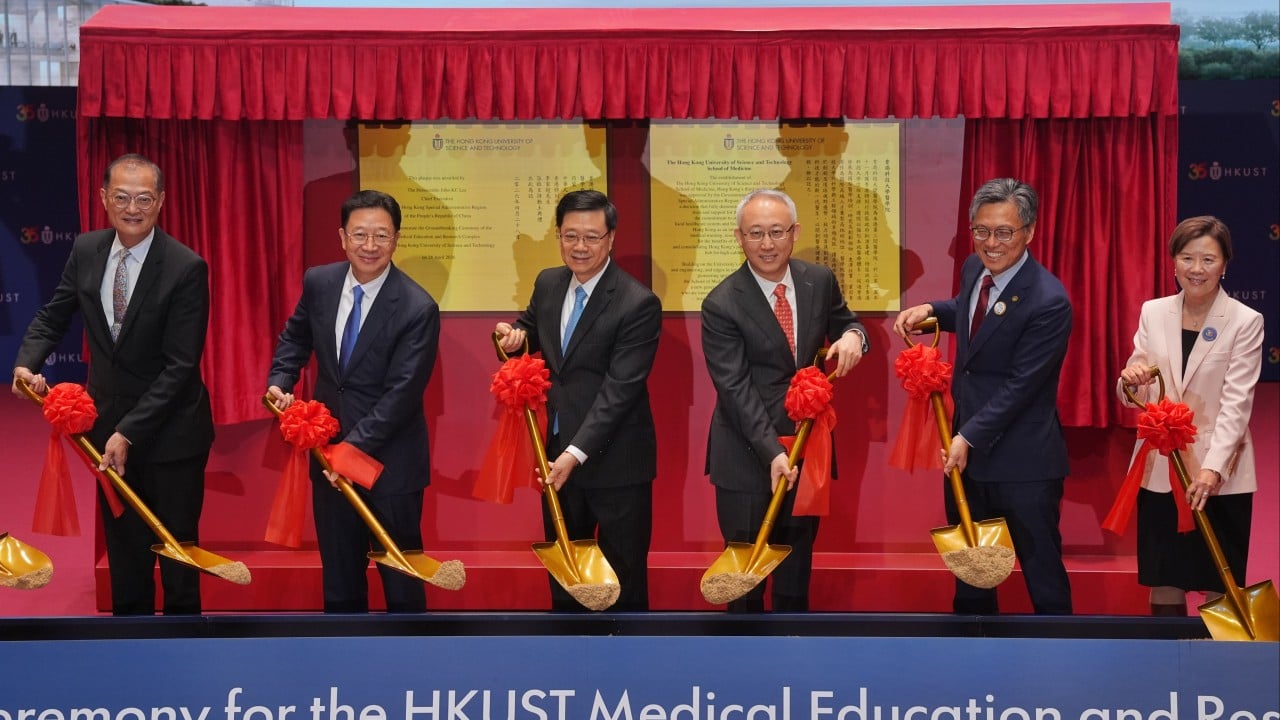
Hong Kong is no longer just planning its third medical school; it is physically carving out the space for it. The Hong Kong University of Science and Technology (HKUST) recently broke ground on an interim medical complex, a move intended to signal that the city is serious about solving its chronic doctor shortage. With seven professors already recruited from international institutions, the project is moving at a pace rarely seen in academic bureaucracy. This infrastructure push aims to stabilize a healthcare system currently buckling under the weight of an aging population and a steady exodus of veteran practitioners to the private sector or overseas markets.
The Physical Foundation of a Medical Ambition
The interim complex serves as a temporary bridge. While the permanent facility remains a long-term goal, this initial structure allows HKUST to begin training students without waiting years for a full campus expansion. It is a strategic pivot. By building modular and interim facilities, the university bypasses the usual decade-long lead time required for medical infrastructure.
This speed is necessary. Hong Kong currently relies on two prestigious but overstretched institutions: the University of Hong Kong (HKU) and the Chinese University of Hong Kong (CUHK). For decades, these two have held a duopoly on medical education. The introduction of a third player is a direct challenge to the status quo, intended to break the bottleneck that has kept local doctor-to-patient ratios significantly lower than those in other developed economies like Singapore or the United Kingdom.
The seven initial faculty hires are more than just names on a payroll. They represent a targeted attempt to import global standards and diverse clinical perspectives. These recruits are expected to design a curriculum that integrates technology and data science into traditional clinical practice, reflecting HKUST’s strengths as a technical powerhouse.
Beyond Bricks and Mortar
Building a school is the easy part. Populating it with a sustainable workforce and ensuring its graduates are accepted by the medical establishment is where the real friction lies. The medical fraternity in Hong Kong is notoriously protective of its standards, often viewing the rapid expansion of training seats as a potential threat to quality.
To counter this, the third medical school is positioning itself as a "med-tech" hub. The goal is to produce "doctor-scientists"—professionals who are as comfortable with artificial intelligence and genomic sequencing as they are with a stethoscope. This isn't just about adding more bodies to the wards; it is about changing the type of healthcare professional the city produces.
The Competition for Global Talent
Hong Kong is fighting a two-front war for human capital. Locally, the public hospital system—the Hospital Authority—is struggling with burnout. Globally, every major city is trying to lure the same pool of elite medical researchers and educators.
The hiring of seven professors is a start, but a medical school needs hundreds of clinical teachers and researchers to function effectively. The university must convince high-caliber talent that Hong Kong remains a stable, lucrative, and intellectually stimulating place to build a career. Incentives such as research grants, housing allowances, and state-of-the-art laboratory access are the chips on the table. Without a massive and sustained financial commitment from the government, the initial momentum of the groundbreaking ceremony will evaporate.
The Problem of Clinical Placement
Where will these new students learn to treat real patients? This is the elephant in the room. Hong Kong’s public hospitals are already crowded, and clinical teaching space is at a premium. HKU and CUHK already have established relationships with major hospitals like Queen Mary and Prince of Wales.
A third school must negotiate for its own "territory" within the public health system. This requires more than just government approval; it requires the cooperation of frontline nurses and doctors who are already overworked and may not have the capacity to supervise an additional influx of students. If the clinical training environment is subpar, the quality of the graduates will suffer, regardless of how modern the interim complex at HKUST happens to be.
Why the Duopoly is Ending
The shift toward a third school marks the end of an era. For years, the argument was that Hong Kong was too small for three medical schools. Critics suggested that resources would be spread too thin. That argument has been defeated by the reality of four-year wait times for specialized outpatient services and a public health system that nearly collapsed during the latter stages of the pandemic.
Political pressure has also played a role. The government is under intense scrutiny to improve livelihoods and social services. Healthcare is at the top of that list. By backing a third school, the administration is making a visible, multi-billion-dollar bet on the city’s long-term viability. It is a move to future-proof the city against the next health crisis while catering to a middle class that is increasingly frustrated with the lack of accessible care.
Financial Realities and the Cost of Care
Medical education is incredibly expensive. The cost per student is higher than in almost any other discipline. Beyond the construction costs, the operational budget for a third medical school will require a permanent increase in public spending.
Some industry analysts question whether this money would be better spent on retaining existing doctors. The "leaky bucket" problem is real: if the city trains 500 new doctors but 550 leave the public sector for private practice, the net gain is negative. The third medical school is a supply-side solution to a problem that also has significant demand-side and retention issues.
However, the "med-tech" angle offers a potential return on investment that a traditional school might not. If HKUST can spin off biotech startups or develop new medical patents, the school could eventually become a self-sustaining engine of economic growth, rather than just a drain on the public purse. This aligns with the broader push to diversify the city's economy beyond finance and real estate.
The Curricular Departure
Traditional medical training in Hong Kong follows the British model, focusing heavily on rote learning and early clinical exposure. The third school has the opportunity to tear up the script.
Expected innovations include:
- Interdisciplinary Research: Forcing medical students to work alongside engineers and data scientists from day one.
- Flexible Entry Pathways: Allowing students with non-science backgrounds or those who have already completed a first degree to enter the program, widening the talent pool.
- Global Rotations: Leveraging international faculty connections to send students abroad for part of their training, ensuring they aren't isolated in a local bubble.
This experimental approach is risky. Medical boards are conservative by nature. If the new curriculum deviates too far from the norm, the school may face hurdles in getting its graduates registered. The leadership at HKUST will need to navigate this with extreme precision, balancing the need for innovation with the rigid requirements of professional licensing.
Strategic Timing in a Shifting Region
The timing of this groundbreaking is not accidental. As the Greater Bay Area integrates, there is an ambition for Hong Kong to serve as a high-end medical hub for the entire region. Patients from mainland China already come to the city for specialized treatments and vaccinations. A third medical school increases the total "intellectual horsepower" available to serve this massive market.
This isn't just about local service; it's about regional dominance in life sciences. If Hong Kong can position itself as the premier training ground for the next generation of physicians in Asia, it secures its relevance for another fifty years. The seven professors hired aren't just teachers; they are the advance guard in a struggle for regional scientific influence.
The Risks of Rapid Expansion
Speed often comes at a price. The rush to build interim facilities and hire faculty could lead to a fragmented institutional culture. A medical school needs more than just experts; it needs a cohesive philosophy and a shared commitment to patient care.
There is also the risk of "poaching" talent from the existing two schools. If the third school simply lures staff away from HKU and CUHK with higher salaries, the city's overall capacity doesn't actually increase—it just gets reshuffled. The true measure of success will be the school’s ability to attract "new" talent to Hong Kong from the US, Europe, and elsewhere in Asia.
The interim complex is a signal of intent, but the hard work begins when the first cohort of students walks through the door. They will be the guinea pigs for a new model of education in a city that is reinventing itself under pressure.
Every new professor hired and every brick laid in the interim complex is a gamble that the city can solve its manpower crisis through sheer force of will and capital. The success of this venture will not be measured in the number of buildings completed, but in the reduction of waiting times at public clinics and the quality of the life-saving decisions made by its graduates ten years from now.
The groundwork is laid. The scrutiny now turns to the recruitment of the remaining faculty and the finalization of a curriculum that must be both revolutionary and rigorously safe.


