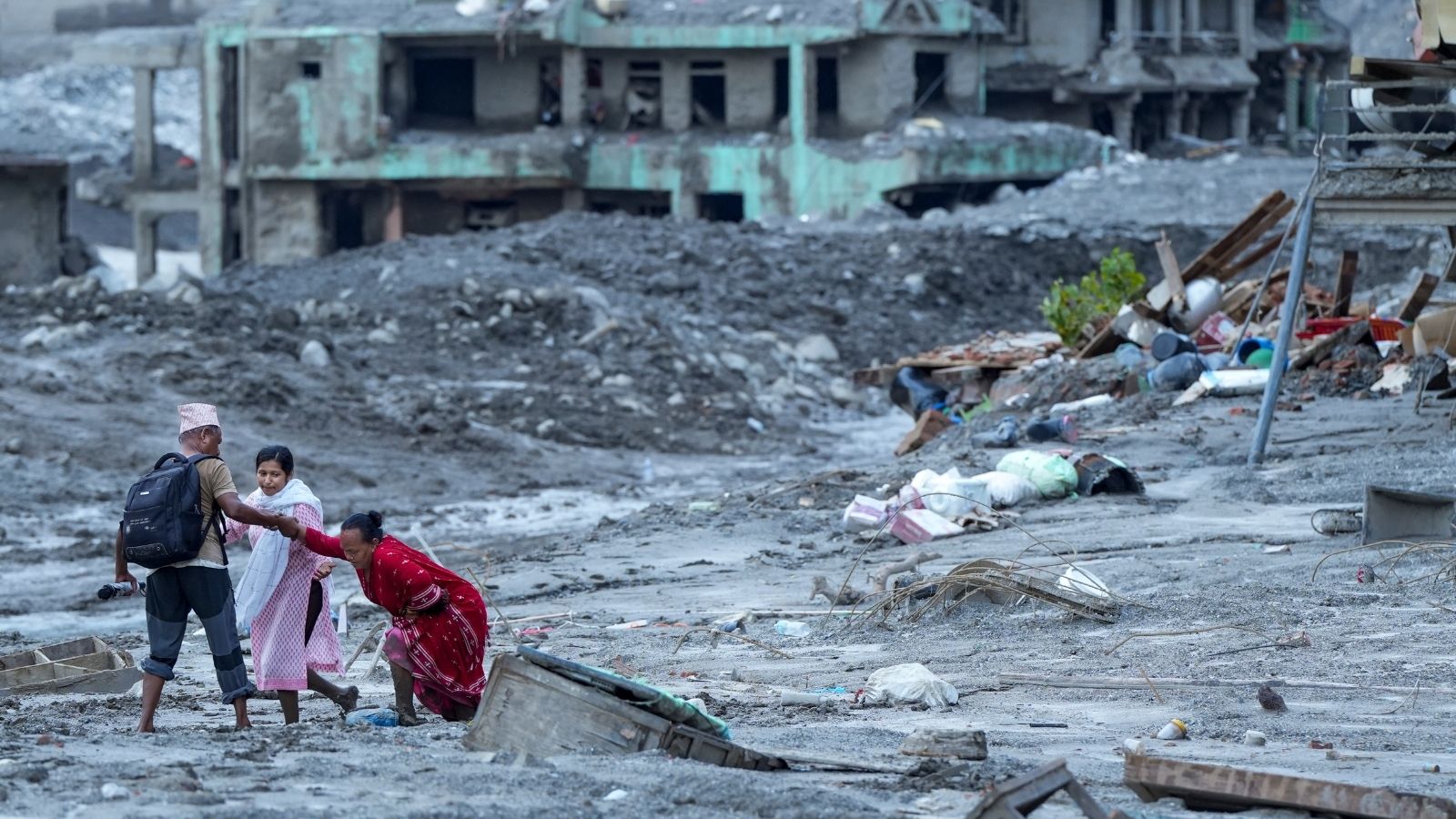
When catastrophic flash floods and glacier collapses tore through the Himalayan border regions of Nepal, they did not merely carry away bridges, homes, and human lives. They also dislodged the heavy infrastructure of commerce. A massive bank safe originating from the Bhotekoshi area in Rasuwa district was plucked from its foundation by roaring wall-of-water torrents and dragged downstream along the Trishuli River. Weeks later, as the water levels receded and left behind monumental blankets of mud in the Dhading district, that steel vault became the center of a desperate localized scramble. Local residents at Belkhukhola discovered the water-battered container, forced it open using improvised tools, and divided over 9.268 million Nepalese rupees—roughly translating to 58 lakh Indian rupees—among themselves.
The intervention of the Nepal Police and the Armed Police Force was swift. Authorities detained 29 individuals from areas such as Mastar and Adamghat in connection with the field-expedient heist, recovering the entirety of the dispersed cash. Yet, this bizarre episode is much more than a footnote of opportunistic crime. It acts as a glaring window into the systemic vulnerabilities exposed when extreme climate events collide with fragile rural financial systems.
The Geography of Dislocation
To understand how a multi-ton vault travels dozens of kilometers down a Himalayan river system, one must grapple with the sheer physics of a glacial outburst flood. When a glacier collapse sends millions of tons of rock, ice, and debris crashing into high-altitude river corridors, the resulting hydraulic force behaves like liquid concrete. It does not flow around obstacles; it pulverizes them.
Small mountain bank branches and local cooperatives perched near riverbanks often operate under severe infrastructural constraints. While major urban institutions in Kathmandu rely on deep subterranean vaults anchored to bedrock, remote outpost facilities face profound structural limitations. When the Bhotekoshi and Trishuli rivers swell beyond historical parameters, ordinary security measures vanish.
The vault did not float downstream; it rolled, tumbled, and scraped along the riverbed, propelled by an immense mass of slurry. By the time it came to rest in the alluvial mud of Galchhi Rural Municipality in Dhading, its locking mechanisms had been compromised by tectonic impacts against boulders, rendering it vulnerable to anyone equipped with basic pry bars and hammers.
Anatomy of a Rural Scramble
The twenty-nine people detained by the District Police Office in Dhading represent a cross-section of rural survival economies pushed to the brink. Among those arrested are young laborers and middle-aged residents whose livelihoods were entirely erased hours prior by the same weather system.
When survival gives way to desperation, legal boundaries blur. Sociological studies of disaster zones consistently highlight how severe resource scarcity triggers a breakdown of communal norms. In isolated pockets cut off from federal aid, an unearthed cash vault ceases to be stolen property in the minds of desperate locals. It is perceived as a windfall deposited by nature itself.
Security forces faced an immense logistical nightmare trying to police miles of debris-choked riverbanks while simultaneously conducting search-and-rescue operations for thousands of missing persons. The deployment of joint patrols to recover the 9.268 million rupees underscores the state's insistence on maintaining institutional order amidst a wider humanitarian catastrophe. Investigators are still working to trace the exact ledger origins of the cash, verify which financial institution held the ultimate title, and determine whether additional tranches of money vanished before security cordoned off the site.
The Broader Financial Fragility
Beyond the immediate theater of local arrests, this incident forces a harsh reckoning upon regional banking compliance in disaster-prone topographies. Physical cash management in the Himalayas is undergoing a brutal stress test. As climate volatility accelerates glacial melting and monsoon fury across South Asia, traditional brick-and-mortar safety paradigms are proving obsolete.
Financial institutions operating in high-risk river valleys face steep insurance premiums and logistical nightmares. Transporting physical currency to remote branches is already an exercise in high-security vulnerability. When those branches are obliterated, the liabilities extend far beyond lost paper notes. They disrupt credit flows for agrarian communities that depend on micro-loans distributed through these exact rural outposts.
The monetary recovery by the Nepal Police closes one criminal docket, but it opens a deeper institutional audit. Regional banks can no longer treat remote vaults as static assets anchored safely away from environmental hazards. Resilience engineering must now account for extreme hydrological displacement.
Heavy steel containers meant to withstand professional safecrackers are no match for the raw kinetic energy of a displaced mountain river. Until banking networks adapt to an era where rivers routinely swallow entire neighborhoods, the line between victim of a natural disaster and perpetrator of a crime will remain dangerously thin.