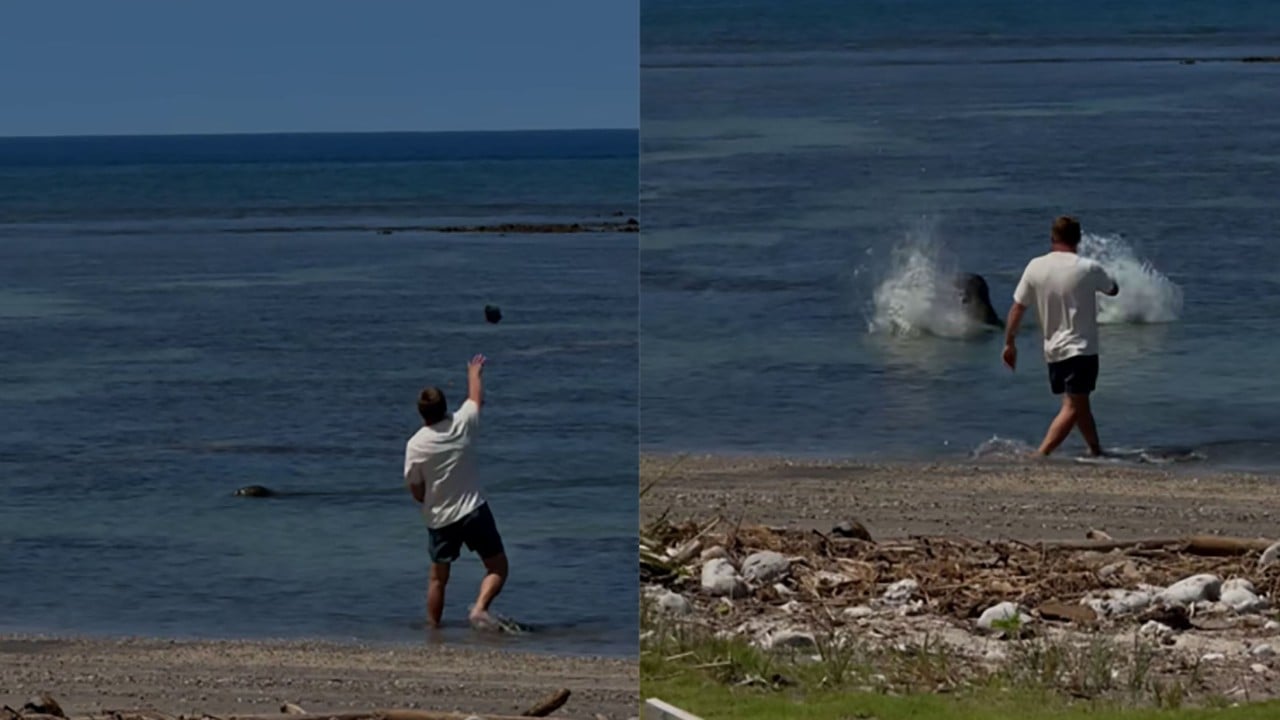
A Florida man found himself in handcuffs after a brief, violent interaction with one of the rarest marine mammals on the planet. The arrest follows a reported incident where the tourist allegedly threw a rock at a Hawaiian monk seal lounging on a Kauai beach. While the legal system begins its slow grind, the event has reignited a fierce debate over the collision between high-volume tourism and the fragile ecosystems of the Pacific. This is not just a story about a single unruly visitor. It is an indictment of a travel culture that prioritizes the "perfect shot" over the biological survival of the species being photographed.
The Hawaiian monk seal, or Neomonachus schauinslandi, is a biological relic. There are roughly 1,600 of them left in existence. They are native only to the Hawaiian Islands, and their survival is a precarious balancing act managed by federal agencies and local volunteers. When a tourist decides to treat an endangered animal like a prop or a target, they aren't just breaking a minor local ordinance. They are violating the Marine Mammal Protection Act and the Endangered Species Act, federal crimes that carry heavy fines and the potential for prison time. Meanwhile, you can read other developments here: The Gilded Teeth of the Carpathian Giant.
The Mechanics of a Federal Offense
Most visitors see a seal on the sand and assume it is sunbathing for their entertainment. It isn't. These animals spend days at sea hunting, diving hundreds of feet into the dark, cold depths of the ocean. When they haul out onto the beach, they are in a state of deep exhaustion. They are there to rest, digest, and regulate their body temperature.
Interrupting this process causes immediate physiological stress. When a seal is startled or struck, its heart rate spikes, and it may flee back into the water before it has fully recovered its energy. For a nursing mother or a pup, this can be a death sentence. The legal threshold for "harassment" under federal law is surprisingly low because the biological impact of that harassment is so high. Throwing an object at a seal is a clear-cut violation, but even getting within 50 feet can constitute a crime if it alters the animal's behavior. To see the full picture, check out the excellent article by Condé Nast Traveler.
Law enforcement didn't need to hunt for clues in this case. The digital age has turned every bystander into a witness and every perpetrator into their own cameraman. Social media platforms have become the primary evidence lockers for the Division of Conservation and Resources Enforcement (DOCARE). In this instance, witness accounts and potential digital footprints allowed authorities to move quickly. The message from the Hawaii Department of Land and Natural Resources (DLNR) is blunt. If you harass the wildlife, the footage will find its way to a prosecutor’s desk.
The Cultural Friction of the Islands
To understand why this arrest caused such a visceral reaction in Hawaii, you have to look past the environmental data. There is a deep, historical tension between the local population and the sheer volume of visitors that descend on the islands annually. For many residents, the monk seal is a symbol of the land’s original identity—a "living ancestor" that deserves a level of respect that modern tourism rarely affords.
When a tourist strikes a seal, it is viewed as an extension of the broader "extractive" mindset of the travel industry. This is the idea that the world is a playground where the entrance fee entitles the buyer to do whatever they please. We see this in the trampling of sacred sites, the destruction of coral reefs, and now, the physical assault on an animal that was here long before the first hotel was built. The pushback isn't just about the seal. It’s about a community feeling that their home is being treated with contempt by people who will be gone in a week.
The Ineffectiveness of Warning Signs
Hawaii's beaches are littered with signs. There are placards, rope lines, and volunteer "seal sitters" who spend their days standing near resting animals to keep crowds away. Yet, the incidents continue. This suggests a fundamental failure in the way travel information is consumed.
We have reached a point where physical signage is invisible to a person viewing the world through a five-inch screen. The psychological drive to capture "content" creates a sort of tunnel vision. In that state, the danger to the animal is filtered out, and the legal consequences are ignored until the handcuffs are clicked shut. The Florida tourist likely didn't arrive in Kauai planning to commit a federal crime, but the desire for a reaction—whether from the animal or an online audience—overrode basic common sense.
Education is often touted as the solution, but education requires a willing student. The state has tried public service announcements on incoming flights and digital campaigns. Still, the needle hasn't moved significantly. The reality is that the only deterrent that seems to resonate with the modern traveler is the visible threat of prosecution.
The Economic Reality of Conservation
Protecting the Hawaiian monk seal is an expensive endeavor. It involves constant monitoring, medical interventions for hooked or entangled animals, and the maintenance of a sprawling volunteer network. When a tourist intervention occurs, it diverts these limited resources. Officers who could be patrolling against illegal fishing are instead filing reports on a rock-throwing incident. Biologists who should be studying population trends are instead performing health checks on a stressed pup.
There is also a hidden cost to the tourism industry itself. Hawaii’s brand is built on "pristine" nature. If that nature is perceived as a zone of conflict or if the wildlife disappears due to human interference, the very product being sold begins to degrade. The irony is that the tourist who harms the wildlife is effectively destroying the reason they traveled thousands of miles in the first place.
The Legal Gauntlet Ahead
The individual arrested in this case faces a daunting legal path. Federal charges for violating the Endangered Species Act are not a "slap on the wrist." Fines can reach $50,000 per violation, and jail time is a genuine possibility for egregious acts. In 2021, a couple was fined $500 just for touching a monk seal on their honeymoon and posting it to TikTok. Throwing a rock elevates the intent and the potential for injury, which usually results in a significantly harsher penalty.
The judicial system in Hawaii has shown an increasing lack of patience for these cases. Judges are aware of the public's frustration and the ecological stakes. They are using these cases to set a precedent. The goal is to make the cost of a viral stunt so prohibitively high that even the most oblivious visitor thinks twice.
What Happens Next for the Species
The seal involved will likely be monitored for any signs of internal injury or behavioral shifts. If the animal becomes "sensitized" to humans, it may begin to seek out human interaction, which is a different kind of death sentence. "Friendly" seals are often hit by boats or accidentally drowned by people trying to play with them. The best-case scenario for a monk seal is to remain completely indifferent to humans. Every rock thrown and every close-range selfie works against that indifference.
The survival of the Hawaiian monk seal depends on a collective decision to be invisible. It requires tourists to accept that they are observers, not participants, in the lives of the creatures they encounter. Until that shift occurs, the cycle of arrest and outrage will continue.
Respecting the boundary isn't a suggestion. It is a requirement for the continued existence of a species that is currently hanging on by a thread. The Florida tourist learned this the hard way, but the real test is whether the millions of people who follow him to the islands will take the lesson to heart before the next haul-out.
Stay back. Observe from a distance. Put the phone away.