An official portrait is rarely just a portrait. Under the hot studio lights, every stitch of fabric, every calculated shadow, and every choice of jewelry is a silent language.
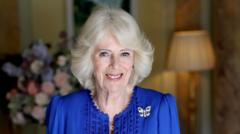
When Buckingham Palace released the official photograph marking Queen Camilla’s 79th birthday, the untrained eye saw a standard, albeit radiant, royal portrait. She stands in the State Drawing Room of Hillsborough Castle, Northern Ireland, wearing a sharp blue dress. She is smiling.
But look closer.
Pinned to her chest is a diamond and sapphire butterfly brooch.
This is not a random accessory pulled from a velvet-lined drawer at the last minute. This brooch was presented to the late Queen Elizabeth II in February 1977 during the Birmingham Spring Fair. In the delicate world of royal symbolism, wearing a predecessor's jewelry is a quiet, powerful nod to continuity, duty, and the invisible weight of a crown that was never supposed to be hers to help carry.
Yet, the true story of her 79th year isn't found in the glittering vaults of the House of Windsor. It is found in a quiet, devastating statistic that keeps educators awake at night.
The Cliff Edge of Childhood
Imagine a ten-year-old child. Let’s call him Leo.
Leo represents thousands of kids across the United Kingdom transitioning from the safe, imaginative harbor of primary school to the daunting, high-stakes world of secondary school. Right now, Leo loves stories. He gets lost in them. But statistics compiled by the National Literacy Trust reveal a heartbreaking trend: this exact transition is where children’s enjoyment of reading dies. It is a steep, unforgiving cliff.
As the pressures of growing up take hold, the books get pushed to the back of the shelf. The magic fades.
Queen Camilla, who has spent decades quietly championing literacy, decided her 79th birthday wouldn't be marked by self-indulgence or hollow celebrations. Instead, she used the global spotlight of her birthday portrait to launch a massive rescue mission for the minds of children like Leo.
The initiative, called The Queen’s Christmas Present, is a direct intervention. This winter, every single child in their final year of primary school across the UK—Year 6 in England, Wales, and Northern Ireland, and P6 in Scotland—will receive a free, special edition copy of Katherine Rundell’s bestselling fantasy novel, Impossible Creatures.
No child left out.
To ensure this reaches the kids who need it most, the National Literacy Trust is bypassing traditional distribution lines to target the places where books are a luxury: food banks, refuges, hospitals, and disadvantaged communities.
Why a Fantasy Book Matters Now
Some might wonder why a queen would choose a book about mythical beasts and terrifying enemies as a national gift. Why not a historical text or a classic piece of stiff literature?
Because fantasy is the ultimate armor.
When you are eleven years old, the world is shifting under your feet. Your body is changing, your social circles are fracturing, and the academic expectations are rising. Reality is heavy. A book like Impossible Creatures offers a safe space to practice bravery.
Inside each copy, children will find a personal note from the Queen herself. "Impossible Creatures... is a brilliant fantasy that will introduce you to a host of mythical friends and terrifying enemies," her message reads, "and I hope that you will love it as much as I do."
Imagine a child in a cold room, opening a package to find a story that belongs entirely to them, validated by a Queen who insists that their imagination is worth defending.
Author Katherine Rundell notes that this generation of children faces extraordinary, unprecedented challenges. They are growing up in an era of digital noise, climate anxiety, and social fragmentation. They do not just need to learn how to read for exams; they need to learn how to read to survive. Books are not passive entertainment. They are the sharpest tools we have to build empathy, critical thinking, and intellectual freedom.
The Quiet Evolution
For decades, the public narrative around Camilla was defined by conflict, noise, and the relentless glare of tabloid speculation. It would have been easy for her to retreat into the comfortable, silent background of royal life.
Instead, she did something much more difficult. She listened.
She turned her genuine, lifelong love of reading into a lifeline for others. From launching her global book club, The Queen’s Reading Room, to sitting on the floor of public libraries reading aloud to toddlers, her advocacy has never felt like a forced royal duty. It feels like a woman sharing her quiet sanctuary with a chaotic world.
She is spending her actual birthday privately at Highgrove, away from the cameras and the public eye. But the portrait she left behind on the morning of her 79th year remains.
She stands there in Hillsborough Castle, looking forward. The butterfly on her lapel reminds us of where she came from. But the millions of books heading to children this Christmas tell us exactly where she is going.