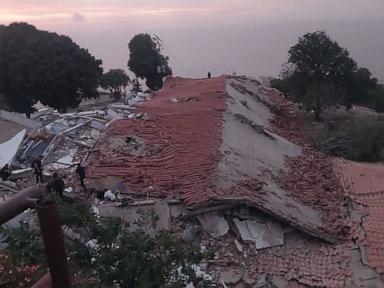
A standard immigration enforcement flight departing from Miami has turned into one of the most harrowing humanitarian crises on the South American coastline. Hours after an Immigration and Customs Enforcement charter landed near Caracas, a pair of historic earthquakes measuring 7.2 and 7.5 magnitude reduced their processing facility, the Hotel Santuario La Llanada, to a pile of pulverized concrete. More than 100 recently deported Venezuelan citizens remain missing beneath the ruins in the hard-hit coastal enclave of La Guaira, exposing severe structural gaps in transnational administrative communication during emergencies.
The timing was precise, automated, and catastrophic. The flight, monitored closely by border tracking groups, taxied down the runway in Florida carrying 146 Venezuelan nationals, a group that included 19 women and seven children. For many on board, this journey marked the abrupt end of multi-year efforts to secure asylum within the United States. They arrived at Simón Bolívar International Airport in the middle of the morning, filing past processing agents before being loaded onto transport buses. Their destination was a seaside hotel designated by local authorities as a temporary holding camp for mandatory health screenings and document issuance. By sunset, that very hotel would become their tomb.
The Midnight Manifest and the Final Descent
Immigration policy operates on a clock that completely ignores external physical realities. When the charter flight touched down at 10:22 a.m., it was treated as a routine bureaucratic victory, the culmination of an enforcement drive that had accelerated significantly over the previous months. Flight logs indicate that the manifestation of passengers had been cleared days in advance through federal detention centers, notably facilities located in El Paso, Texas, and various rural holding nodes throughout the American South.
The passengers had no choice in their immediate destination. Local protocol dictating the repatriation process required all incoming deportees to be held for at least 24 hours at the seaside resort property in La Guaira. This rule was designed to ensure that the state could issue internal identification papers and run medical diagnostics before releasing the individuals to their respective home provinces.
Survivors recall the oppressive heat of the coastal afternoon as they were assigned to communal rooms. The facility, while originally built as an oceanfront escape, had been retrofitted with heavy steel partitions and checkpoints to manage the influx of returnees. This modification fundamentally altered the building's internal weight distribution and exit pathways, a factor that would prove fatal when the tectonic plates beneath the Caribbean Sea shifted.
Seconds of Destruction in La Guaira
The physical reality of a dual earthquake is distinct from a single shock. At approximately mid-evening, the first tremor rippled through the alluvial soil of the coastline, causing the multi-story structure to groan. It was followed almost immediately by a second, more violent rupture that severed the main structural columns supporting the upper floors.
Earthquake Data Analysis - La Guaira Coastal Impact Area
--------------------------------------------------------
Primary Shock:      7.2 Magnitude
Secondary Shock:    7.5 Magnitude
Interval:           Less than 90 seconds
Structural Failure: Total collapse of Hotel Santuario
The building did not merely tilt; it pancaked vertically. Upper balconies sheared away from the main facade, crashing down onto the lower holding areas where the majority of the repatriated families were resting. Survivors described an acute sound, a repetitive mechanical snapping of rebar that preceded the complete failure of the ceiling beams.
A small faction of those inside managed to escape through pure geographical luck within the building. Those located near the external balconies or on the lower ground levels found themselves thrown outward rather than crushed downward. For the rest, the collapse was instantaneous, sealing off air pockets with dense slabs of unreinforced concrete that have stymied manual rescue efforts for days.
The Scramble on the Streets of Macuto
For the handful of deportees who clawed their way out of the wreckage, the immediate aftermath offered no relief. They emerged into a landscape where the municipal infrastructure had completely dissolved. Power lines whipped across the roadways, gas mains ruptured, and the local population was already fleeing upward toward the safety of the mountains to avoid a potential tsunami.
A small contingent of approximately 20 survivors, consisting largely of women who had been housed on the second-floor sea-facing wing, banded together. They were entirely without resources. Their newly issued Venezuelan identification papers were buried under tons of rubble, and their American cellular phones had been confiscated during the initial deportation process or lost in the collapse.
This group walked for miles through the darkness, navigating streets filled with injured civilians and structural debris. Their destination was an outpost of the Venezuelan National Guard, one of the few concrete installations left standing with operational satellite communications. It was from this military checkpoint that the first concrete details regarding the fate of the flight passengers began to filter out to families across the hemisphere.
Silence from the Sending State
The administrative response from the north has been defined by a total absence of clarity. In the hours following the confirmation of the hotel collapse, families of the deportees flooded telephone lines at the El Paso Processing Center and federal administrative offices in Miami. The answers they received highlight the clinical, one-way nature of modern immigration operations.
Once an individual is processed, walked across the tarmac, and placed onto a charter flight that breaks American airspace, their file is effectively marked as closed. The logistical machinery that tracks an immigrant through years of detentions, check-ins, court dates, and ankle-monitoring protocols stops functioning the moment the wheels touch down in a foreign country.
Federal agencies have largely deferred to diplomatic channels, yet those channels are severely compromised by recent geopolitical developments. The lack of a centralized, transparent registry tracking where individual deportees were sent after disembarking has left families in a state of administrative limbo. They are forced to rely on WhatsApp groups, grainy social media videos posted by local search teams, and the whispered testimonies of the few survivors who made it to a functioning telephone.
Geopolitical Realignment and Forced Return
To understand why 146 people were placed on that specific flight, one must examine the broader shifts in regional migration management. Repatriation flights to Caracas had only recently resumed after an extended pause, driven by intense political pressure within the United States to demonstrate decisive enforcement metrics. This political imperative created a pipeline that prioritized the sheer volume of removals over the operational stability of the receiving country.
Chronology of Repatriation Protocols
--------------------------------------------------------
Mid-2010s:    Refugee crisis begins as millions depart Venezuela
Early 2024:   Fourteen-month pause on direct US removal flights
Feb 2025:     Deportation charters resume under strict new quotas
Jan 2026:     Geopolitical shift alters Caribbean security cooperation
June 2026:    Twin earthquakes strike ground zero at La Guaira
The receiving infrastructure in Venezuela was already buckling under the weight of severe economic strain before the earthquakes hit. The state had converted commercial properties, budget hotels, and older colonial structures into temporary processing centers to handle the sudden influx of returning citizens. These buildings were never vetted for structural integrity under high-stress scenarios, nor were they equipped with the emergency supplies necessary to sustain life in the event of a catastrophic system failure.
The policy of mass removal operates on the assumption that the destination state possesses a baseline capability to absorb and protect its citizens. In this instance, that assumption proved completely false. The individuals were returned to a zone that was geologically vulnerable and structurally unprepared, transforming a standard civil immigration penalty into a life-threatening ordeal.
The Human Toll Beneath the Concrete
The physical reality at the site of the Hotel Santuario remains grim. Heavy lifting equipment is scarce along the coastline, as the majority of the region’s construction assets have been diverted to clear the primary highways connecting the port to Caracas. This has left the search for the missing deportees largely in the hands of local volunteers and specialized rescue teams from neighboring Caribbean nations who are working with minimal mechanical support.
Every hour that passes reduces the probability of finding survivors within the compressed cavities of the hotel. The families who remain on site are not just fighting against time; they are fighting against an opaque state bureaucracy that has historically treated returning migrants with suspicion.
The tragedy underscores a systemic flaw in the global migration apparatus. When state entities collaborate to execute high-volume deportations, their cooperation is highly efficient, heavily digitized, and rigidly enforced. Yet, when those same entities are required to track, protect, or account for those individuals in the wake of a humanitarian disaster, the system dissolves into mutual denials of responsibility, leaving the most vulnerable buried beneath the weight of international indifference.