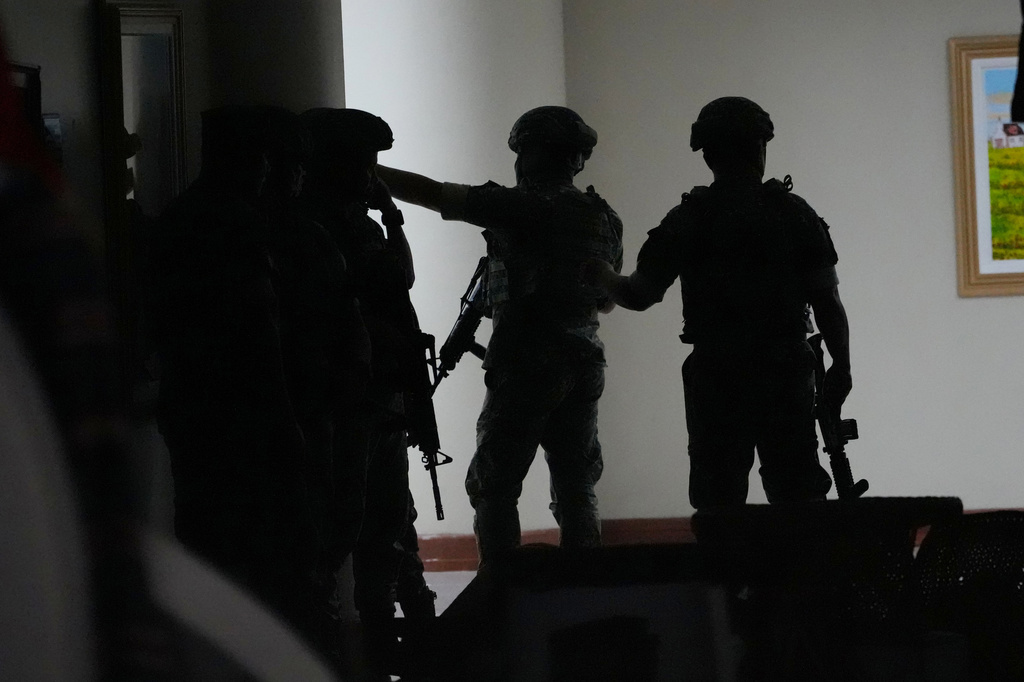
The headlines are screaming about a "breakdown of law and order" in the Philippine Senate. They paint a picture of chaos, a desecration of a sacred democratic institution, and a shocking security lapse that allowed bullets to fly where bills are usually debated.
They are wrong. Every single one of them.
What happened wasn’t a failure of the system. It was the physical manifestation of how power actually functions in Manila. If you’re shocked that a high-stakes arrest warrant ended in a shootout within the halls of government, you haven’t been paying attention to the last fifty years of Southeast Asian geopolitics. You’re looking at a polished floor and expecting a vacuum; I’m looking at the floor and seeing the structural cracks that were always there.
The "lazy consensus" dictates that government buildings are neutral zones of safety. This is a fairy tale we tell investors to keep the BPO industry humming and the REITs growing. In reality, the Philippine Senate isn't just a legislative body. It is a fortress for the elite, a legal sanctuary, and occasionally, a tactical chokepoint.
When the lead started flying, it wasn’t because security was "lax." It was because two competing versions of "the law" finally collided in a space where only one could survive.
The Myth of the Neutral Sanctuary
The media wants to talk about "breach of protocol." Let’s talk about the reality of the Principal-Agent Problem in high-stakes governance.
In a standard Western democracy—or at least the version of it they teach in Ivy League ivory towers—the police are agents of the state. In the Philippines, the lines of loyalty are blurred by decades of patronage. When authorities move to arrest a sitting senator, they aren't just serving a piece of paper. They are attempting to decapitate a political ecosystem.
I’ve sat in boardrooms from Makati to Singapore where we price "political risk." Most analysts use a sliding scale of 1 to 10. They look at GDP growth and inflation targets. They miss the "Lead Factor."
The Lead Factor is the realization that in this region, the law is often a secondary consideration to personal loyalty. The security detail of a senator isn't there to check badges; they are there to protect the Principal. When the Senate Sergeant-at-Arms or the National Police enter that fray, they aren't entering a "government building." They are entering the private domain of a rival power player.
The shootout was the logical conclusion of a system where legal immunity is treated as a physical shield. We shouldn't be asking "how did this happen?" We should be asking why anyone expected it to go any other way.
Immunity is Not a Suggestion
Let’s dismantle the premise of the "People Also Ask" sections regarding parliamentary immunity. Most people think it’s a dusty rule to prevent a King from arresting someone on the way to a vote.
In practice, it’s an asset class.
In the Philippines, a Senate seat is the ultimate insurance policy. It’s better than any hedge fund or offshore account. It provides the Legislative Shield. When the executive branch tries to pierce that shield, the friction is not legal—it is kinetic.
The mistake the mainstream press makes is treating the Senate as a monolithic entity. It isn’t. It is a collection of twenty-four independent kingdoms that share a cafeteria. When authorities tried to cross the threshold of one of those kingdoms, they triggered a defensive response that was entirely predictable.
Imagine a scenario where a CEO tries to fire a board member who owns the building, the security company, and the local police precinct. You don't get a polite exit interview. You get a standoff. That is the Philippine Senate.
The Business of Political Theatre
Investors are panicking, thinking this violence will scare off foreign direct investment. Again, you’re reading the wrong signals.
Smart money doesn't care about a few bullet holes in the Senate walls. Smart money cares about Predictability.
The shootout proves that the current administration is willing to use hard power to enforce its will, even in the "sacred" halls of the legislature. For a certain type of institutional investor, this is actually a buy signal. It shows a consolidation of power. It shows that the "soft" period of political maneuvering is over and the "hard" period of enforcement has begun.
Does it look bad on CNN? Sure. Does it matter to the people moving billions into infrastructure and energy? Not one bit. They’ve seen this movie before. They know that in this market, stability is often enforced at the end of a barrel, not through a subcommittee hearing.
Stop Asking for Reform
Every time this happens, the "experts" come out of the woodwork calling for "security reforms" and "stricter protocols."
This is the equivalent of putting a new lock on a door when the walls are made of paper.
You cannot reform away a culture of Warlordism Lite. The Philippine political structure is built on the foundation of the Datu—the local strongman. The Senate is simply where the biggest Datus go to play. You can change the security guards, you can install more X-ray machines, and you can give the Sergeant-at-Arms a bigger budget. None of it matters.
As long as the political stakes are "winner-take-all" and the losers face jail or worse, the Senate will remain a potential combat zone.
I’ve watched companies spend millions on "Political Risk Assessments" that ignore the cultural reality of the utang na loob—the debt of gratitude. A security guard's loyalty to a senator who paid for his daughter’s tuition will always trump his loyalty to a manual of procedures. That’s not a "flaw" to be fixed; it’s the operating system of the country.
The Cost of the "Clean" Image
The real tragedy here isn't the violence. It’s the lie.
The Philippine government spends an enormous amount of energy trying to look like a standard OECD-style democracy. They want the "seamless" integration into the global economy. They want the "robust" legal frameworks.
But every time they try to play by those rules, the reality of the underlying power structure breaks through. The gunfire in the Senate was the sound of the reality breaking through the PR.
If you want to understand the Philippines, stop reading the Constitution. Start reading the history of the families that run the provinces. Stop listening to the speeches on the Senate floor. Start looking at who is standing in the hallways with a sidearm.
The Strategy for the New Reality
If you are operating in this environment, you have to stop asking the wrong questions.
- Don't ask: "Is it safe?"
Ask: "Who is currently winning the feud?" - Don't ask: "What is the law?"
Ask: "Who is the patron of the person I'm dealing with?" - Don't ask: "Why did the police fail?"
Ask: "Which side were the police on today?"
The shootout wasn't a "dark day for democracy." It was an honest day. It was a day when the masks came off and everyone saw exactly what the Senate is: a high-stakes arena where the rules are written in blood as often as they are in ink.
The competitor’s article will tell you this is a crisis. I’m telling you it’s a clarification.
You now know exactly where the lines are drawn. You know exactly what the stakes are. The "sanctity" of the Senate was a myth that was holding you back from seeing the truth.
Now that the myth is dead, you can finally start making real decisions. Stop waiting for the smoke to clear; start figuring out who held the gun. That’s the only metric that matters.
Take your eyes off the "violation of democratic norms." Focus on the movement of the pieces. The board just changed. Either learn the new rules or get out of the way before the next round starts. Because there will be a next round. And next time, they won't just be aiming for the ceiling.
Buy the dip. Watch your back. Ignore the eulogies for democracy. It was never here to begin with.