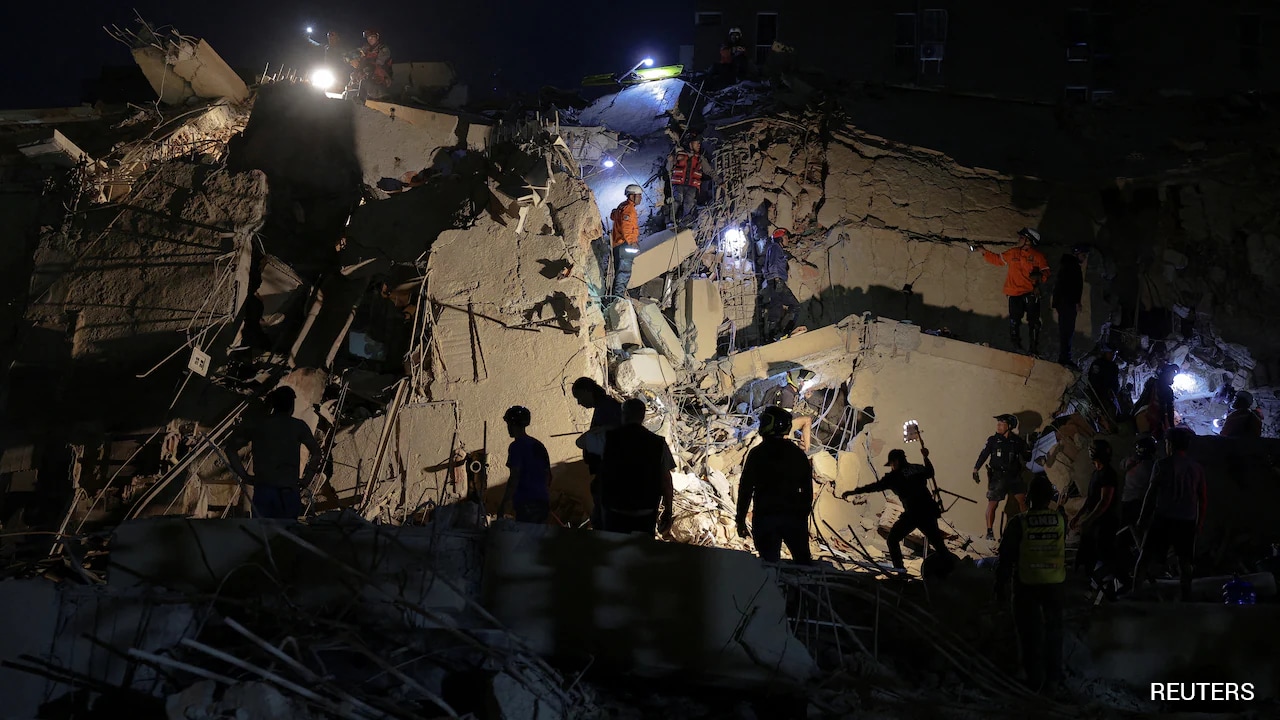
The coffee in Caracas always gives you a warning. It is not a sound, not exactly. It is a tiny, rhythmic shudder in the ceramic cup, a miniature tide rippling across the dark surface of your morning espresso. If you are new to the city, you assume it is the heavy rumble of a passing bus on the Avenida Francisco de Miranda. If you have lived here long enough, your hand instinctively hovers over the table, waiting.
You wait because you know what lies beneath the concrete.
Venezuela is a land defined by a cruel geographic irony. Its surface is a breathtaking display of Caribbean beaches, sweeping savannahs, and the jagged, majestic teeth of the Andes. But underneath this beauty lies a fractured foundation. The country sits directly on top of a geological demolition derby, a place where two colossal pieces of the Earth’s crust are locked in a slow-motion, millennia-long wrestling match.
To understand why this ground refuses to stay still, you have to look past the political headlines and the economic chaos. You have to look at the rocks.
The Tectonic Vice
Imagine two stubborn giants pushing against each other in a crowded room. Neither wants to give way.
In this scenario, the giants are the South American tectonic plate and the Caribbean tectonic plate. Venezuela is trapped right in the middle of their grip. Specifically, the northern edge of the country—where more than eighty percent of its population lives—is a complex zone of faults. The most notorious of these is the Boconó Fault system, a deep scar in the earth that stretches over five hundred kilometers across the Venezuelan Andes all the way to the Caribbean Sea.
But it is not just one clean break. Think of it less like a single crack in a window and more like a shattered windshield held together by a thin layer of plastic. The earth here is a network of fractures: the San Sebastián Fault runs along the coast, and the El Pilar Fault cuts across the east.
Every single day, the Caribbean plate creeps eastward relative to South America. It moves at a agonizingly slow pace—roughly twenty millimeters a year. That is about the speed your fingernails grow. It sounds insignificant. It sounds harmless.
It isn't.
Because the rock faces are jagged and rough, they do not slide past each other smoothly. They catch. They snag. They lock tight. While the deep interiors of the plates keep moving, the edges remain stuck in place. The energy doesn’t vanish; it accumulates. It compresses the rock, bending it like a wooden bow drawn back further and further. Months pass. Decades pass. The tension builds to a screaming pitch inside the dark, silent belly of the earth.
Then, something snaps.
The bow breaks. The trapped energy releases in a fraction of a second, sending shockwaves tearing through the bedrock toward the surface. That is an earthquake. And in Venezuela, those snaps have shaped history.
The Ghost of 1812
Consider what happens when that tension reaches its breaking point.
On March 26, 1812, Caracas was a bustling colonial city, filled with citizens celebrating Holy Thursday. The churches were packed. Incense hung heavy in the air. At roughly four in the afternoon, the ground beneath the worshippers began to roar.
It was not a gentle sway. The earth bucked. The massive stone walls of churches like San Jacinto and La Trinidad, built to withstand the centuries, folded like wet cardboard. Within seconds, the city was reduced to a suffocating cloud of dust and screams. Somewhere between ten thousand and twenty thousand people died in a matter of minutes.
The catastrophe was so profound that it altered the course of South American history. The young republic was fighting for independence from Spain, and the royalist clergy quickly claimed the earthquake was divine punishment for rebelling against the King. The psychological blow shattered the revolution’s momentum, forcing Simón Bolívar to flee the country to regroup.
The earth didn't just destroy buildings; it rewrote the geopolitical landscape.
The vulnerability hasn't changed since Bolívar's time. If anything, the stakes have risen exponentially. The 1967 Caracas earthquake, a magnitude 6.6 tremor, proved that modern concrete is no match for tectonic wrath. It pancaked high-rise apartments in the upscale Altamira neighborhood and claimed hundreds of lives.
The problem is that the geography dictates where people live. The coastal mountain ranges offer cooler air and fertile valleys, drawing millions to settle directly on top of the fault lines. Caracas, Maracay, Valencia, Barquisimeto—these are not just major urban centers; they are cities built inside the impact zone.
The Invisible Vulnerability
Step away from the science for a moment and walk into any barrio clinging to the hillsides of Petare, one of the largest informal settlements in Latin America.
Here, the houses are built of red brick and corrugated iron, stacked precariously on top of each other like a precarious game of Jenga. They climb the steep slopes, connected by narrow staircases and frayed utility lines. The views of the valley are stunning, but the engineering is nonexistent.
This is where the true danger of a Venezuelan earthquake shifts from geology to human vulnerability. It is a concept experts call "seismic risk."
Risk is not just about how big the earthquake is; it is about what the earthquake hits. A magnitude 7.0 earthquake in an empty desert does no damage. The same earthquake hitting a densely populated city with weak infrastructure is an apocalypse.
Venezuela’s economic struggles over the last few decades have created a quiet crisis of preparedness. Building codes exist on paper, but enforcing them requires resources, oversight, and stability. When people are struggling to find daily necessities, retrofitting a concrete home for an event that might happen tomorrow is a luxury few can afford.
Furthermore, the very nature of the soil in certain coastal areas multiplies the danger. In places like Cariaco—which suffered a devastating magnitude 6.9 quake in 1997—the ground is composed of loose, water-saturated sediments. When the shaking starts, a phenomenon called liquefaction occurs. The solid ground suddenly behaves like a liquid, swallowing foundations and causing entire structures to sink or slide down hillsides.
It is a terrifying lottery. You do not know if the ground beneath your feet will hold or turn to soup.
Living on the Edge
There is a unique psychological weight to living in a seismic zone. It creates a subtle, perpetual background hum of anxiety. You learn to read the environment differently.
You notice how the street dogs sometimes start barking in unison for no apparent reason. You memorize the quickest path to the door from every room in your house. You look at the massive, beautiful Avila mountain towering over Caracas not just as a landmark, but as a silent giant that could violently shake its shoulders at any moment.
The scientists at FUNVISIS, the Venezuelan Foundation for Seismological Research, keep a constant watch on the needles and digital readouts. They monitor the micro-tremors that happen every day—tiny release valves that remind everyone the faults are alive. But they cannot predict the big one. No one can. Science can tell us where the strain is building, but it cannot tell us the exact second the rock will finally give way.
So, the people of Venezuela live with the paradox. They build their lives, raise their children, and drink their coffee on a surface that is fundamentally temporary.
The next time you see a picture of Caracas, look past the colorful hillsides and the gleaming towers. Think of the two ancient giants beneath the soil, locked in their eternal, invisible struggle, moving at the speed of a growing fingernail, waiting for the next snap.