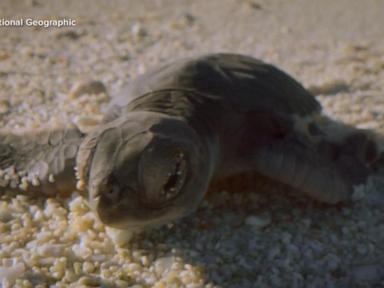
Every year, thousands of tiny green sea turtles burst from the sand in a synchronized scramble for the ocean, generating viral videos and viral sympathy across social platforms. The footage is undeniably captivating. Yet, behind the brief charm of a newly hatched green sea turtle crawling across a moonlit beach lies a high-stakes survival gauntlet that most casual observers completely miss.
Only one in a thousand hatchlings makes it to adulthood. The internet watches the sprint, claps for the survivors, and turns off the screen. Meanwhile, the marine biology community watches an endangered species fight against industrial coastal development, warming sands, and predatory saturation. For another perspective, check out: this related article.
The Physics of the Sand Sprint
When green sea turtles hatch, they do not simply wake up and start moving. They engage in a collective physical negotiation beneath the surface. Temperature dictates everything. Warmer nests speed up development, while cooler nests slow it down.
For decades, researchers tracked incubation periods to predict emergence windows. Now, extreme heat waves shift those timelines into dangerous territory. When sand temperatures exceed critical thresholds during incubation, mortality rates skyrocket long before a single flipper hits the surf. Similar analysis on the subject has been shared by The New York Times.
Once the collective movement begins, the hatchlings push upward together. This cooperative digging requires dozens of turtles thrashing simultaneously to shift the heavy sand grains upward.
- Sand collapse: Individual turtles would suffocate trapped in the grains.
- Thermal regulation: Group movement helps vent excess heat from the lower chamber.
- Synchronized exhaustion: The mass exit overwhelms visual predators waiting at the surface.
If you pull away the charm of the viral video, you see an evolutionary mechanical process tuned over millions of years. It is fragile. Urban light pollution scrambles their navigational compasses instantly. Instead of heading toward the low horizon reflection of the open ocean over white-capped waves, modern hatchlings routinely crawl inland toward parking lots, highway lights, and swimming pool patios, where dehydration or vehicular strikes claim them by morning.
The Invisible Battleground of the Open Ocean
Reaching the water is merely the first major hurdle. The surf zone introduces a fresh set of executioners. Ghost crabs, shorebirds, and predatory fish form a welcoming committee that decimates the initial cohort within the first sixty minutes.
Those that break past the shorebreak enter what scientists call the lost years. For a long time, marine science had virtually no tracking data on where juvenile green sea turtles went after leaving coastal waters.
Tiny acoustic tags and satellite telemetry changed our understanding of this phase, though gaps remain. Neonates ride pelagic sargassum mats, using ocean currents to drift thousands of miles into open-ocean gyres.
"People assume the ocean is a sanctuary once they leave the sand. In reality, the pelagic zone is an open-air supermarket for pelagic predators like tuna, mahi-mahi, and seabirds."
The survival math here is unforgiving. Starvation, microplastic ingestion, and entanglement in discarded fishing gear—known widely as ghost nets—systematically reduce the population before the juveniles ever return to coastal foraging grounds.
The Demographic Shift Beneath the Waves
Temperature-dependent sex determination creates a ticking clock for green sea turtle populations worldwide. Unlike mammals, where sex is determined by chromosomes at conception, sea turtle embryos derive their biological sex from the temperature of the surrounding sand during the middle third of incubation.
Cooler temperatures produce males. Warmer temperatures produce females.
Global temperature increases skew nest ratios dramatically. On major nesting beaches across the globe, recent studies show female-to-male ratios exceeding ninety-nine to one in several key rookeries.
- Population tipping points: A female-heavy demographic works temporarily, but an absence of males collapses reproduction rates entirely within a generation.
- Management intervention: Conservation groups now shade specific nesting sectors with artificial canopies or water the sand to artificially lower incubation temperatures.
- Geographic migration: Populations are attempting to shift nesting ranges toward higher latitudes, running headfirst into heavily developed private beachfronts.
These interventions cost millions of dollars and require round-the-clock volunteer monitoring. They are stopgap measures, not permanent fixes. Shading a nesting beach does not cool the planet. It merely buys time for a species cornered by shifting climatic baselines.
What Real Conservation Actually Demands
Watching a video of baby green sea turtles triggers an immediate dopamine response. It makes people feel connected to nature from the comfort of an air-conditioned room. But passive admiration does not translate into systemic protection.
Protecting green sea turtles requires aggressive, unglamorous policy work. It means banning beachfront lighting ordinances during peak hatching seasons, heavily fining coastal developers who ignore setbacks, and phasing out single-use plastics that choke marine ecosystems.
When you encounter nesting beaches, keeping a respectful distance is not just a polite suggestion. Flash photography blinds disoriented hatchlings, and human footsteps compact the sand, suffocating unhatched nests buried below.
The hatchlings will keep running toward the sea every season, driven by ancient programming. Whether they find an ocean capable of sustaining them depends entirely on whether human societies move past viral fascination and commit to structural protection long after the cameras are turned off.