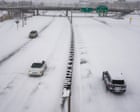
The local news cycle has a favorite ghost story: the "Triple-Threat Megastorm." It sounds cinematic. It sounds terrifying. It sounds like something that requires a trip to the grocery store to fight over the last gallon of milk. But if you look past the neon-red radar overlays and the breathless adjectives, you aren’t looking at a meteorological anomaly. You are looking at a marketing campaign designed to monetize atmospheric variance.
Weather coverage has devolved into disaster theater. By branding every standard cold front as a "bomb cyclone" or a "triple-threat," the industry has successfully decoupled "severity" from "actual impact." We are being conditioned to fear the transition of seasons as if it were an existential crisis.
The reality is far more boring, yet far more significant. The "megastorm" isn't a threat to your life; it’s a distraction from the fact that our predictive precision hasn't actually improved as much as the graphics packages suggest.
The Semantic Inflation of the Atmosphere
Meteorology has a vocabulary problem. We’ve entered an era of linguistic "power creep" where a standard low-pressure system is no longer allowed to just be a storm. It has to be a "megastorm." It has to have "triple-threat" status.
Why? Because "rain followed by breezy conditions" doesn't generate clicks.
When a competitor screams about snow, high winds, and thunder "scattering across the US," they are describing a common mid-latitude cyclone. This isn't a freak occurrence. It’s how the Earth balances its heat budget. Warm air moves north, cold air moves south, and they spin. To call this a "triple threat" is like calling a sandwich a "triple-threat culinary event" because it contains bread, meat, and cheese.
I’ve spent years analyzing how data is fed to the public. I’ve seen newsrooms take a GFS (Global Forecast System) model run that shows a 10% chance of a blizzard and turn it into a 100% chance of "Snowpocalypse." This isn't just harmless hype. It creates "warning fatigue." When a truly historic, once-in-a-century event actually occurs, the public is already deaf to the sirens because we’ve spent the last three months screaming about every dusting of snow in the Midwest.
The Model Fetish and the Fallacy of Certainty
The "lazy consensus" in modern weather reporting is that more data equals better outcomes. We have more satellites, more ground stations, and more computing power than ever before. Yet, the margin of error for a five-day forecast remains stubbornly high when it comes to localized impacts.
Media outlets love to show "spaghetti plots"—those colorful lines representing different model paths. They present these as evidence of scientific rigor. In reality, they are showing you the profound uncertainty of the system.
The industry hides behind the "ensemble" approach. If one model (the European ECMWF) says the storm goes out to sea, and another (the American GFS) says it hits New York, the media chooses the one that creates the most fear. They aren't predicting the weather; they are selecting the most profitable narrative.
Consider the physics of a "triple-threat" storm. The energy is derived from baroclinic instability—the temperature gradient between air masses.
$$E_{avail} \propto \int \frac{\partial T}{\partial y} dA$$
When these journalists talk about "megastorms," they ignore the fact that the very intensity they are rooting for often leads to the storm’s rapid demise. Intense storms "choke" themselves out by mixing the atmosphere too quickly, neutralizing the temperature gradients that fuel them. The "threat" is often its own thermal brake.
The Infrastructure Lie
We are told to prepare for these storms by "stocking up" and "staying off the roads." This is a classic shift of responsibility. It moves the burden of weather impact from the state and the utility providers to the individual.
If a "megastorm" knocks out power for 500,000 people, the media blames the wind. I blame the grid. We live in a country where the energy infrastructure is treated as a static relic rather than a dynamic system. We prioritize "storm updates" over "grid hardening."
Stop asking if it’s going to snow 6 inches or 12. Start asking why your local utility hasn't buried the lines or upgraded the transformers in thirty years. The "weather" is rarely the catastrophe; the catastrophe is the fragile state of the systems we rely on. We’ve spent billions on "predicting" the wind, but pennies on making sure the wind doesn't turn the lights off.
Stop Checking Your Weather App Every Hour
The modern weather consumer has become an amateur data-junkie, refreshing apps that use automated algorithms to spit out "hourly forecasts" that are statistically meaningless. If an app tells you there is a 42% chance of rain at 3:00 PM, it is lying to you.
These percentages are often a product of the "Probability of Precipitation" (PoP) formula:
$$PoP = C \times A$$
Where $C$ is the confidence that precipitation will occur somewhere in the area, and $A$ is the percentage of the area that will receive it. A 40% chance could mean the model is 100% sure it will rain on 40% of the city, or it could mean it’s 40% sure it will rain on the whole city.
The app doesn't tell you which one it is. It just gives you a number that feels scientific. You are making life decisions based on a calculation that the app designers know you don't understand.
The Contrarian Guide to Atmospheric Events
If you want to actually survive the "Triple-Threat Megastorm" era without losing your mind, you need to change your filter.
- Ignore the Adjectives: If the article uses words like "monstrous," "historic," "crippling," or "megastorm" before the event has even started, close the tab. These are emotional hooks, not meteorological terms.
- Watch the Pressure, Not the Snow: A storm's strength is better measured by its central pressure (in millibars) than by how many inches of snow it might drop. A rapid drop in pressure (cyclogenesis) tells you more about the storm’s energy than a frantic reporter standing in a parking lot.
- The Three-Day Rule: Anything predicted more than 72 hours out is a guess. Atmospheric chaos theory dictates that small errors in initial conditions lead to massive deviations. If they are calling for a "megastorm" next Tuesday, they are essentially reading tea leaves with a supercomputer.
- Follow the NWS, Not the "Personalities": The National Weather Service (NWS) is boring. That is its greatest strength. They don't have advertisers. They don't need your clicks. Their "Area Forecast Discussions" are written by actual meteorologists for other meteorologists. They use technical language that admits uncertainty. That is where the truth lives.
The "Triple-Threat" isn't the snow, the wind, or the thunder. The real triple-threat is a sensationalist media, a crumbling infrastructure, and a public that has forgotten how to distinguish a seasonal shift from an apocalypse.
Weather is a chaotic, non-linear system. It cannot be tamed by a catchy headline or a 3D-rendered map. The more they try to sell you "certainty" in a "megastorm," the more you should hold onto your wallet.
Stop preparing for the end of the world every time a cold front moves in from Canada. Buy a better coat, demand a more resilient power grid, and turn off the news. The sky isn't falling; it’s just doing its job.