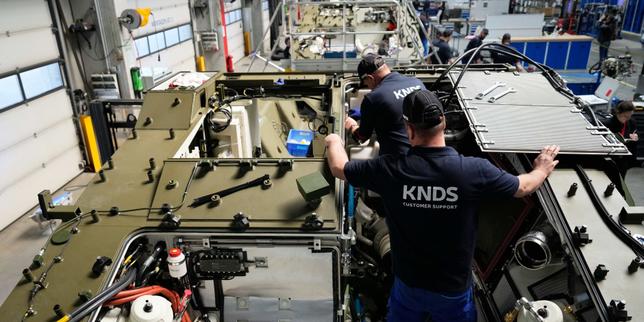
The French state expects a massive windfall from the upcoming stock market debut of KNDS, the state-backed tank manufacturer born from the 2015 marriage of France Nexter and Germany Krauss-Maffei Wegmann. Paris wants to cash in on a historic defense boom by reducing its 50% stake to around 40% through a dual listing in Paris and Frankfurt, valuing the group at up to 20 billion euros. But treating this initial public offering as a simple budgetary relief mechanism ignores a more volatile reality. The listing is not just an exit strategy for cash-strapped treasuries; it is an industrial battlefield where Berlin is aggressively moving to seize structural control of Europe land defense infrastructure while French negotiators risk trading long-term strategic autonomy for short-term fiscal comfort.
The financial narrative pushed by state planners looks attractive on paper. KNDS enters the market carrying a staggering 23.5 billion euro order book, riding an unprecedented defense supercycle. The war in Ukraine exposed an acute, generational deficit in heavy armor and artillery across the continent. Yet beneath the corporate optimism lies a deeply dysfunctional corporate structure that has spent a decade fighting internal national turf wars rather than building true industrial integration.
The Valuation Friction and the Shadow of Rheinmetall
Investment bankers are pitching a 20 billion euro valuation based on a multiple of roughly five times the company 2024 revenue of 3.8 billion euros. It is an aggressive target. Berlin-based defense giant Rheinmetall currently commands a valuation near 70-billion euros, but that premium is built on rapid, unilateral execution and aggressive capacity expansion. KNDS is a different beast entirely. It remains a binational holding company split right down the middle, headquartered in Amsterdam for tax neutrality, and governed by an intricate network of political vetoes.
Institutional investors are already expressing skepticism about whether a company shackled by two competing ministries of defense can match the agility of its fully private peers. Consider the production philosophies. KNDS France, the legacy Nexter, has historically operated as an architecture and systems integrator, heavily reliant on an external network of specialized subcontractors. KNDS Deutschland, the legacy Krauss-Maffei Wegmann, prefers deep vertical integration, manufacturing almost every critical component inside its own secure facilities.
These operational mismatches cannot be scrubbed from the prospectus. For ten years, the group has essentially functioned as two separate corporate entities flying under a single marketing banner. When Italy Leonardo sought a partnership to acquire Leopard 2A8 tanks, the negotiations collapsed because the French and German arms of KNDS could not agree on industrial workshare and technical configurations. A public listing does not magically resolve these systemic frictions; it merely exposes them to quarterly public scrutiny.
Berlin Power Play for the Blocking Minority
The true flashpoint of this market debut is not happening in Paris trading rooms, but within the German ruling coalition. Berlin is actively debating the acquisition of a 40% direct stake in KNDS during the offering to achieve absolute parity with the French state. Currently, the German half of the company is held entirely by the Wegmann Group, a private family dynasty. As those private shareholders look to cash out a portion of their holdings, the German federal government recognizes a rare window to institutionalize its influence over European land systems.
"Germany wants a direct seat at the table to protect its national security interests and guarantee that its own industrial standards dictate the future of continental defense," notes a veteran analyst familiar with the trilateral negotiations.
This is an aggressive recalibration of power. If Berlin secures a 40% stake while the Wegmann family retains a residual slice, German influence over the group will outweigh French state ownership. Paris appears content to dilute its holdings to extract immediate cash to balance a strained national budget. Berlin, conversely, views the transaction through the cold lens of multi-decade industrial dominance.
The Toxic Legacy of the Future Tank
Nothing illustrates the danger of this imbalanced partnership clearly than the Main Ground Combat System, the highly publicized project designed to replace the French Leclerc and German Leopard 2 tanks by 2040. The programmatic architecture reveals how fragile the Franco-German defense alliance remains. To get the project off the ground, the states had to mandate a joint venture involving KNDS France, KNDS Deutschland, Thales, and Rheinmetall, each holding an identical 25% share.
[MGCS PROJECT COMPANY SHAREHOLDING]
├── Germany: 50% Workshare
│   ├── KNDS Deutschland (25%)
│   └── Rheinmetall Landsysteme (25%)
└── France: 50% Workshare
    ├── KNDS France (25%)
    └── Thales (25%)
The setup is a recipe for stagnation. Rheinmetall, an independent corporate predator, has little interest in playing nice with a state-backed French entity. It has spent years developing its own proprietary main battle tank, the Panther KF51, which directly competes with the very platforms KNDS is trying to sell. By allowing Germany to consolidate its domestic position via the KNDS listing, France is effectively permitting its primary industrial competitor to hold the keys to its future armored capabilities.
The technical requirements for this future platform are dizzying. It calls for hybrid 1,400-kilowatt propulsion systems, automated AI-assisted fire control networks, and a strike range of 8,000 meters. Delivering on these complex promises requires a highly coordinated, single-minded corporate entity. Instead, the post-offering corporate governance will feature an activist German state, a retreating French treasury, a private German family trust, and public equity markets demanding short-term profitability.
The Vulnerability of the French Artillery Engine
The immediate casualty of an uneven corporate realignment could be the jewels of France domestic manufacturing. The Caesar self-propelled howitzer, produced in Roanne, has become an international icon of highly mobile artillery. Production rates have scaled up significantly to meet export demand and domestic replacement cycles. Yet the long-term survival of this sovereign assembly line depends entirely on capital allocation choices made at the holding level in Amsterdam.
When public markets take ownership, capital flows toward the highest margins. Right now, the massive backlog for German Leopard 2 upgrades and heavy armored engineering vehicles offers a different scale of profitability compared to wheeled artillery systems. A restructured board, dominated by German state capital and public fund managers, will inevitably face pressure to prioritize heavy tracked platforms over French-designed wheeled systems.
Sovereignty cannot be maintained on a fractional basis. The French state gamble assumes that maintaining a 40% share and an assortment of golden shares will provide enough defensive leverage to protect local jobs and design authorities. History suggests otherwise. When dual-national defense champions face restructuring, the partner with the deepest pockets and the clearest strategic intent dictates where the intellectual property stays and where the factories close. Berlin has a clear plan for its land defense sector. Paris has a budget deficit.