The modern defense establishment is suffering from a collective hallucination. For the last few years, naval planners and defense commentators have swallowed a seductive piece of fiction: that the era of massive, expensive crewed warships is dead, and an army of cheap, autonomous drone boats is about to replace them. They call it a sea change. They call it a revolution in military affairs.
They are wrong.
The comforting narrative suggests that small, smart, and cheap swarms can easily blind and sink a multi-billion-dollar aircraft carrier or destroyer. This thesis relies on a fundamentally flawed reading of recent black swan events, specifically the success of Ukrainian uncrewed surface vessels (USVs) in the Black Sea. To look at a highly localized, land-locked conflict involving a nation without a functional navy and conclude that the global rules of deep-ocean blue-water naval warfare have changed forever is peak intellectual laziness.
We are over-indexing on cheap tech because it looks good in a slide deck and fits neatly into a tight budget cycle. The reality of naval warfare is stubborn. Physics, logistics, and the brutal reality of salt-water environments do not care about Silicon Valley hype.
The Myth of the Cheap Swarm
The core argument for the "uncrewed revolution" rests on an asymmetrical math problem. Why spend $2 billion on a destroyer when twenty $1 million drones can overwhelm its air defense systems?
This logic falls apart the moment you move out of narrow coastal littorals and into the open ocean.
I have watched defense contractors pitch these autonomous platforms for a decade. They show animations of pristine drone fleets operating flawlessly in calm, glassy waters. They rarely show what happens to a 30-foot autonomous vessel trying to maintain a sustained data link while taking twelve-foot waves in the middle of the Pacific Ocean.
Operating in a blue-water environment requires three things that cheap drones cannot provide: endurance, range, and sea-keeping capability.
The Law of Scale in Ship Design
To survive the open ocean for months at a time, a vessel needs mass. It needs internal redundancy. It needs heavy diesel engines or gas turbines that can run for thousands of hours without a human engineer replacing a blown gasket or clearing a clogged fuel line.
If you scale up a drone to survive those conditions, it is no longer small, and it is no longer cheap. It becomes a massive, complex piece of machinery. By the time you add the necessary propulsion, fuel capacity, hull strengthening, and defensive systems to ensure it does not get sunk by a routine storm, you have built a ship. And when that ship costs $150 million instead of $1 million, the math of the "expendable swarm" evaporates.
The Maintenance Nightmare
Let's address the elephant in the engine room. Ships break. Constantly.
Ask any retired naval engineer about the daily reality of keeping a surface combatant operational. It is an endless cycle of preventative maintenance, manual valve adjustments, and fixing saltwater corrosion.
[Traditional Warship] ---> 300+ Crew Members ---> Real-time Repairs ---> Operational
[Autonomous Vessel]  ---> 0 Crew Members    ---> Single Component Failure ---> Mission Failure
When an automated auxiliary pump fails on an uncrewed vessel 800 miles from the nearest port, there is no sailor to swap the filter or patch the pipe. The vessel sits dead in the water. It becomes a drifting piece of high-tech junk waiting to be captured or sunk by a low-cost adversary. The current push for autonomy ignores the fact that human crews are not just operators; they are the primary repair and survival mechanism of the ship.
The Electronic Warfare Trap
The second massive blind spot in the drone-worshipping consensus is the assumption of a persistent, unjumbled data link.
Autonomous vessels are not truly autonomous; they are remotely managed or rely heavily on external data streams for targeting, navigation, and command validation. They require satellite connectivity, localized line-of-sight communications, and robust GPS or celestial tracking systems.
In a peer-to-peer conflict against a sophisticated adversary, the electromagnetic spectrum will be completely denied.
The Illusion of Autonomous Logic
Proponents argue that artificial intelligence will allow these ships to operate independently even when communications are cut. They claim algorithms will identify targets and make tactical decisions according to pre-programmed rules of engagement.
This is dangerously naive. Consider the following thought experiment:
Imagine an uncrewed surface vehicle operating under strict emissions control in a contested strait. Its communications are jammed. Its optical sensors detect a large hull moving through the fog. The onboard algorithm matches the radar cross-section to an enemy amphibious assault ship. It fires its anti-ship missiles.
Upon impact, the target is revealed to be a stranded commercial oil tanker or a neutral nation's hospital ship that altered its routing. The political fallout completely derails the strategic objective of the campaign.
The legal, ethical, and strategic risks of fully autonomous lethal force in a fluid, ambiguous naval environment are untenable. Without a human in the loop to interpret nuance, assess intent, and absorb the moral responsibility of a strike, these platforms are strategic liabilities. If you keep the human in the loop, you need a high-bandwidth, unjammable communications link that does not exist in a real war zone.
The Reality of Power Projection
We hear constantly that the carrier strike group is a relic of the twentieth century. Critics point to long-range anti-ship ballistic missiles like China's DF-21D and argue that big ships are just floating targets.
This view completely misunderstands the nature of deterrence and power projection.
A navy is not just an instrument for sinking other ships during a total war. It is a tool of statecraft, diplomacy, and persistent presence. An uncrewed drone boat cannot conduct a freedom of navigation operation with the same geopolitical weight as a guided-missile cruiser. A drone boat cannot pull into a partner nation's port to reassure an ally. It cannot project the visible, undeniable willpower of a nation.
Furthermore, big ships possess something smaller platforms can never replicate: magazine depth and power generation.
The Physics of Directed Energy
The future of naval defense relies on directed energy weapons—lasers and high-power microwaves designed to burn incoming missiles and drone swarms out of the sky. These systems require immense amounts of electrical power and massive cooling systems.
- Small Autonomous Platforms: Cannot generate the megawatts of power required to run a defensive laser array.
- Large Surface Combatants: Possess the nuclear reactors or massive gas turbines necessary to feed these power-hungry systems indefinitely.
By abandoning large hulls in favor of small, distributed platforms, we are trading away the very architecture required to field the next generation of defensive technology. We are building a fleet that is fundamentally incapable of defending itself against the weapons of tomorrow.
The Wrong Lesson from the Black Sea
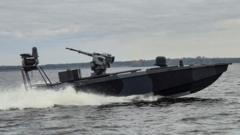
The current obsession with small drone boats stems almost entirely from the conflict in Ukraine. The Ukrainian navy, using explosive jet-ski-sized USVs, successfully forced the Russian Black Sea Fleet to retreat from Sevastopol.
This was a brilliant, resourceful campaign. But it is a terrible blueprint for a global navy.
The Black Sea is a small, confined bathtub. The operations were launched from nearby coastlines against a static, poorly led, and technologically deficient adversary that lacked basic airborne early warning capabilities.
Try running those same jet-ski drones across 3,000 miles of the Pacific Ocean to contest the South China Sea. They will run out of fuel before they clear the second island chain. If they are carried there by a larger mother ship, that mother ship becomes the single point of failure—a massive, vulnerable target that the enemy will prioritize and destroy on day one.
The Balanced Fleet Fallacy
When pressed on these realities, defense bureaucrats usually retreat to a middle ground: "We aren't replacing the old fleet; we are building a hybrid fleet of both crewed and uncrewed vessels."
It sounds sensible. It is a classic bureaucratic compromise designed to please everyone and offend no one.
But in a world of capped defense budgets, it is a recipe for disaster. Every dollar spent chasing the uncrewed mirage is a dollar taken away from building the hulls we actually need. We are underfunding our submarine production, neglecting our overstretched shipyards, and letting our core surface combatant fleet shrink to dangerously low levels while we pour hundreds of millions into experimental ghost ships that will never survive a high-intensity conflict.
We must stop treating Silicon Valley buzzwords as a substitute for naval strategy. Mass matters. Armor matters. Human ingenuity and repair capability on the spot matter. The navy that wins the next major maritime war will not be the one with the flashiest algorithms or the most autonomous drone swarms. It will be the one with the most resilient, heavily armed, crewed warships capable of taking a hit, fixing the damage on the fly, and staying in the fight.
Stop building toys for an imaginary war. Build the fleet we need for the real one.