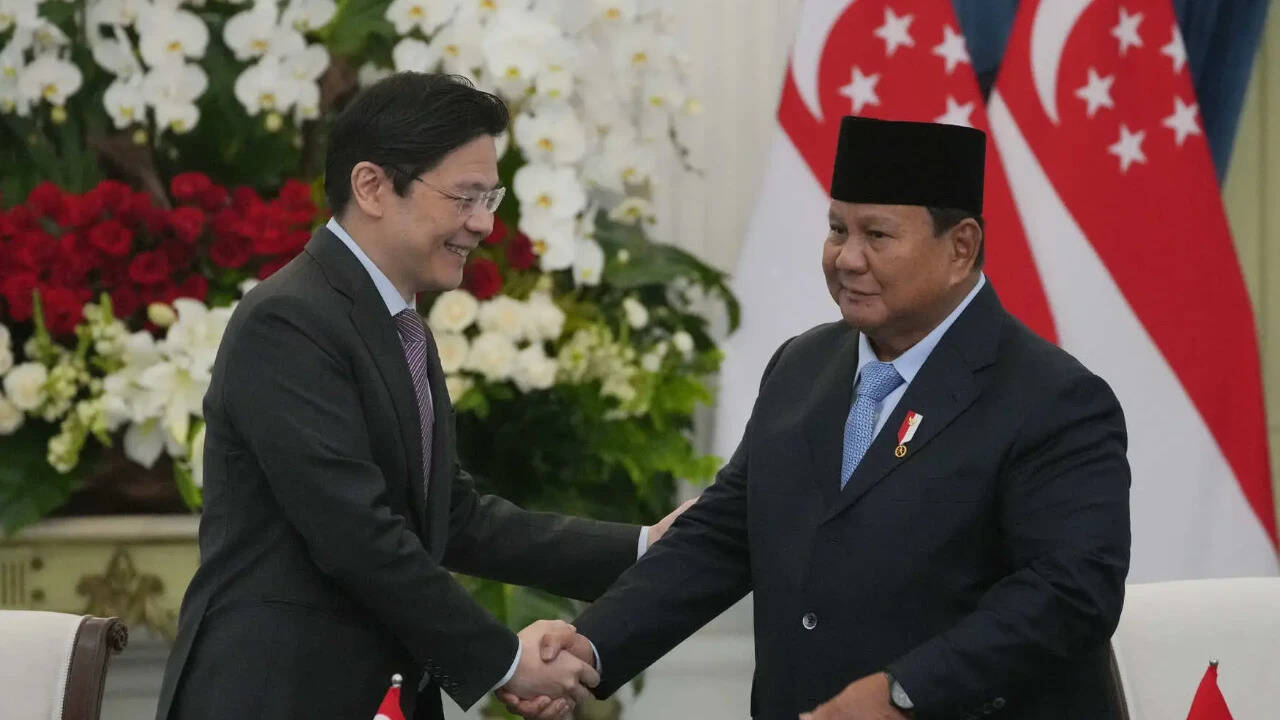
Diplomatic photo-ops are the junk food of geopolitics. They taste comforting in the moment, but they offer zero actual sustenance.
The recent high-profile declarations from Singapore and Indonesia pledging to keep the Strait of Malacca "open and free" are a masterclass in this brand of performative statecraft. Bureaucrats shake hands, sign memorandums of understanding, and issue press releases celebrating their strategic alignment. The international community breathes a sigh of relief, convinced that one of the primary arteries of global trade is safe because two neighboring nations smiled for the cameras.
It is a comforting narrative. It is also entirely detached from the hard realities of maritime geography, naval economics, and national self-interest.
The uncomfortable truth is that the "open and free" consensus is a fragile myth. Singapore and Indonesia are not naturally aligned partners in perpetuity; they are historical competitors with fundamentally divergent views on maritime sovereignty, economic priorities, and security architecture. Behind the veneer of bilateral cooperation lies a messy, transactional relationship that will crumble the moment a true geopolitical crisis hits the region.
If you are managing a global supply chain or allocating capital based on the assumption that these diplomatic pledges guarantee smooth sailing through the world's busiest choke point, you are asking the wrong questions. The real threat to the Strait of Malacca isn't pirate skiffs or a lack of bilateral meetings. The threat is that the structural foundations supporting this vital waterway are actively fracturing.
The Divergent DNA of Maritime States
To understand why these joint pledges are fundamentally hollow, you have to look past the rhetoric and examine the structural DNA of the two nations involved.
Singapore is a classic micro-state whose entire existence depends on the absolute, uncompromised freedom of navigation. It produces nothing of its own raw materials; it survives by being the ultimate middleman, a hyper-efficient transshipment hub that thrives when global trade flows without friction. For Singapore, an "open and free" strait is an existential necessity.
Indonesia is a massive, sprawling archipelagic nation of over 17,000 islands. Its historical and political worldview is shaped by the concept of Wawasan Nusantara—the archipelagic outlook—which views the waters connecting its islands not as international highways, but as internal territory to be controlled, secured, and protected. Indonesia’s primary maritime goal is not the maximization of global corporate profits; it is the assertion of domestic sovereignty and the enforcement of its own cabotage laws.
+-------------------------------------------------------------+
|               THE STRUCTURAL MARITIME DIVIDE                |
+-------------------------------------------------------------+
| SINGAPORE:                                                  |
| - Total reliance on global transshipment                    |
| - Prioritizes absolute freedom of navigation                |
| - Views maritime security through an international lens     |
+-------------------------------------------------------------+
| INDONESIA:                                                  |
| - Focus on domestic connectivity and resource control       |
| - Prioritizes territorial sovereignty and archipelagic law  |
| - Views maritime security through a national lens           |
+-------------------------------------------------------------+
This fundamental divergence manifests in real-world friction that a simple handshake cannot erase. For decades, the two countries have locked horns over control of the Flight Information Region (FIR) over Indonesia's Riau Islands, military training areas, and Singapore's reclamation of land using Indonesian sand. While recent agreements have attempted to smooth over these issues, the underlying tension remains: Singapore wants the region to be an open global common, while Jakarta wants to ensure that its sovereign rights are respected by its wealthier neighbor.
When push comes to shove, Indonesia will always prioritize its domestic stability and regional dominance over the corporate supply chain timelines of Western or East Asian multinationals. Assuming otherwise is blind optimism.
The Choke Point Math Joint Patrols Cant Fix
The conventional wisdom, parroted by regional defense analysts, is that initiatives like the Malacca Straits Patrols (MSP)—comprising Singapore, Indonesia, Malaysia, and Thailand—are sufficient to maintain order. This view mistakes tactical policing for strategic deterrence.
Coordinating radar data to chase down petty thieves and opportunistic sea robbers in the Singapore Strait is useful, but it does not prepare the region for a major systemic shock. The Strait of Malacca handles over 90,000 vessels a year, carrying roughly a quarter of the world's traded goods and a massive portion of the energy supplies heading to China, Japan, and South Korea.
Imagine a scenario where geopolitical tensions in the South China Sea boil over into a kinetic conflict. A superpower seeking to apply leverage decides to execute a distant blockade, or a series of asymmetric maritime strikes occur within the strait itself.
In that scenario, the Malacca Straits Patrols become instantly irrelevant. The navies of Singapore and Indonesia do not possess the kinetic capability, the unified command structure, or the shared political will to defy a major global power bent on disrupting shipping.
- Singapore would likely lean heavily on its security partnerships with Western nations to keep the lanes open at all costs.
- Indonesia would almost certainly adopt a stance of strict neutrality, prioritizing the protection of its own archipelagic sea lanes (ASLs) and avoiding any actions that could draw it into a superpower conflict.
The idea that a bilateral pledge between these two countries guarantees an open strait during a global crisis is a dangerous illusion. They can police the peace, but they cannot enforce it against a great power.
The Flawed Premise of the Peoples Questions
If you look at the standard queries corporate boards and logistics firms ask about this region, the flaws in the current consensus become even more glaring. The common questions focus almost exclusively on superficial metrics:
"Are pirate attacks increasing in the Malacca Strait?"
"How are Singapore and Indonesia improving their joint naval exercises?"
These questions miss the entire point. They focus on micro-level disruptions while ignoring the macro-level shifts that are altering the entire landscape of maritime logistics.
The question isn't whether Indonesia and Singapore can catch pirates. The question is whether the economic model of the Malacca Strait itself is sustainable over the next two decades.
By focusing on the maritime security pledges of the littoral states, businesses miss the real danger: the accelerating efforts by outside powers to bypass the Malacca Strait entirely.
China's heavy investments in the China-Pakistan Economic Corridor (CPEC) and the China-Myanmar Economic Corridor (CMED) are not just infrastructure projects; they are explicit, strategic attempts to mitigate the "Malacca Dilemma." Land-based pipelines and rail networks designed to pump oil and move goods directly from the Indian Ocean into southwestern China are being built precisely because Beijing knows that a diplomatic pledge between Singapore and Indonesia won't keep the strait open during a war.
Furthermore, Thailand’s persistent pursuit of a land bridge across the Kra Isthmus—a multi-billion-dollar project involving rail and pipeline links connecting ports on the Andaman Sea and the Gulf of Thailand—poses a direct structural threat to the Malacca-Singapore shipping route. While analysts frequently dismiss the Kra Land Bridge as economically unviable, they underestimate the political will of nations desperate to escape the vulnerability of a single, easily blockaded maritime bottleneck.
                  [ The Kra Isthmus Alternative ]
                        /               \
                       /                 \
        [ Andaman Sea Port ] -------- [ Gulf of Thailand Port ]
                                 ^
                          (Rail / Pipeline)
                                 ^
                     Bypasses Malacca Entirely
The High Cost of the Bureaucratic Consensus
I have spent years analyzing regional supply chains and watching multinational corporations map out their logistics networks. The companies that suffer the most are always the ones that take government declarations at face value. They build just-in-time inventory models that assume the Malacca Strait will always function with the predictable regularity of a Swiss train station.
This reliance on the bureaucratic consensus breeds complacency. It causes firms to under-invest in true redundancy. They assume that because Singapore and Indonesia signed a treaty, their cargo is safe.
But what happens when Indonesia decides to enforce stricter environmental regulations on transshipping vessels within its territorial waters, slowing down traffic to a crawl to extract higher administrative fees? What happens when a localized political crisis in Jakarta leads to a temporary closure of specific archipelagic sea lanes to foreign warships, forcing commercial traffic to reroute around Sumatra via the Sunda or Lombok straits?
These are not far-fetched scenarios. They are well within the playbook of an archipelagic nation asserting its sovereign rights. The downside of our contrarian view is obvious: acknowledging the fragility of the Malacca Strait requires admitting that global supply chains are fundamentally exposed, which demands immediate, expensive investments in diversification. It means accepting that your shipping costs will go up as you map out alternative routes that add days or weeks to your transit times.
But the alternative is far worse. Relying on a diplomatic press release to secure billions of dollars in floating inventory is not a strategy; it is a gamble.
Stop Watching the Handshakes
It is time to change how we evaluate maritime risk in Southeast Asia. Stop tracking the number of joint naval patrols or the signing of bilateral maritime frameworks. These are lagging indicators of diplomatic goodwill, not leading indicators of regional stability.
Instead, look at where the hard capital is flowing.
Monitor the construction of deep-water ports in western Myanmar. Track the volume of crude oil moving through pipelines that terminate in Yunnan province. Watch the political maneuvering around Thailand's infrastructure spending. Look closely at Indonesia's domestic defense procurement—are they buying patrol boats to secure trade lanes, or anti-ship missiles to deny access to their internal waters?
The answers to these questions will tell you the real future of the region. The era of a guaranteed, universally open global maritime common is drawing to a close. No amount of smiling, handshaking, or strategic pledging between Singapore and Indonesia will alter the underlying physics of geopolitical competition.
If your business relies on the permanent openness of the Strait of Malacca, you need to start building your escape hatches now. The bridge is sturdy during a calm summer afternoon, but the pillars are already showing deep, structural cracks.