For decades, the journey between the glittering coast of Abu Dhabi and the rugged, sun-bleached mountains of Fujairah belonged exclusively to the asphalt. Anyone who has ever made that drive knows the distinct psychological weight of it. You strap yourself into a metal box, crank the air conditioning against the oppressive desert heat, and brace for a multi-hour battle against shimmering tarmac, shifting sand drifts, and the relentless glare of the midday sun. It is a functional journey, but it drains you. By the time the craggy peaks of the Hajar Mountains finally rise out of the haze, your shoulders are tight, your eyes are strained, and a piece of your day is gone forever.
But a quiet shift is happening beneath the surface of the sand. If you found value in this article, you should check out: this related article.
On June 30, 2026, the UAE enters an entirely new era of human mobility. The steel tracks of Etihad Rail, which for years have been quietly snaking across the desert floor like a giant iron ribbon, will finally welcome their very first flesh-and-blood passengers. The sheer gravity of this moment became undeniable the second the digital booking system went live. Within hours, the inaugural trains were completely booked. Over 5,000 tickets vanished. The Premium Class cabins sold out almost instantly, leaving only a scattering of Comfort Class seats for the latecomers.
This isn't just about a new transit option. It is a psychological unburdening of the landscape. For another perspective on this story, check out the recent coverage from National Geographic Travel.
Consider a hypothetical traveler named Rahul. He is an IT consultant from Mumbai, visiting his family in Abu Dhabi for the summer. He wants to see the Indian Ocean crashing against the rocky shores of Fujairah, a stark contrast to the manicured luxury of the capital. In the past, Rahul would have faced a daunting logistical puzzle: negotiating expensive intercity taxis, decoding bus schedules, or renting a car to navigate unfamiliar highways where the traffic moves at a terrifying clip.
Now, Rahul opens an app on his phone while sitting in a cafe in Mohamed bin Zayed City. With a few taps, he secures a seat on a train that will rocket him across the entire width of the country in just one hour and 45 minutes.
The invisible stakes of this project lie in how it changes our relationship with time and distance. By slashing the travel time between the Arabian Gulf and the Gulf of Oman down to 105 minutes, the railway effectively shrinks the geography of the Emirates. It transforms a grueling cross-country expedition into a casual day trip.
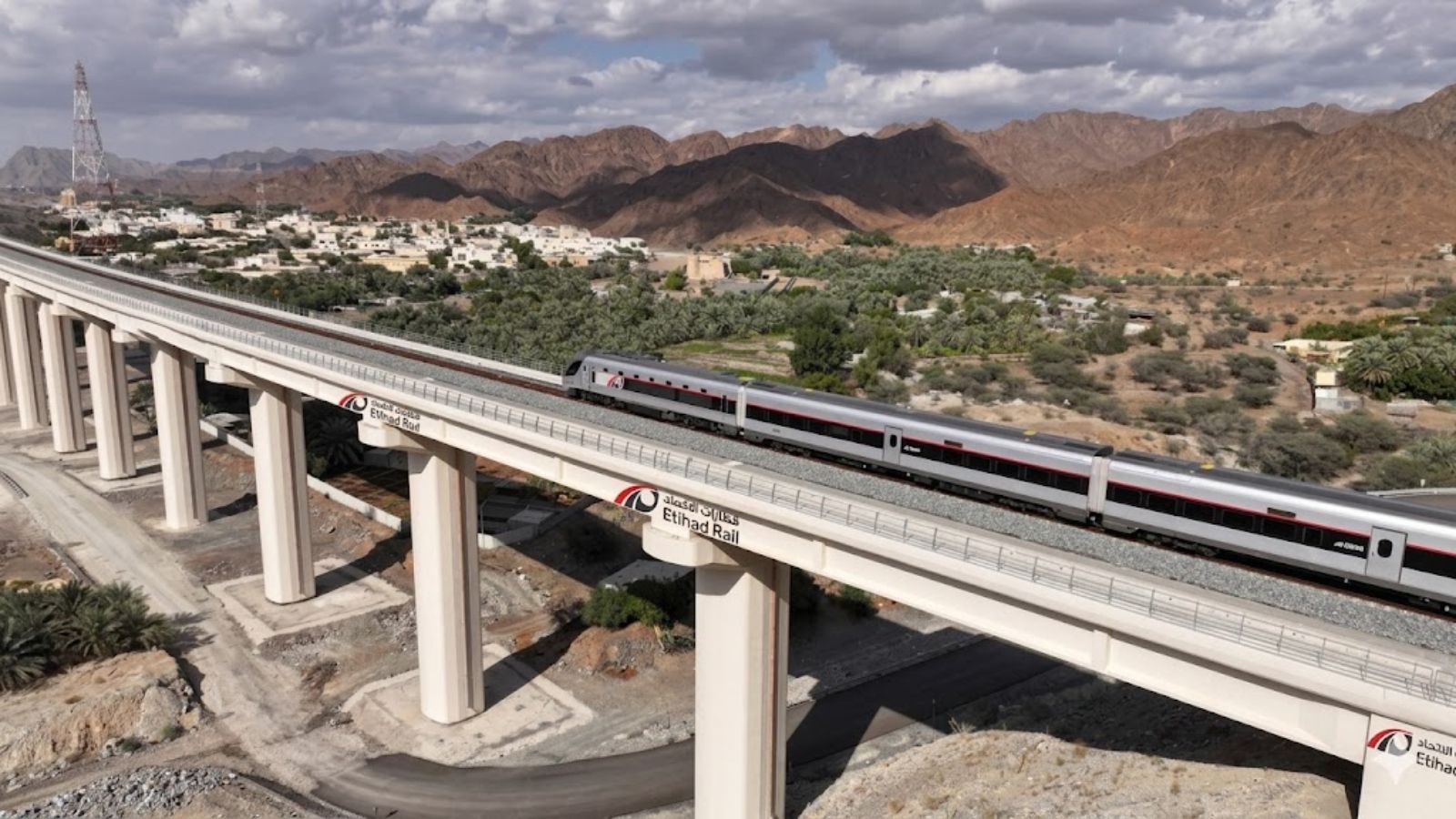
To understand how monumental this is, you have to look at the sheer engineering defiance required to build it. Adhraa Almansoori, a commercial director at Etihad Rail, recently pointed out that this specific route was chosen for the grand debut precisely because it is the most brutal. The tracks don't just sit on flat ground. They cut through volatile, shifting sand dunes that threaten to swallow infrastructure overnight. Even more challenging, they slice directly through the ancient, unforgiving rock formations of the northern mountains. It is a landscape that has resisted easy passage for thousands of years.
Yet, when you step inside one of the 13 sleek new passenger trains, that chaotic, hostile wilderness outside is reduced to a silent, cinematic backdrop rolling past a panoramic window.
The onboard experience has been meticulously calibrated to feel less like transit and more like a sanctuary. In Comfort Class, which currently costs a heavily discounted introductory fare of AED 55 (roughly 1,413 Indian Rupees), passengers are treated to wide, guaranteed seating, personal power outlets, and high-speed Wi-Fi that remains stable even when flying through mountain tunnels. For those who snagged the highly coveted Premium Class tickets at AED 120, the experience elevates to something akin to a boutique airline lounge, complete with deeply cushioned, extra-wide seats and complimentary refreshments served as the desert blurs past.
For international visitors, particularly the millions of Indian tourists who flock to the UAE every year, this network is a profound democratization of travel. It strips away the anxiety of the unknown.
The booking process itself has been stripped of any bureaucratic friction. A tourist landing in Abu Dhabi doesn't need a local driver's license or an intimate knowledge of Emirati highway systems. They simply download the Etihad Rail app, select their route—from the newly minted Mohamed bin Zayed City Station to Fujairah’s Al Hilal City—and choose a fare tier that matches their psychological need for flexibility. The "Saver" tier works perfectly for those with rigid, bulletproof itineraries, while the "Flex" option allows travelers to alter their departure times on a whim, recognizing that the best travel experiences are often the ones that deviate from the plan.
But the true magic of this transformation is that it is designed to be an interconnected ecosystem. The stations aren't isolated islands dropped into the desert; they are being woven directly into the existing fabric of the cities. In Abu Dhabi, travelers can opt for seamless shuttle transfers that tie the train station directly to major hubs like Reem Mall and the Corniche. You can wake up, stroll along the Abu Dhabi beachfront, and find yourself eating fresh seafood on the Fujairah coast before the sun has even reached its peak.
The initial rollout on June 30 is just the first domino to fall.
Consider what happens next: on September 30, 2026, the network expands as the massive Dubai and Al Dhaid stations roar to life. By the end of the year, the tracks will stretch deep into the western Al Dhafra region, and by March 2027, the final station in Sharjah will open, completing a massive 900-kilometer loop that will eventually carry an estimated 36 million people every single year.
It is easy to look at those numbers and see a massive infrastructure victory. But the real victory is much quieter, measured in the small moments of human relief it creates. It is the business commuter who can now prep for a presentation on a stable tray table instead of white-knuckling a steering wheel on the E11 highway. It is the family of tourists who can share a meal together in a spacious cabin while watching the sunset paint the Hajar Mountains in shades of deep purple and gold.
The age of the mandatory highway slog is drawing to a close. As the first maiden voyage departs Fujairah at 5:34 AM on June 30, the low hum of the electric motors will signal something far deeper than a train leaving a station. It is the sound of a country finally breaking the tyranny of distance, turning a vast, formidable wilderness into a shared backyard.