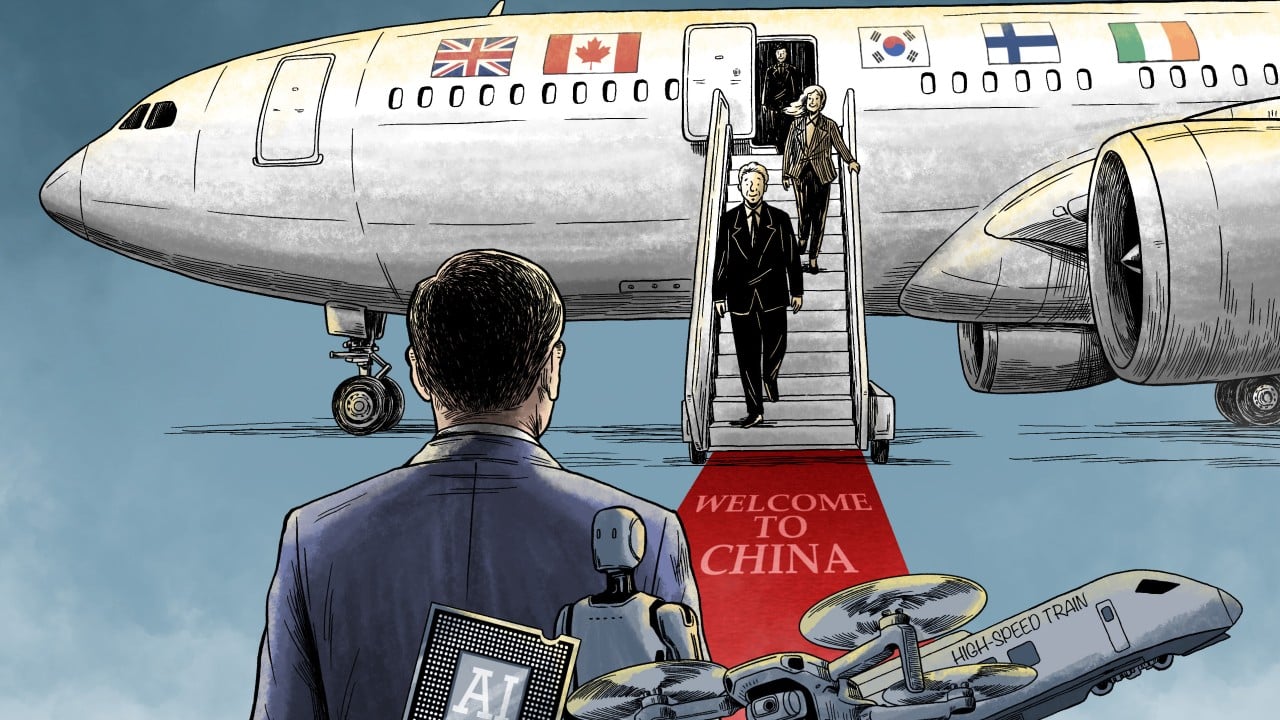
The traditional image of the Chinese President as a globe-trotting statesman is dead. For years, the world grew accustomed to Xi Jinping appearing in world capitals, flanking regional leaders to sign multi-billion dollar infrastructure deals and promising a new era of globalization with Chinese characteristics. But a sharp, quiet pivot has occurred. In the last twenty-four months, the leader of the world’s second-largest economy has effectively shuttered his travel office, choosing instead to transform Beijing into a fortress of high-level reception.
This is not a temporary scheduling conflict or a lingering hang-up from the pandemic era. It is a calculated retreat that signals a fundamental realignment of how China intends to exert power. By making foreign dignitaries come to him, Xi is signaling that the era of China courting the world is over. The world must now court China.
The Shrinking Footprint of a Superpower
Before 2020, Xi was one of the most traveled leaders on the planet, averaging fourteen overseas trips annually. In 2023, he spent a grand total of two days outside Chinese borders—a visit to Moscow to see Vladimir Putin. Even as 2024 and 2025 progressed, the numbers failed to rebound to their pre-crisis highs. The empty chair at the G20 in New Delhi and the absence from major climate summits are not oversights. They are the tactical manifestation of a "Security First" doctrine.
This inward turn is driven by a toxic cocktail of domestic fragility and strategic paranoia. Inside the Zhongnanhai leadership compound, the focus has shifted from external expansion to internal preservation. The "why" behind this shift is found in three distinct fractures: a sputtering property market that has wiped out household wealth, a purge of top-tier military and diplomatic officials that suggests deep-seated loyalty concerns, and a darkening geopolitical sky where the United States and its allies have tightened the noose on advanced technology transfers.
Beijing as the Diplomatic Sun
Xi has replaced his own travel with a revolving door in Beijing. The strategy is "inbound diplomacy." By staying home, Xi maintains total control over the optics, the security, and the narrative. When European leaders or Middle Eastern monarchs land in the capital, they are entering a meticulously curated environment where the power dynamic is inherently skewed.
This shift serves a dual purpose. First, it projects an aura of imperial stability. In the traditional Chinese political lexicon, the "Center" does not move; the periphery comes to pay respects. Second, it minimizes the risk of international embarrassment or the need to answer unscripted questions from a foreign press corps. In Beijing, the script is written, directed, and produced by the Party.
The High Cost of Absence
There is a significant downside to this diplomatic isolationism. Diplomacy is a contact sport, and by removing himself from the playing field, Xi is losing the ability to influence "the room." When he skips a summit, the narrative is shaped by Washington, Tokyo, or New Delhi without a counterweight.
The consequences are already visible. China’s global image has soured across most developed economies. Pew Research data shows unfavorable views reaching historic highs. Without the personal "face-time" that previously allowed Xi to smooth over tensions with European counterparts, China is increasingly viewed not as a partner, but as a systemic rival to be contained.
The Security Dilemma
Why would a leader risk international isolation? The answer lies in the "Fortress China" mentality. Xi has centralized more power than any leader since Mao, but that power comes with an "opportunity cost" of absence. If he is away, he cannot directly manage the internal tremors of a stalling economy or the ongoing cleanup of the Rocket Force.
The purge of figures like former Foreign Minister Qin Gang and former Defense Minister Li Shangfu sent shockwaves through the bureaucracy. When the inner circle is in flux, the leader cannot afford to be ten time zones away. Security is now the filter through which all Chinese policy—domestic and foreign—is strained.
Economic Gravity and the Great Disconnect
The domestic crisis is no longer a secret. Provincial governments are drowning in debt, and the "no mother can cook for her children with no rice" sentiment is trickling into official discourse. Xi’s refusal to travel is a signal to his own people that he is focused on their "rice bowl" issues, even if the actual policies involve more ideological control than economic stimulus.
The "Belt and Road" initiative, once the crown jewel of Xi’s foreign policy, has been quietly downsized. The era of the "mega-project" is being replaced by "Small and Beautiful" investments that are easier to manage and less likely to result in massive debt defaults. This fiscal conservatism at home naturally leads to a diplomatic retrenchment abroad.
The Return of Middle Kingdom Logic
We are witnessing the restoration of a historical pattern. China is reverting to its role as the Middle Kingdom—a self-contained universe that interacts with the outside world only on its own terms. The "Global Security Initiative" and "Global Civilization Initiative" are being launched from Beijing, not from the podiums of the UN or the Davos stage.
Xi is betting that China’s market is still too large for the world to ignore. He believes that eventually, the CEOs and the heads of state will have no choice but to keep booking flights to Beijing, regardless of whether he ever returns the favor. It is a high-stakes gamble on the endurance of Chinese gravity in an era of decoupling.
The silence from the tarmac is the loudest signal Xi has sent in a decade. He is no longer seeking a seat at the global table; he is building his own, and he expects the world to find its own way there.
Learn more about the shift in China's diplomatic strategy
This video provides additional context on how Beijing is being developed as a global hub to centralize power and innovation under Xi's direct oversight.