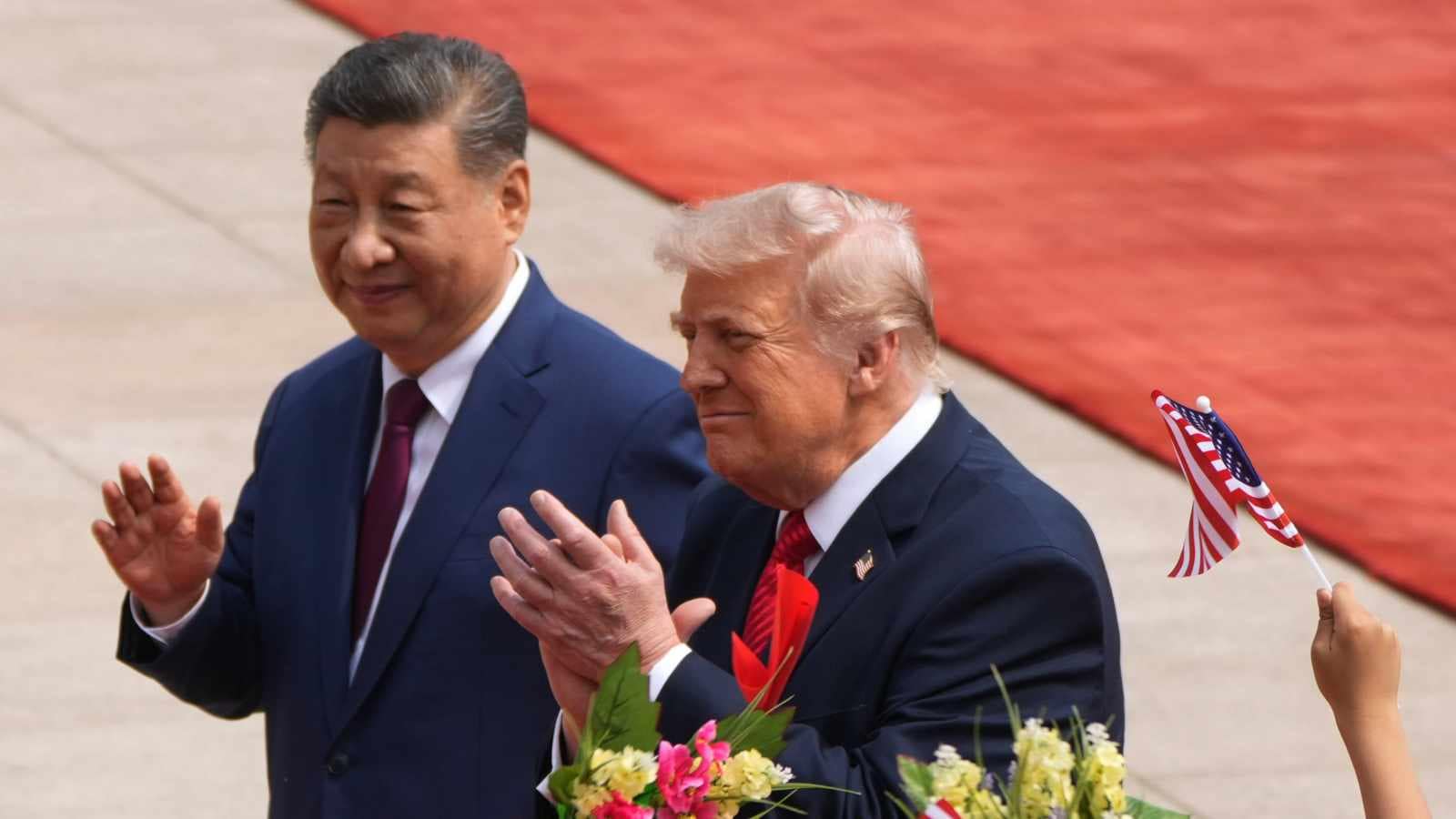
Donald Trump and Xi Jinping have spent years trapped in a cycle of high-stakes brinkmanship, alternating between "great friend" rhetoric and scorched-earth economic warfare. While the official line from the White House often points to personal chemistry and transactional wins as the grease that keeps the wheels of diplomacy turning, the reality is far more clinical. They didn't "resolve" their differences in the traditional sense of finding common ground. Instead, they reached a state of managed hostility, a fragile equilibrium where both sides realized that total economic separation would be more expensive than a strained, suspicious peace.
This peace is held together by a series of informal "red lines" and the raw mathematics of global supply chains. When the President speaks of resolving issues, he is usually referring to the tactical de-escalation of specific tariff threats or the securing of large-scale commodity purchases. These are band-aids on a structural rift.
The Art of the Stalemate
The narrative that a few rounds of golf or a state dinner in the Forbidden City fixed the structural imbalances between the US and China is a fantasy designed for cable news consumption. The friction between a market-driven superpower and a state-directed economy is not a misunderstanding. It is a fundamental conflict of interest.
True resolution would require China to dismantle its industrial subsidy programs or the US to accept a diminished role in the Pacific. Neither is going to happen. What we have witnessed instead is the perfection of the tit-for-tat trade model. Every time a new round of restrictions hits high-end semiconductors, a counter-measure appears involving critical minerals. They haven't solved the problem; they have merely mapped out the cost of escalation so clearly that neither side wants to pay the next bill.
The Personalization of Geopolitics
One of the most effective tools in this relationship has been the weaponization of ego. The President’s insistence that his personal rapport with Xi is the primary driver of policy serves a dual purpose. It allows for quick pivots in strategy without appearing weak, and it provides a face-saving mechanism for Beijing. In the Chinese political system, "saving face" is a strategic asset. By framing concessions as favors to a "friend" rather than surrendering to a foreign power, Xi can maintain domestic stability while quietly adjusting trade flows.
However, this reliance on personal ties makes the global economy incredibly volatile. If the rapport breaks, the policy breaks. We saw this during the initial phases of the trade war when a single tweet could wipe out billions in market capitalization. The "resolution" the President speaks of is often just a temporary ceasefire in a war that both sides are now too tired—and too integrated—to fight to the finish.
The Supply Chain Trap
The biggest obstacle to a total break is the reality of the "Made in China" sticker. Despite the aggressive push for "near-shoring" and moving production to places like Vietnam or Mexico, the deep-tier components of almost every American electronic device still flow through Chinese factories.
- Sub-component Dependency: You can assemble a phone in India, but the specialized glass, the sensors, and the battery chemistry are still heavily reliant on Chinese intellectual property and processing.
- The Rare Earths Lever: China controls roughly 80% of the world’s rare earth processing. Any "resolution" of differences must account for the fact that a total trade freeze would paralyze the American defense and EV industries overnight.
- Market Access: For American giants like Apple or the major car manufacturers, China isn't just a factory; it is the world's most important growth market.
The President’s strategy has been to use the threat of losing this access as a blunt instrument. It works for short-term wins—like getting China to buy more American soybeans or Boeing jets—but it does nothing to address the long-term theft of intellectual property or the forced transfer of technology.
The Hidden Conflict in the South China Sea
While the headlines focus on trade deficits and currency manipulation, the real differences being "resolved" behind closed doors involve the Pacific. This is where the diplomacy gets dangerous. The US has maintained a policy of "strategic ambiguity" regarding Taiwan for decades, but the current administration has tested those boundaries repeatedly.
The resolution here isn't a treaty; it's a series of quiet understandings about military proximity. We are currently seeing a massive buildup of "dual-use" infrastructure. China builds islands; the US builds alliances like AUKUS. They resolve these differences by ensuring that neither side accidentally triggers a kinetic conflict. It is a high-speed game of chicken where both drivers have their hands glued to the wheel.
The Myth of the Phase One Victory
Much of the current rhetoric stems from the "Phase One" trade deal. On paper, it looked like a massive win for American exports. In practice, the numbers rarely met the targets. The "resolution" was more about creating a political narrative of victory than it was about shifting the tectonic plates of global trade.
China agreed to buy more, but the global pandemic and subsequent economic cooling gave them a convenient exit ramp. The President’s claim that things are resolved often overlooks the fact that the underlying tariffs—the "tax" on American consumers and Chinese manufacturers—remain largely in place. We are living in a permanent state of emergency that has been rebranded as the new normal.
The Technological Iron Curtain
The most significant way differences are being handled now is through the creation of two separate technological ecosystems. Instead of trying to play by the same rules, the US and China are simply building different playgrounds.
- The Silicon Divide: The US is effectively banning China from the most advanced 3nm and 2nm chip architectures.
- Software Borders: The push to ban or force the sale of Chinese-owned apps like TikTok is the opening salvo in a war for the "digital soul" of the next generation.
- Financial De-risking: Major US pension funds and investment firms are being pressured to pull out of Chinese tech firms linked to the military.
This isn't a resolution. It's a divorce. But it's a divorce where the couple still has to live in the same house and share the same kitchen. They are dividing the cabinets and the fridge, trying to see who can survive longer on their own supplies.
Why the Rhetoric Matters
When the President says they have resolved differences, he is speaking to the markets. He knows that the global economy thrives on the perception of stability. If the two largest economies are seen as being on the brink of war, investment stalls, interest rates spike, and the domestic economy suffers.
By projecting an image of two strong leaders shaking hands and "solving" problems, he prevents a market panic. It is a performance of power. Xi participates because he needs the American consumer to keep buying Chinese goods to fuel his country’s slowing growth. They are two men trapped in a room, both claiming they have the key, while both know the door is actually bolted from the outside.
The Cost of the "Win"
The American consumer has paid for this "resolution" in the form of higher prices. Every tariff is a tax. While the administration argues that these costs are absorbed by Chinese exporters, the data shows a different story. Prices on everything from washing machines to construction steel have stayed elevated because of the trade frictions.
On the other side, Chinese companies have seen their profit margins squeezed and their access to Western capital markets restricted. Both sides have taken significant hits to their "economic health" to prove a political point. The "resolution" is simply the realization that they have both hit their limit for pain.
The Future of the Friction
Looking at the map of 2026, the idea of a final, lasting peace between Washington and Beijing is a pipe dream. The competition for the future of Artificial Intelligence, quantum computing, and space exploration is just beginning. These are winner-take-all fields. There is no way to "resolve" a race where only one person can be first.
The President’s strategy will continue to be one of targeted aggression followed by public reconciliation. It is a cycle of breaking things to show you are the only one who can fix them. We should expect more "historic" deals that don't actually change the status quo, more "breakthrough" meetings that lead to more of the same, and a continued drift toward a world where the two powers operate in parallel, but never in unison.
The differences haven't been resolved. They have been institutionalized. This is no longer a temporary dispute; it is the fundamental organizing principle of the 21st century. Those waiting for a return to the era of seamless globalization are looking for a world that has been dismantled and sold for parts.
The strategy now isn't about winning or losing. It's about surviving the friction. Every time a new "resolution" is announced, look past the handshake. Look at the tariffs that didn't move, the ships that are still patrolling the strait, and the factories that are still struggling to find a way to operate without the "enemy's" parts. That is where the real story lives.