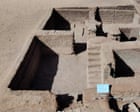
The Myth of the Lost City
Mainstream archaeology loves a Hollywood narrative. Last week, headlines buzzed with the "thrilling discovery" of a massive, previously unknown Byzantine city buried deep within Egypt’s Western Desert. The reports painted a picture of a bustling, isolated metropolitan hub thriving against all environmental odds, suddenly uncovered by ground-penetrating radar and eager shovel-work.
It is a beautiful story. It is also completely wrong.
What the current consensus labels a "city" is the historical equivalent of an over-glorified truck stop. For decades, institutional archaeology has suffered from a chronic case of scale inflation. Every time an expedition uncovers a cluster of mud-brick foundations and a few broken amphorae in the arid wastes, the press releases start throwing around words like "urban center" and "lost civilization."
Let's look at the actual mechanics of the Egyptian frontier during the Byzantine period, roughly between the fourth and seventh centuries. These were not self-sustaining cities. They were heavily subsidized, highly specialized military and economic outposts designed for one thing: extracting resources and securing trade routes. Calling them cities misrepresents how the Byzantine Empire actually projected power and how fragile these desert ecosystems truly were.
The High Cost of Scale Inflation
I have spent years analyzing regional trade data and settlement patterns in arid zones. I have seen academic institutions burn through millions in grant money trying to prove a remote site was a thriving cultural capital, only to ignore the harsh realities of water logistics and supply chain economics.
To understand why the "Byzantine city" narrative falls apart, you have to look at the resource math.
A true city requires a sustainable agricultural hinterland. It needs a reliable, localized food surplus to support a non-producing urban population—artisans, bureaucrats, priests, and elites. The Western Desert of Egypt, specifically around the Kharga and Dakhla oases, relies on fossil water stored in the Nubian Sandstone Aquifer.
During the Roman and Byzantine periods, the state utilized advanced irrigation technology, including qanats (underground aqueducts), to tap into this water.
But water access does not instantly equal urbanization. The infrastructure required to maintain these systems was brutal, labor-intensive, and entirely dependent on imperial stability.
Consider the economic data compiled by historians like Alan Bowman and Dominic Rathbone on Roman and Byzantine Egypt. The cost of transporting grain overland just 50 miles by camel or donkey often exceeded the value of the grain itself. If these "cities" were genuinely massive, independent populations, they would have starved the moment a single well fouled or a trade caravan was raided.
They were not cities. They were fortified nodes. They were garrison towns and processing hubs for specific high-value commodities like dates, olives, and alum.
Dismantling the PAA Fallacies
When people read about these discoveries, the same automated questions pop up across search engines. The answers provided by institutional experts usually perpetuate the same romantic nonsense. Let's fix that.
Did millions of people live in the ancient Egyptian desert?
Absolutely not. The premise assumes that because a site covers a large geographic footprint, it was densely populated. This ignores the nomadic and seasonal reality of desert life. A site might show signs of occupation over a three-hundred-year span, but the actual permanent population at any given moment was likely a few hundred soldiers, customs officials, and enslaved laborers. The rest of the footprint consists of temporary encampments, animal pens, and abandoned structures that were filled with sand the moment the wind shifted.
How did Byzantine cities survive in the desert without water?
They didn't. They didn't survive, and they weren't cities. They existed on a knife-edge of imperial subsidization. The Byzantine state poured resources into these outposts because the trade routes across the Sahara—linking Sub-Saharan Africa with the Mediterranean—were incredibly lucrative. The moment the central government in Constantinople faced fiscal crises or Islamic conquests disrupted the supply lines in the seventh century, these outposts evaporated. They didn't decline; they collapsed overnight because they had no internal economic viability.
The Real Danger of the Discovery Narrative
By treating these outposts as grand discoveries of ancient urban planning, archaeology misses the far more interesting, nuanced reality: the Byzantine Empire was running a high-stakes, highly precarious colonial extraction operation.
When you look at the ceramic evidence from recent digs in the Western Desert, you don't find a diverse, thriving local market. You find mass-produced, standardized imperial pottery. You find coins minted in Alexandria or Constantinople. This is the material footprint of a franchise, not a cultural melting pot.
Imagine a scenario where future archaeologists uncover the ruins of a remote oil drilling town in the Arctic Circle. If they applied the same logic mainstream media is using for Egypt's desert, they would declare they had found a "thriving polar metropolis with advanced architectural adaptations." In reality, it’s just a place where people suffered through miserable conditions to send oil back home until the well ran dry.
The contrarian truth is uncomfortable for university PR departments: the desert was never tamed. It was temporarily leased by an empire with deep pockets and a brutal disregard for long-term sustainability.
Stop Looking for Houses; Look at the Roads
If we want to understand the Byzantine frontier, we have to stop obsessing over the size of the buildings and start analyzing the connectivity of the network.
The value of these sites lies not in their domestic architecture, which was mostly shoddy mud-brick prone to rapid degradation, but in their defensive and communicative infrastructure. The Byzantines built a system of watchtowers, fortified monasteries, and waystations (mansiones) that allowed messages and wealth to move across vast distances with minimal friction.
| Structure Type | Function | True Population | Imperial Value |
|---|---|---|---|
| Fortified Monastery | Securing water sources; grain storage | 20–50 monks/guards | High (Logistical hub) |
| Castrum (Fort) | Border patrol; customs collection | 100–300 soldiers | Maximum (Security) |
| Kome (Village/Outpost) | Seasonal labor; resource extraction | Variable (Mostly transient) | Medium (Production) |
The table clarifies the hierarchy. The massive structures picked up by satellite imagery are almost always military walls or containment structures for livestock and goods, not apartment blocks for ancient families.
Admitting this approach is correct means accepting a less romantic view of history. It means trading the fantasy of "lost desert kingdoms" for the cold reality of ancient logistics, tax collection, and military occupation. It requires archaeologists to act less like Indiana Jones and more like forensic accountants.
Stop celebrating the discovery of ancient cities where they could not possibly exist. Start examining the fragile imperial supply lines that allowed a desperate empire to hold back the sand for just a little too long.