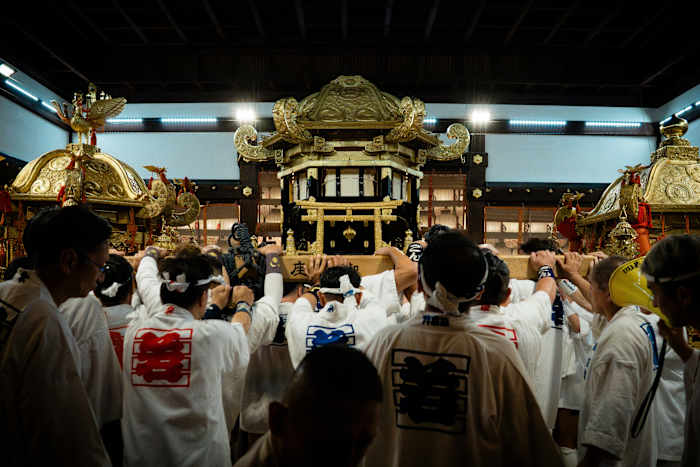
The asphalt of Kyoto in July does not merely radiate heat; it sticks to the soles of your shoes like warm tar. On the corner of Shijo and Kawaramachi, ten thousand people are screaming. The noise is a wall of sound—shuffled feet, erratic flutes, the sharp, metallic clatter of hand gongs.
At the center of this human sea stands a wooden tower the size of a three-story house. It weighs twelve thousand pounds. It has no engine, no steering wheel, and not a single metal nail holding its massive cedar frame together.
A man named Takashi stands on the front crossbeam of this behemoth, suspended fifteen feet above the pavement. His fingers are white from gripping the ropes. His traditional straw sandals offer zero traction against the polished wood. He does not look at the crowd of tourists snapping photos with their smartphones. Instead, his eyes are locked onto a line of thirty men standing in front of the structure, all gripping a thick hemp rope.
They are about to attempt the tsuji-mawashi. It is a maneuver where this gargantuan wooden tower must turn a sharp ninety-degree corner on a narrow city street. If the ropes snap, the float will plow into a glass-fronted convenience store. If the wood splits, twelve thousand pounds of ancient history will collapse onto the asphalt, crushing anyone beneath it.
Silence drops over the intersection. It happens in an instant. The flutes stop. The crowd holds its breath.
Takashi raises a fan. He screams a single, guttural command.
Go.
The Plague that Never Ended
To understand why grown men risk their collarbones to drag wooden towers through the financial district of Japan’s old capital, you have to look past the bright textiles and the ice-cream vendors. The Gion Matsuri is framed today as a brilliant spectacle of travel photography. But its origins are soaked in terror.
In the summer of the year 869, Kyoto was a swamp of death.
Epidemics tore through the narrow wooden alleys of the city. The imperial capital had no modern sanitation, and the summer humidity turned the local rivers into breeding grounds for disease. People died in their beds, on the doorsteps of temples, and in the muddy gutters. The living were too exhausted or too terrified to bury the dead.
The people believed the disaster was not a biological failure, but a spiritual invasion. The restless spirits of the deceased, combined with the wrath of Gozu Tenno—a fierce deity associated with pestilence—had descended upon the valley.
The Emperor demanded an emergency intervention. Officials erected sixty-six massive halberds—one for every province of old Japan—at the sacred garden of Shinsen-en. They brought portable shrines from the Gion Shrine directly into the streets. It was an act of desperate spiritual warfare. The citizens marched to appease the unseen forces, begging for a reprieve from the dying.
It worked. Or, at least, the plague eventually waned.
The ritual became an annual necessity. For over a millennium, through civil wars that burned Kyoto to the ground, through the rise and fall of the samurai class, and through the devastation of World War II, the city has maintained this truce with the invisible.
When you watch a float creak down the modern street today, passing Starbucks signs and neon apparel storefronts, you are looking at a living shield against pestilence. The stakes are no longer about survival in the medical sense, but they are absolutely about survival in a cultural sense. Without this ritual, the thread snaps.
Ropes, Knots, and the Art of Friction
Consider what happens to wood under immense pressure.
The massive floats, called hoko, are built from scratch every single July and dismantled completely immediately after the procession ends. This is not because the neighborhood associations lack storage space. It is because the act of construction is itself a form of prayer.
The craftsmen who build these structures do not use bolts, brackets, or glue. They use a technique called nawagarami—the art of rope-binding. Over several days, teams of local builders wrap miles of rough hemp rope around the giant logs in intricate, geometric patterns.
The knots are beautiful, but their purpose is strictly mechanical.
A rigid structure held together by iron nails would shatter under the immense twisting forces of the parade route. The uneven cobblestones, the slopes of the modern street gutters, and the sudden jolts of the turning maneuvers require flexibility. The ropes allow the giant logs to slide, groan, and shift against one another. The structure breathes. It absorbs the shock of its own immense weight.
But this flexibility comes at a cost. The men who pull the ropes must become the brakes and the steering mechanism.
Back at the intersection of Shijo and Kawaramachi, Takashi drops his fan. The thirty men pull with everything they have. Their muscles strain against the hemp. Their heels dig into the hot pavement.
Underneath the giant wooden wheels of the float, workers have placed thin, wet bamboo slats. They pour water over the bamboo to make it slick.
The men pull. The float groans—a low, terrifying sound like a dying tree in a storm. The giant wheels slide sideways across the wet bamboo, screeching as the wood splinters under the friction. Smoke rises from the pavement. The smell of wet grass and burning cedar fills the air.
The float turns maybe twenty degrees.
They stop. The workers rush forward to reset the bamboo slats. They must repeat this process four or five times just to clear a single corner. The physical toll is immense. The mental toll is worse. One wrong angle, one slip of the foot, and the momentum of the twelve-thousand-pound tower becomes uncontrollable.
The Invisible Neighborhoods
It is easy to look at this event and see only the performers. The men in traditional tunics, the musicians sitting high up in the rafters of the floats, the officials in formal robes.
But the real engine of the festival belongs to the people you don't see in the tourism brochures.
Kyoto is organized into chonaikai—small, historic neighborhood associations. Each neighborhood is responsible for its own specific float. These are not professional event planners. These are local dry-cleaners, retired schoolteachers, bank clerks, and small-business owners. For eleven months of the year, they lead ordinary, modern lives. They send emails, argue about parking spaces, and worry about inflation.
Then July arrives.
Suddenly, the local community center transforms into an armory of sacred artifacts. Centuries-old tapestries, imported from Persia and Europe via the Silk Road hundreds of years ago, are pulled from climate-controlled vaults. Elderly women spend hours inspecting the gold embroidery for signs of wear. Young men practice the flutes late into the night, their melodies echoing through the covered shopping arcades long after the stores have closed.
This is where the true friction of the modern world occurs.
As younger generations move away to Tokyo or into modern high-rise apartments outside the city center, the neighborhoods are shrinking. The cost of maintaining these massive floats is astronomical. A single replacement wheel can cost tens of thousands of dollars and requires sourcing rare, decades-old wood from protected forests.
Why do they keep doing it?
"If we don't build it," an elderly resident named Mariko told me, her hands calloused from decades of working in the local textile trade, "the neighborhood vanishes. The float is the reason we know our neighbors' names. It is the reason we know who is sick, who needs help, and who has died. The festival is the skeleton that holds our community upright."
Without the float, the neighborhood becomes just another collection of expensive real estate and tourist boutiques. The invisible stakes are nothing less than the preservation of human connection in an increasingly isolated world.
The Final Turn
By mid-afternoon, the procession winds down. The heat is oppressive, the air thick with humidity and the collective exhaustion of hundreds of thousands of bodies.
Takashi’s float has made its final turn. His hands are raw, blistered from the rough ropes and the constant tension. His voice is entirely gone, reduced to a raspy whisper after hours of shouting commands over the roar of the crowd.
The giant cedar tower rolls back into its temporary home in the middle of the street. The musicians play one final, celebratory melody. The crowd applauds, a polite, rhythmic sound that feels small compared to the ancient noise of the wood and the pavement.
Tomorrow, the craftsmen will return with their tools. They will cut the miles of hemp rope. They will stack the giant cedar logs back into storage crates. The priceless textiles will return to their dark vaults, safe from the humidity and the light.
By dusk, the street will be reopened to traffic. City buses will roll over the exact spot where the bamboo slats smoked and splintered. Salarymen will walk home from the subway station, staring at their phones, completely unaware of the spiritual cleansing that just took place beneath their feet.
But for those who stood in the heat, who smelled the burning wood and felt the vibration of twelve thousand pounds of moving history in their chest, the city looks different. The modern asphalt feels a little thinner. The ancient swamp feels a little closer.
And the invisible shield remains intact for one more year.