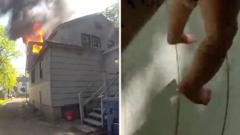
The air inside a burning home does not taste like woodsmoke. It tastes like acid. It claws at the back of the throat, thick and oily, turning the simple act of breathing into a violent calculation. Within minutes, the temperature near the ceiling can soar past 600 degrees, hot enough to melt plastic and turn oxygen into a memory.
When a house catches fire in the dead of night, the universe shrinks. It reduces itself to a frantic sequence of binary choices. Left or right. Stay or run. Hold on or let go.
We read about these moments in the morning news, wedged between political updates and weather forecasts. A headline flashes across a screen: Police officer catches baby dropped from window of burning home. It is a remarkable sequence of words, certainly. But standard journalism treats it like a mathematical equation. Fire plus window plus officer equals rescue. It strips away the terrifying, beautiful friction of what it actually means to be alive in the seconds before the equation balances out.
To understand the weight of that rescue, you have to look at the space between the window sill and the pavement. That is where the real story lives.
The Geography of Panic
Imagine standing at a second-story window. The ledge is rough against your palms. Behind you, the hallway is already gone, replaced by a roaring, pitch-black wall of heat. The smoke is heavy, pressing down on your chest like a physical weight. In your arms, you hold everything that matters. A child. A bundle of soft fabric and fragile bones, completely dependent on your ability to make the next choice.
You cannot go backward. The stairs are an oven.
You look down. The ground is fifteen feet away. It looks like fifty.
In public safety, there is a concept known as the "critical decision window." It is the brief, agonizing sliver of time where human agency intersects with pure physics. When a building is compromised by fire, structural collapse is only part of the danger. The immediate threat is flashover—the moment when every exposed combustible surface in a room ignites simultaneously. It happens in a heartbeat.
For a parent trapped in that room, the math is brutal. If you stay, the outcome is certain. If you drop the child, the outcome is a terrifying variable.
This is not an abstract exercise in risk management. It is a raw, ancient human instinct. Every fiber of your biology screams at you to protect your offspring, to shield them with your own body. To open your hands and let them fall into the void goes against every evolutionary impulse we possess. It requires a desperate, paradoxical kind of faith. You have to believe that the air will hold them, or that someone below will catch them.
The Man on the Asphalt
Now shift the perspective. Stand on the pavement looking up.
A police officer’s shift is largely comprised of routine actions. It is paperwork, traffic stops, neighbor disputes, and cold coffee. Officers are trained for emergencies, yes, but training is a sterile environment. It happens in bright daylight, with plastic dummies and padded mats. It does not prepare the senses for the sensory overload of a structure fire—the deafening roar of the flames, the screams of the neighbors, the blinding, strobe-like glare of emergency lights reflecting off thick, rolling smoke.
When that officer arrived at the scene, the fire department was still minutes away. Minutes are an eternity when wood and drywall are fueling a chemical reaction.
He did not have a ladder. He did not have a net. He had a uniform, a duty belt, and two hands.
When you see a face appear at a second-story window through the smoke, your brain does not process the situation through a series of logical bullet points. The nervous system takes over. Adrenaline floods the bloodstream, narrowing the visual field down to a single point of focus. This is known as tachypsychia—the psychological phenomenon where time appears to slow down dramatically during a high-stress event.
The world quieted. The shouting of the crowd faded into a dull hum. There was only the window, the smoke, and the small shape silhouetted against the orange glow.
The Arc of a Fall
Then, the child was dropped.
Physics dictates that an object dropped from a height of fifteen feet reaches the ground in less than one second. It accelerates at $9.8 \text{ m/s}^2$. To a bystander, it is a blur. To the person waiting below, that single second stretches out, expanding into a vast, empty expanse of time where everything can go wrong.
A baby is not a football. It has no predictable trajectory. It is a shifting, moving weight. If the officer lunges too early, he misses. If he hesitates by a fraction of a second, the pavement wins. The margin for error does not exist.
Consider the sheer mechanics of the catch. The human body is remarkably resilient, but it is also fragile when subjected to sudden, concentrated force. The officer had to position his body to absorb the kinetic energy of the fall without dropping the child or causing internal injury. He had to become a human shock absorber, a buffer between life and the unforgiving concrete.
He reached out.
The impact was loud, a sudden thud against his chest that knocked the wind from his lungs. For a terrible, agonizing beat, nobody breathed.
Then came the cry. It was a sharp, high-pitched wail, piercing through the rumble of the fire. It was the most beautiful sound in the world. It meant the lungs were working. It meant the heart was beating. It meant the equation had balanced.
The Invisible Ripples
We consume these stories of heroism like fast food. We read them, we feel a brief surge of warmth, we click "share," and then we move on to the next piece of content. We treat them as isolated anomalies, freak occurrences in an otherwise predictable world.
But these moments do not happen in a vacuum. They leave scars, and they create ripples that extend far beyond the morning news cycle.
For the family, the recovery is not measured in seconds, but in years. They lost their home, their clothes, their photographs, the quiet safety of their everyday lives. The psychological toll of surviving a fire is a long, heavy road marked by sleepless nights and a sudden, sharp panic at the smell of burnt toast. The physical rescue is just the prologue to a much longer story of rebuilding from the ash.
For the officer, the adrenaline eventually fades. The flashing lights go out. The fire trucks pack up their hoses and drive away. He goes back to the precinct, washes the soot off his face, and finishes his paperwork. But you do not simply walk away from a moment like that unchanged.
The human mind is not built to process that level of intense, concentrated stakes on a Tuesday night. In the quiet hours of the morning, when the city slows down, the memory returns. The weight of the child in his arms. The heat on his skin. The terrifying knowledge of how easily the night could have gone the other way.
Beyond the Headline
We live in a culture that is increasingly cynical, a world where we are constantly told to look out for number one, to insulate ourselves from the problems of others. We retreat behind screens and walls, viewing the struggles of our communities through a lens of detached observation.
A story like this shatters that detachment.
It reminds us of a truth we often try to forget: we are profoundly, terrifyingly dependent on each other. We are all just one bad wire, one careless candle, one stroke of terrible luck away from standing at a window, looking down into the dark, and hoping someone is there to catch us.
The officer who stood on that asphalt did not know the family inside the house. He did not know their politics, their background, their beliefs, or their flaws. None of that mattered. In the grand calculus of that evening, all that mattered was that a human life was falling, and he had the capacity to stop it.
It is easy to look at the world and see only the fire. The news is filled with it—the slow, burning destruction of our social fabric, the heat of our arguments, the thick smoke of our collective anxieties. It can feel overwhelming, like a building that is too far gone to save.
But every now and then, the smoke clears just enough to show us what we are still capable of. It shows us that amid the chaos, there are still people willing to look up, to stretch out their arms, and to hold the weight of the world, if only for a single, breathless second.