The marble of Washington D.C. has a way of swallowing sound. If you stand on the National Mall at dawn, the city feels like a collection of ghosts carved into stone, each monument competing for a permanent slice of the American identity. But lately, a new weight is pressing against the horizon. It isn't a ghost yet. It is an ambition.
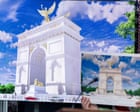
The proposal for Donald Trump’s triumphal arch has moved from a fever dream of political branding to the gray, bureaucratic reality of federal approval. The National Capital Planning Commission met recently, and the air in the room didn't smell like revolution; it smelled like stale coffee and floor wax. That is how history usually happens—not with a shout, but with the scratching of pens on thick paper.
The Weight of the Arch
Consider a stonemason standing before a block of Georgia white marble. Hypothetically, let’s call him Elias. Elias doesn’t care about the polls or the cable news cycles. He cares about the grain. He knows that once a name is etched into stone, the sun will hit it the same way for three hundred years. When we build monuments, we are trying to cheat death. We are telling the future that we were here, and that we mattered more than the people who came before us.
The triumphal arch, a form borrowed from the Roman Empire to celebrate military conquest, is a specific kind of statement. It says: I conquered.
The Commission's recent movement toward approval suggests that this isn't just a vanity project anymore. It is becoming an infrastructure of memory. Critics argue it disrupts the "L'Enfant Plan," the original 1791 design that keeps the city’s vistas open and democratic. But supporters see it differently. They see a void that needs filling, a definitive stamp on the 21st-century skyline.
The stakes aren't just about traffic flow or sightlines. They are about the stories we tell our children when they look up at the clouds.
The Invisible Battle for the Mall
Washington is a city of strict rules. You cannot build higher than the width of the street plus twenty feet. This ensures that the Capitol remains the focal point, a lighthouse for the Republic. When you introduce a massive arch into that delicate ecosystem, the geometry changes.
The recent agency meeting delved into the technicalities—the soil composition, the height requirements, the impact on pedestrian movement. But the technicalities are a mask. Beneath the talk of "structural integrity" is a fundamental disagreement about who owns the visual soul of the capital.
The Arch of Constantine in Rome was built to commemorate a victory at the Milvian Bridge. It was a physical manifestation of a shift in the world order. In Washington, the proposed arch functions as a similar pivot. It isn't just a gateway; it is a boundary. It marks the "before" and the "after."
Think about the tourists who will walk through it. Imagine a family from Ohio, their shoes dusty from the walk from the Lincoln Memorial. They stand under the curve of the arch. For them, it isn't a policy debate. It’s a backdrop for a photo. But that photo carries a silent message. It validates the presence of the structure. It makes the controversial inevitable.
The Bureaucracy of Immortality
The National Capital Planning Commission is the gatekeeper. They are the ones who decide if a shadow is allowed to fall across a specific patch of grass. During the latest session, the tension was palpable, even through the dry language of zoning and land use.
One member pointed out that the Mall is already crowded. Another noted that the arch would serve as a powerful orientation point for visitors. They talked in circles, a slow-motion dance of political caution.
The reality is that monuments are rarely about the person they celebrate. They are about the people who build them. We build them because we are afraid of being forgotten. We build them because we want to win the argument long after we are gone. If you can put a name on a piece of granite that weighs forty tons, you have effectively silenced your critics for a century. You can't argue with a mountain.
A City of Mirrors
Washington is already full of arches, though most are tucked away in the architecture of the Treasury or the alcoves of the Supreme Court. A standalone triumphal arch is different. It is a solo. It demands to be heard over the chorus.
The approval process is moving forward because the momentum of power is difficult to slow down once it hits the federal level. The agencies involved—the Park Service, the Commission of Fine Arts—are designed to be objective. But how do you remain objective about a symbol?
You look at the blueprints. You measure the height. You check the drainage.
But you can't measure the way a monument makes a person feel small. You can't calculate the emotional displacement of a city that is supposed to belong to everyone but feels increasingly like a private gallery.
The arch is moving closer to reality because, in the end, stone is harder than words. You can retract a statement. You can delete a post. You can even lose an election. But once the foundation is poured, once the crane lifts the keystone into place, the debate is over. The monument becomes a fact.
The Keystones of Tomorrow
If the arch is built, the city will adjust. It always does. The trees will grow around it. The pigeons will find their ledges. The protesters will use its base as a podium.
But the silence of the marble will remain.
The recent meeting was a quiet victory for those who want to see the skyline redefined. It was a reminder that while we argue about the day's headlines, the physical world is being reshaped in our image. Or rather, in the image of those with the will to carve it.
Elias, our hypothetical stonemason, looks at his hands. They are calloused and gray with dust. He knows that the men who commission the work never touch the stone. They just sign the papers. They provide the vision, and he provides the muscle.
But the stone doesn't care who signed the check. It only knows the pressure of the earth and the bite of the chisel.
As the sun sets over the Potomac, the monuments begin to glow. The Washington Monument reaches up like a needle, stitching the earth to the sky. The Lincoln Memorial sits like a heavy, thoughtful heart. And soon, if the approvals continue their steady march, a new shadow will join them. It will be a curve of triumph, a gate that leads somewhere we haven't quite arrived yet.
The bureaucrats have packed up their folders. The coffee is cold. The room is empty. But on the maps of the city, a new line has been drawn. It is a line that cannot be erased with an apology or a vote. It is a line intended for the ages.
Somewhere in a quarry, the marble is waiting. It is cold, ancient, and indifferent to the names we give it. It is just waiting for the weight of the world to settle.