The narrative currently circulating through the beltway is comfortable, lazy, and fundamentally wrong. It suggests that Google—by virtue of its massive compute and existing cloud contracts—is "sitting pretty" while upstarts like Anduril or Palantir scramble for scraps at the Pentagon’s table.
This view confuses size with utility. It mistakes a massive balance sheet for a strategic moat. In reality, Google’s massive footprint is its greatest liability in the theater of modern warfare. While the tech giant plays a delicate PR dance to appease its internal activist base, more agile, mission-first entities are rewriting the doctrine of digital conflict.
The Pentagon doesn’t need a general-purpose search engine or a productivity suite. It needs weapons systems that think. Google’s DNA is built for the "don’t be evil" era of consumer internet, and that cultural baggage is a terminal weight in a world of kinetic AI.
The Myth of the Neutral Platform
The "lazy consensus" argues that the Department of Defense (DoD) prefers Google because it offers a "neutral" infrastructure. This is a misunderstanding of what modern defense procurement actually values. The Pentagon is moving away from the era of "dumb" cloud storage (the failed JEDI mindset) and toward Integrated Combat Platforms.
Google provides the plumbing. Companies like Palantir provide the intent.
When you look at the JWCC (Joint Warfighting Cloud Capability), Google is there because they have to be. They are a utility. But utilities are commodities. They have high volume and low influence. If your only value is providing a virtual machine to host someone else's intelligence, you aren't winning; you're being used as a backdrop.
The Innovation-Ethics Paradox
I have seen companies blow millions trying to bridge the gap between Silicon Valley "safety" guidelines and the brutal reality of the battlefield. Google’s internal friction is its biggest bottleneck. Every time a new project surfaces, a subset of the workforce threatens to walk. This creates a "hesitation tax" that the DoD can no longer afford to pay.
Contrast this with firms that are "defense-native." They aren't trying to satisfy both a pacifist engineer in Mountain View and a theater commander in INDOPACOM. They have a singular focus. The Pentagon is tired of being a side-hustle for Big Tech. They want partners who are all-in on the lethality of the machine.
Dismantling the Compute Moat
There is a flawed belief that because Google owns more GPUs and TPUs than almost anyone else, they automatically win the AI race. This is "Linear Thinking" in a "Non-Linear" environment.
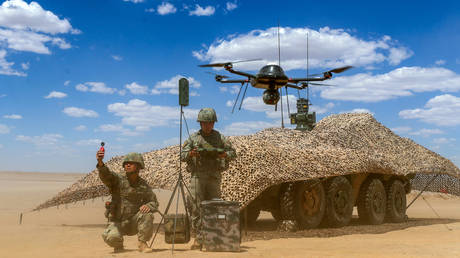
In a conflict zone, you don't need a trillion-parameter Large Language Model (LLM) running in a cooled data center in Iowa. You need a highly optimized, quantized model running on the edge—inside a drone, a headset, or a missile.
- Google's Approach: Centralized, massive, cloud-dependent.
- The Combat Reality: Disconnected, intermittent, low-bandwidth.
The battle isn't for the most powerful AI; it's for the most resilient AI. Smaller rivals are winning because they are building for the "Tactical Edge." They are optimizing for the $15$ watts of power available on a robotic platform, not the $15$ megawatts available to a Google server farm.
The Physics of the Edge
To understand why the "Google wins by default" argument fails, we have to look at the math of latency. If a sensor picks up a threat, sending that data to a centralized Google Cloud region to be processed by a Gemini-class model is a death sentence.
We use the formula for propagation delay:
$$d_{prop} = \frac{d}{v}$$
Where $d$ is the distance to the server and $v$ is the speed of signal propagation. In a contested electronic warfare environment, $v$ can drop or $d$ can become effectively infinite due to jamming. Google’s architecture is built on the assumption that the internet always works. The military operates on the assumption that it won't.
The "People Also Ask" Fallacy
If you look at the common questions regarding Big Tech and the military, you see a trend of people asking the wrong things:
- "Who has the most data?" This is the wrong question. The military has the data. The question is who has the best tools to label, clean, and deploy it in real-time. Google is used to web data. Military data is messy, unstructured, and often comes from 40-year-old sensors.
- "Who has the most researchers?" Irrelevant. You don't need PhDs to win a skirmish; you need engineers who understand the "kill chain."
- "Is Google's AI more 'advanced'?" "Advanced" is a marketing term. In defense, "reliable" and "interpretable" are the only metrics that matter. If an AI can't explain why it flagged a target, a commander can't use it. Google’s "black box" approach is a non-starter for high-stakes kinetic decisions.
The Rise of the Defense-Native Unicorn
While the media focuses on Google’s massive contracts, the real movement is happening in the specialized sector. Companies like Anduril are not building "AI for everything." They are building a "Lattice" for the battlefield.
This is the "Vertical Integration" of war.
Google sells a toolkit. Their rivals sell a finished, integrated weapon. The Pentagon is shifting its procurement strategy from "buying parts" to "buying outcomes." If Google won't build the actual hardware that carries the AI, they will forever be relegated to the role of a subcontractor, regardless of the size of their logo on the contract.
The Trust Deficit
Let’s be brutally honest: The DoD does not trust Google. They remember Project Maven. They remember the 2018 employee revolt that forced Google to pull out of a critical AI project.
Trust in a defense context is not about "privacy" or "terms of service." It is about "Mission Assurance." It is the knowledge that when the pressure is on, the supplier won't pull the plug because of a PR crisis or a change in corporate "values."
The upstarts have no such conflict. Their values are explicitly aligned with the mission. That alignment is worth more than a billion extra parameters in a training set.
Stop Thinking About "Cloud" and Start Thinking About "Kill Chains"
The mistake the "Google Sits Pretty" crowd makes is viewing this as a traditional IT upgrade. They think the Pentagon is just upgrading from Microsoft Word to a smarter version of Workspace.
It’s not. It’s an overhaul of the OODA loop (Observe, Orient, Decide, Act).
To disrupt the OODA loop of an adversary, you need tight integration between the sensor (the camera), the processor (the AI), and the effector (the weapon). Google is only interested in the middle part. By refusing to touch the "sensor" and the "effector," they are voluntarily cutting themselves out of the most lucrative and critical parts of the value chain.
The Revenue Trap
Google’s search revenue is so massive that defense contracts—even billion-dollar ones—are a rounding error. This is a structural weakness. When a project becomes "too difficult" or "too controversial," Google’s leadership can afford to walk away.
For a company like Palantir or Shield AI, the defense contract is the lifeblood. They cannot afford to fail. They cannot afford to be "ethically flexible." This desperation creates a level of innovation and grit that a trillion-dollar company simply cannot replicate.
The Final Calculation
The "Contrarian Truth" is that we are witnessing the balkanization of the AI industry. The idea that one or two companies will provide the "base layer" for everything from search to warfare is a fantasy.
Google will continue to win "Administrative AI" contracts—HR, logistics, back-office automation. They will "sit pretty" on the boring stuff. But the "Combat AI"—the intelligence that actually determines the outcome of a peer-to-peer conflict—will be owned by the companies that aren't afraid to get their hands dirty.
Google isn't winning the Pentagon; they are being sidelined into the role of a glorified IT department. While they focus on making AI "safe" for the public, their rivals are making it effective for the soldier. In the math of survival, "effective" beats "safe" every single time.
The next time you hear that Google is the dominant force in military AI, ask yourself: would you rather have the world’s best search engine, or the company that built the brain for the drone swarm?
The Pentagon has already made its choice.
Audit your assumptions about "Big Tech" dominance. The moat is shrinking, and it’s being crossed by people who don't care about your "safety" whitepapers.
Stop looking at the cloud. Start looking at the edge.