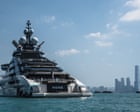
The heat in the Strait of Hormuz does not just sit on your skin. It weighs. It is a thick, salty pressure that blurs the horizon where the jagged cliffs of Oman meet the Iranian coast. Somewhere in that shimmering haze, a vessel worth more than the annual GDP of a small nation slides through the water. It is a palace made of steel and teak, a monument to a kind of wealth that exists above the laws of gravity and, occasionally, the laws of men.
We call them superyachts. But for the men and women watching the radar screens in the naval command centers dotted around the Gulf, this particular ship is a headache wrapped in a riddle. It belongs to a Russian oligarch. Under normal circumstances, its presence would be a curiosity for the jet-set crowd. Today, it is a floating geopolitical landmine.
The Strait is a choke point. It is twenty-one miles wide at its narrowest, a throat through which the world’s energy supply must pass. If you want to understand the tension of this moment, stop looking at the billionaire’s name on the deed. Look at the water. Look at the thousands of sailors on tankers and destroyers who are holding their breath as this ghost ship glides past.
The Invisible Permission
Word came through the wire that the vessel was allowed passage. To the casual observer, that sounds like a simple maritime formality. In reality, it is a masterclass in the delicate, often agonizing dance of international diplomacy.
International law is a rigid structure until it meets the reality of a narrow waterway. The United Nations Convention on the Law of the Sea provides for "transit passage." It means that ships—even those belonging to individuals under heavy international sanctions—generally have the right to move through international straits as long as they do so continuously and expeditiously.
But "generally" is a word that does a lot of heavy lifting in the Middle East.
Imagine a chess board where the pieces are moving themselves. The West wants to squeeze the bank accounts of the Russian elite to stop a war. The Gulf states want to maintain a neutrality that protects their own trade routes. The crew on the yacht just wants to get to the next port without being boarded by a boarding party in fast boats.
When that ship entered the Strait, it wasn't just moving through water. It was moving through a legal gray zone. The "source" who confirmed the passage wasn't just reporting a movement; they were confirming a compromise. By allowing the ship through, the regional powers signaled that the sanctity of the Strait remains paramount, even when the passenger list is a "who’s who" of the sanctioned.
The Human Cost of High-Stakes Hiding
We talk about these ships as if they are autonomous entities. They aren't.
Behind the tinted, bulletproof glass of the bridge, there is a captain. Most likely, he is not Russian. He is likely British, Dutch, or South African. He is a professional mariner who spent decades earning his stripes, only to find himself navigating a five-hundred-million-dollar target through the most volatile waters on Earth.
Every time the radar pings, his heart rate climbs. He knows that if a stray patrol boat decides to make a point, or if a drone malfunction leads to a misunderstanding, he is the one in the crosshairs. He isn't thinking about the war in Ukraine or the price of Siberian crude. He is thinking about his crew’s safety and the terrifying reality that his ship is a pawn in a game he never asked to play.
Then there is the crew. Stewards, engineers, chefs. They are the invisible gears of the oligarch’s machine. For them, the Strait of Hormuz isn't a strategic interest; it’s a furnace. They work in the bowels of the ship, keeping the air conditioning humming and the champagne chilled, while knowing that their employer’s name is a curse word in half the world’s capitals.
There is a specific kind of loneliness that comes with being on a sanctioned vessel. You cannot dock just anywhere. You cannot fly home for a weekend. You are tethered to a floating island of luxury that the rest of the world views as a crime scene.
The Physics of Neutrality
Why didn't someone stop it?
The answer lies in the cold, hard logic of the oil market. If a regional power decides to block a sanctioned yacht today, what stops them from blocking a tanker tomorrow? The moment you weaponize a strait, you break the seal on global trade.
The Strait of Hormuz is the world’s jugular vein. If you pinch it, the global economy goes into shock. The decision to let the oligarch’s prize sail through isn't an endorsement of the owner. It is a desperate, calculated attempt to keep the vein open.
Consider the optics. You have a US Fifth Fleet presence nearby. You have Iranian Revolutionary Guard Corps boats patrolling the same stretches. It is a neighborhood where a sneeze can sound like a gunshot. In this environment, the superyacht is an anomaly—a bright, white symbol of excess moving through a forest of gray warships.
The irony is thick. The very system of international rules that the Russian elite is accused of undermining is the same system that protects their toys. "Transit passage" is the shield. The law of the sea doesn't care about the moral character of the shipowner; it only cares about the flow of traffic.
The Ghost in the Machine
As the yacht clears the Musandam Peninsula and enters the open Arabian Sea, the immediate tension breaks. But the questions linger.
Where does a ship like that go when the world is closing its doors? It becomes a Flying Dutchman for the billionaire set. It hops from one friendly or neutral port to another, refueling in secret, turning off its Automatic Identification System (AIS) to disappear from public tracking maps, and reappearing only when it needs the safety of a sovereign harbor.
This is the new reality of wealth in a fractured world. It used to be that money bought you access. Now, for a certain class of person, money buys you a very expensive, very beautiful cage. You can have the gold-plated faucets and the infinity pool, but you can never truly come ashore.
The passage through the Hormuz is a microcosm of our current era. It represents the collision of old-world maritime rights and new-world economic warfare. It shows us that even in an age of digital banking and satellite surveillance, geography still wins. The dirt and the water define the limits of power.
The yacht is gone now, a disappearing speck on the horizon. The tankers have resumed their steady, rhythmic crawl. The sailors on the destroyers have lowered their binoculars. The "source" has gone silent.
The water in the Strait remains flat and gray, hiding the secrets of everyone who passes through. It doesn't care about sanctions. It doesn't care about oligarchs. It only cares about the tide, which continues to pull, indifferent to the empires rising and falling on the shore.
Somewhere in the Indian Ocean, the engines of that white ship are still thrumming. The captain is checking his charts, looking for a place where the rules of the world don't apply, or where they can be bought for the price of a night's docking fee. He is sailing toward a horizon that never arrives, on a ship that has everything except a destination.