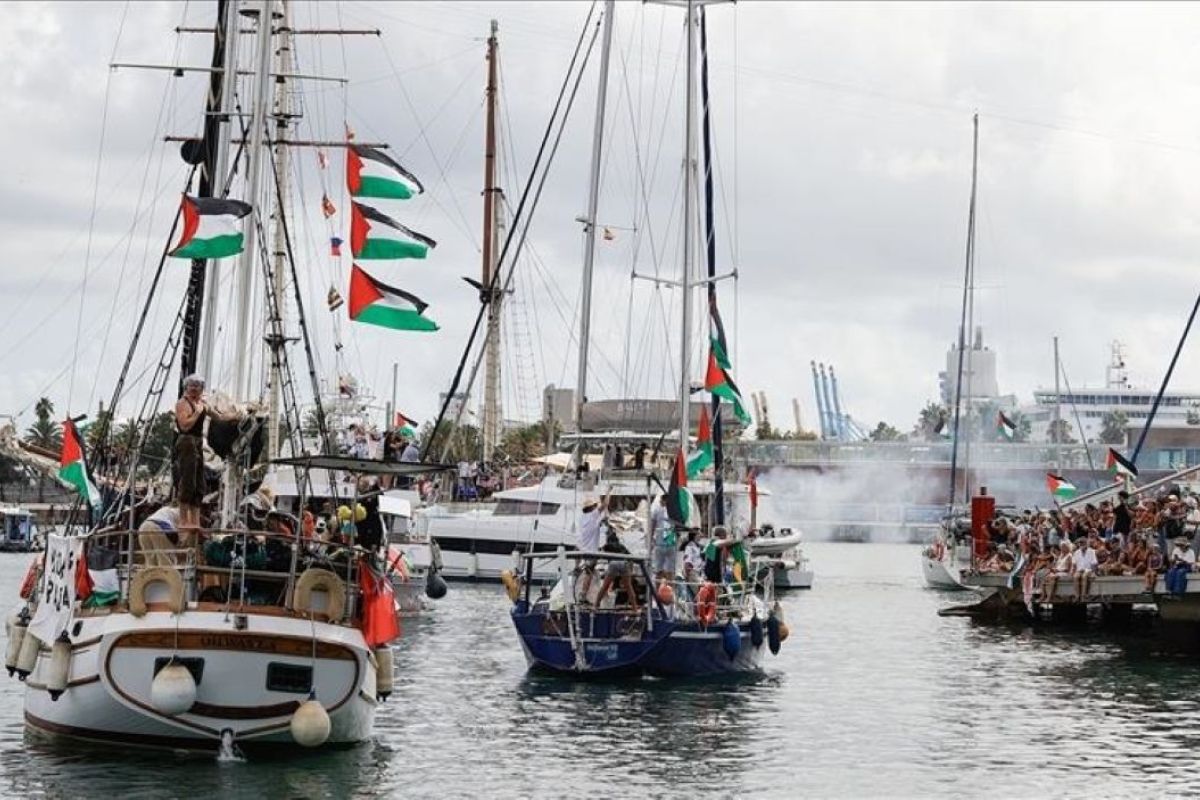
The images are starting to look familiar, but the stakes just got much higher. Israeli naval forces have moved to intercept the first vessels of the Global Sumud Flotilla as they approached the maritime exclusion zone off the coast of Gaza. It's a high-stakes game of chicken on the open sea that we've seen before, yet this specific mission carries a different kind of political weight in 2026. This isn't just about bags of flour or medical crates. It’s about a direct challenge to a blockade that has defined regional geopolitics for nearly two decades.
You’ve probably seen the headlines. Most news outlets focus on the immediate skirmish—the boarding of the boats or the standard "no comment" from military officials. But if you want to understand the real story, you have to look at the math of the cargo and the shifting legal arguments being used by the organizers.
The mechanics of the interception
The Israeli Navy began its operation in the early hours of the morning. They didn't wait for the boats to hit the shoreline. Using fast-attack craft, they surrounded the lead vessel, the Handala, roughly 40 nautical miles out. The military's logic is straightforward and consistent. They claim the maritime blockade is a legal necessity to prevent the smuggling of dual-use materials that could be used for weapons manufacturing.
From a tactical perspective, these interceptions are practiced and precise. They typically involve electronic jamming to cut off the live streams from the activists on board, followed by a physical boarding. The goal is to redirect the ships to the Port of Ashdod. Once there, the "dual-use" dance begins. Authorities inspect the goods, claim they'll transfer the "approved" humanitarian items via land crossings, and detain the crew for deportation.
But here is where the story gets messy. The Global Sumud Flotilla organizers anticipated this. They aren't just carrying rice. They've packed the holds with specific construction materials and specialized medical equipment that Israel often classifies as "dual-use." By doing this, they're forcing a public debate over what actually constitutes a weapon. Is a bag of cement a building block for a home or a tunnel? That's the question the flotilla wants the world to answer.
Breaking down the Global Sumud Flotilla strategy
The organizers of this mission aren't amateurs. They represent a coalition of international NGOs from Norway, Turkey, and the United States. They’ve spent months raising funds and navigating the complex maritime laws of the Mediterranean.
One thing most people miss is the "legal warfare" aspect of this trip. Unlike previous attempts, the Global Sumud Flotilla has a team of maritime lawyers on standby in Cyprus and London. They’re filing immediate injunctions in international courts the moment a boat is boarded in international waters. They argue that since the blockade itself has been called into question by various UN bodies, the act of intercepting a ship in international waters constitutes an act of piracy.
It’s a bold claim. It usually doesn't hold up in the domestic courts of the nations involved, but it creates a massive PR headache. For the activists, the goal isn't necessarily to dock in Gaza. They know the odds of that are slim to none. The goal is the interception itself. The "sumud"—which translates to steadfastness or resilience—is about showing that the sea remains a contested space.
The cargo that creates the conflict
- Solar panels and batteries: These are a major sticking point. Gaza’s power grid is notoriously unstable. The flotilla is carrying high-capacity solar kits. Israel often restricts these because the batteries can be repurposed for military communication systems.
- Specialized surgical kits: We're talking about orthopedic equipment for crush injuries. These are often held up at land crossings for weeks. The flotilla brings them to the forefront of the conversation.
- Clean water filtration units: High-tech membranes that can desalinize small amounts of water. Again, these have components that the military eyes with suspicion.
Why this time feels different
If you've followed Middle Eastern news for a while, you might be thinking, "didn't this happen in 2010 and 2015?" Yes. But the context in 2026 has shifted. The international community is less patient with long-term blockades than it used to be. Recent rulings from the International Court of Justice have put a spotlight on the humanitarian conditions in Gaza, making it harder for any country to justify blocking basic supplies.
The Israeli government is in a tough spot. If they let the ships through, the blockade effectively ends. If they use force, they risk another "Mavi Marmara" moment—a reference to the 2010 raid that ended in several deaths and a massive diplomatic fallout with Turkey.
I've talked to analysts who suggest that the navy is trying a "soft" interception this time. They’re using water cannons and loud-hailers instead of immediate boarding. They want to wear the activists down rather than create a martyr. It’s a slow-motion confrontation that plays out over days, not hours.
What happens after the ships are seized
Once the ships reach Ashdod, the process is predictable. The activists are processed by immigration. Most are put on the first flight out of Ben Gurion Airport. The ships themselves are often impounded for months or years.
The real tragedy is the cargo. While the Israeli government promises to "transfer" the aid, the reality is a logistical nightmare. Much of the food rots in warehouses while the paperwork is debated. The medical equipment often sits in a legal limbo because it doesn't meet the specific bureaucratic standards of the COGAT (Coordinator of Government Activities in the Territories) office.
Basically, the "aid" becomes a political football. The flotilla proves its point about the difficulty of getting supplies in, and the government proves its point about maintaining security. Everyone wins their respective PR battles, but the people in Gaza don't get the solar panels.
The role of international pressure
Don't expect the US or the EU to jump in and stop the interceptions. They generally support Israel's right to secure its borders. However, you'll see a lot of "deep concern" expressed in press briefings.
The real pressure comes from the grassroots. The Global Sumud Flotilla is a massive social media operation. They have influencers on the boats. They have 24/7 satellite uplinks. This is the first flotilla where the majority of the "battle" is happening on TikTok and X (formerly Twitter) in real-time.
When a naval officer boards a ship, it's not just a military action. It's a live-streamed event for millions. That changes the rules of engagement. You can't hide a mistake when five different people are filming it from five different angles.
The legal gray zone of the Mediterranean
International maritime law is a mess. The San Remo Manual on International Law Applicable to Armed Conflicts at Sea says a blockade is legal if it’s declared, effective, and doesn't starve the civilian population. The activists argue the third point is being violated. The Israeli government argues the first two points give them total authority.
There is no easy answer here. Both sides cite the same books to justify different actions.
If you're looking for a resolution, don't hold your breath. This cycle of flotilla, interception, and deportation is part of a larger, frozen conflict. But the Global Sumud Flotilla has succeeded in one thing. It has forced the world to look at the sea again.
Immediate actions and what to watch
If you're following this, keep an eye on the diplomatic cables from Ankara and Oslo. These two cities often have the most skin in the game when it comes to these missions.
- Check the cargo lists: Look for what specifically is being rejected at the Port of Ashdod. That tells you more about the current security climate than any press release.
- Monitor the legal filings: Watch for cases filed in the ICC regarding the seizure of vessels in international waters.
- Verify the footage: In an era of AI and deepfakes, wait for multiple sources to confirm any reports of violence on the ships.
The ships are being towed. The activists are being detained. The blockade remains. It’s a stalemate on the water, but the ripples will be felt in every diplomatic office from Washington to Tehran. Don't expect the news cycle to move on quickly—this is just the beginning of a long summer of maritime tension.