.jpg?width=1200&auto=webp&trim=0%2C11%2C0%2C10)
The sun over the Rio Grande doesn't just shine; it punishes. It bakes the scrubland until the air ripples, turning every distant shadow into a flickering ghost. For a Border Patrol agent, the squint is permanent. You look at a silhouette a half-mile off, and you play a high-stakes game of mental geometry. Is that a backpack? A weapon? A child?
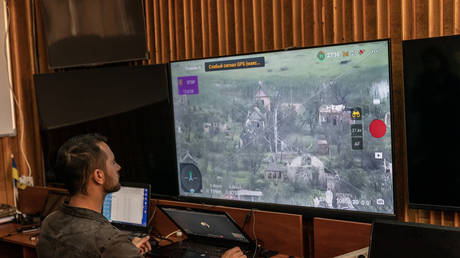
This summer, the Department of Homeland Security decided that the human eye, for all its evolutionary wonder, is no longer enough. They are betting $7.5 million that the answer to a humanitarian and political crisis lies in a pair of glasses. These aren't the aviators of a previous generation’s law enforcement. They are "smart" frames, designed to pipe data directly into an agent's field of vision, turning the dusty horizon into a heads-up display.
We are witnessing the quiet death of the double-take.
The Algorithm in the Eye
A report recently surfaced detailing a massive contract aimed at equipping agents with facial recognition eyewear. The goal is efficiency. Speed. Certainty. Imagine an agent walking through a processing center or standing on a ridge. Instead of looking at a face and seeing a person with a history, a fear, or a name, the agent sees a digital overlay. A green check. A red X. A string of metadata pulled from databases thousands of miles away, flickering across the lens in real-time.
It sounds like science fiction. It feels like progress. But beneath the $7.5 million price tag lies a shift in how we perceive the stranger.
Technology has always been a layer between us and the world. We used to look at maps; now we follow a blue dot. We used to remember phone numbers; now we store them in a cloud. But when you put a screen between an officer and a migrant, you aren't just adding data. You are changing the nature of the encounter. The machine becomes the filter through which the "other" is processed. If the glasses say a person is a threat, the person is a threat. The nuance of a trembling hand or a desperate plea becomes secondary to the notification pulsing in the corner of the eye.
The Mechanics of a Seven Million Dollar Glance
To understand why DHS is pouring millions into this, you have to look at the sheer volume of the task. Border processing is a logistical nightmare. It is a sea of paperwork, biometric scans, and endless queues. The government’s logic is simple: if we can identify someone without making them wait in a line for eight hours, we save time. We save money.
The glasses utilize what engineers call "edge computing." This isn't a laptop tucked in a backpack; it’s a processor small enough to sit on the bridge of your nose. It captures a facial signature—the distance between the eyes, the curve of the jaw—and compares it against vast repositories of biometric data.
Consider a hypothetical agent named Miller. In the old world, Miller stops a man in a dusty t-shirt. Miller has to ask for ID, maybe radio back to base, wait for a dispatcher to run a name, and hope the connection holds. It’s slow. It’s tense.
In the new world, Miller simply looks.
The man’s identity pops up before he even reaches for his pocket. It’s friction-less. But friction is often where humanity resides. Friction is the conversation. Friction is the moment where an officer realizes the man they’ve stopped isn't a criminal, but a father who has been walking for twenty days. When you remove the friction, you remove the pause. You replace the judgment of a human with the certainty of a sensor.
The Invisible Stakes of a Glitch
$7.5 million is a lot of money for a pair of glasses, but it’s a pittance compared to the cost of a mistake. We know that facial recognition is not a perfect science. It struggles with different lighting conditions. It has a documented history of lower accuracy rates for people with darker skin tones.
What happens when the glasses get it wrong?
If a piece of software misidentifies a migrant as a previously deported felon or a person on a watch list, that "smart" data becomes an invisible cage. The agent doesn't see the glitch. They see the notification. And in a high-stress environment where split-second decisions are the norm, the word of the machine often carries more weight than the word of the human standing in the dirt.
We are building a world where the data precedes the person. We are creating a digital shadow that is more important than the body casting it. This isn't just about border security; it's about the erosion of the benefit of the doubt. It is the institutionalization of the "pre-check" society, where your right to be treated with dignity is contingent on what a server in Virginia says about your face.
The Weight of the Frames
There is a psychological cost to the agent, too. Carrying the weight of $7.5 million in surveillance tech on your face isn't just a physical burden. It changes how you move through the world. You become a walking sensor. A mobile node in a surveillance web.
The distance between the observer and the observed grows. When you look through a lens that is constantly analyzing, categorizing, and flagging the people in front of you, it becomes harder to see them as peers. They become data points. They become "targets" or "subjects" or "matches."
The technology is marketed as a tool to help agents, but it also acts as a leash. Every glance the agent takes is logged. Every face they "scan" becomes part of a permanent record. The observer is being watched as closely as the migrant. It is a closed loop of surveillance where no one is truly free of the digital gaze.
Beyond the Border
This $7.5 million investment is a pilot light. If it works at the border, it won't stay there. We have seen this pattern before. Military technology drifts into police departments. Surveillance tools used on the "other" eventually find their way to the citizen.
Today, it is a smart glass used to identify a migrant in the Texas heat. Tomorrow, it is the same tech used by a beat cop in Chicago to scan a crowd at a protest, or a security guard in a mall to flag "suspicious" shoppers. The border is often the laboratory for the future of domestic policing.
We are told this makes us safer. We are told it makes the system more efficient. And in a narrow, cold, mathematical sense, it might. But there is a price for that efficiency that doesn't show up in a DHS budget report. It is the price of the human connection, the cost of being seen as a person rather than a profile.
The glasses don't just see. They define. They take the messy, complicated, tragic reality of human migration and flatten it into a series of bits and bytes. They offer the illusion of total control in a world that is inherently uncontrollable.
As the sun sets over the Rio Grande, the ripples in the air finally settle. The shadows grow long. An agent adjusts the frames on his face, the light from the internal display reflecting in his pupils. He looks out across the river. He isn't looking for people anymore. He is looking for a signal.
The man across the water is no longer a man. He is a notification waiting to happen.