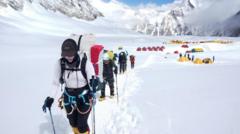
The air at 29,000 feet doesn’t just lack oxygen. It lacks mercy. It tastes like cold pennies and dry needles, scraping against the back of your throat with every desperate gasp. Up here, in the "Death Zone," your cells are literally dying. Your brain swells. Your blood thickens into a sludge that struggles to pump through frozen veins. Every step is a negotiation with gravity, a slow-motion dance where the prize is staying alive for one more minute.
Then you see it.
A block of ice the size of a suburban house, perched precariously over the only viable route to the top of the world.
For the hundreds of climbers huddled in the thin air of the South Col, this wasn't just a geographical feature. It was a cork in a bottle. It was a ticking clock. This massive protrusion of blue ice, dangling from the South Summit, threatened to collapse at any moment, potentially sweeping anyone beneath it into the two-mile abyss of the Kangshung Face.
The Architecture of Terror
Imagine standing on a sidewalk. Now, imagine that sidewalk is only twelve inches wide. To your left, a sheer drop of 8,000 feet into Nepal. To your right, a 10,000-foot plunge into Tibet. Now, place a crumbling, five-story building made of frozen glass directly in your path.
This was the reality facing the 2024 Everest climbing season.
The ice block sat near the "Hillary Step," a nearly vertical rock face that represents the final major obstacle before the true summit. In a normal year, this section is a bottleneck. In a year where a giant chunk of the mountain decides to detach itself, it becomes a graveyard in waiting.
The problem wasn't just the ice. It was the physics of the human body. At this altitude, you cannot "wait out" a problem. You are on a timer. Your supplemental oxygen canisters are whistling toward empty. Your core temperature is dropping. If you stay still for too long, you become a permanent landmark, a colorful speck of Gore-Tex frozen into the mountainside.
The Men Who Breathe for the Rest of Us
We often talk about "climbing" Everest as if it’s a solitary act of will. We see the photos of Western adventurers standing on the peak, arms raised in triumph. But those photos are a lie of omission.
The real story of the 2024 season belongs to the rope-fixing team. These are the Sherpas—men like Kami Rita or Ngima Tashi—who do the work that should be impossible. While the "clients" are still shivering in their sleeping bags at Base Camp, these men are up in the darkness, hauling miles of heavy nylon rope and pounding steel pickets into the ice.
When the giant ice block was discovered, the entire season hit a wall. Expeditions stalled. The "bubble"—that narrow window of good weather when the jet stream lifts off the mountain—was shrinking.
The rope-fixers had a choice. They could wait for the ice to fall on its own, which might take days or weeks, effectively ending the season for everyone. Or, they could go out onto the face, dangling over the void, and find a way around the monster.
They chose the void.
The Invisible Stakes
To understand why this mattered, you have to look at the economics of obsession.
A single permit to climb Everest now costs $11,000, and that’s before you pay for guides, oxygen, food, and gear. Most climbers spend between $45,000 and $100,000 for their shot at the summit. For many, this is a life’s savings. It is the culmination of years of grueling training on lesser peaks, of months away from family, of a singular, burning focus that borders on psychosis.
But there is a darker cost.
When a route is blocked, crowds build up. We have all seen the horrifying photos from recent years: a literal "traffic jam" in the Death Zone. Dozens of people clipped into a single safety line, shuffling inches at a time. When people stop moving, they die. They run out of oxygen while waiting for the person in front of them to take a step.
The giant ice block wasn't just a physical barrier; it was a catalyst for a potential mass-casualty event. If the rope-fixing team couldn't bypass it, the pressure to "push through" once the route opened would create a stampede at 28,000 feet.
The High-Altitude Chess Match
The team of ten Sherpas reached the obstacle under the cover of night, their headlamps cutting weak circles into the swirling spindrift. They didn't have heavy machinery. They didn't have explosives. They had ice axes, crampons, and a level of grit that is difficult for a person sitting at sea level to comprehend.
They had to navigate the "Cornice Traverse," a knife-edge ridge where the snow overhangs the drop-off. One wrong move, one weight shift onto an unsupported shelf of frozen mist, and they would disappear.
They worked in a world of blue and grey. The ice block groaned—a deep, tectonic sound that vibrates in your chest more than your ears. Every crack sounded like a gunshot.
The strategy was a gamble: instead of going over or under the unstable ice, they would swing out further onto the sheer rock and ice of the face, bypass the "bulge," and re-establish the line above the danger zone. It required hundreds of feet of extra rope and a terrifying amount of time exposed to the wind.
While they worked, the mountain stayed silent. The wind screamed at 40 miles per hour, stripping the heat from their bodies despite their thick down suits.
The Breakthrough
The news filtered down to Base Camp via crackling radio bursts.
"The line is fixed."
Four words that signaled the release of a massive, collective breath. The bottleneck was gone. The "gate" was open.
Within hours, the first wave of climbers began their push. They moved past the ice block, many of them never even realizing how close they were to the edge of the end. They saw a wall of blue ice, felt a shiver of awe, and kept climbing. They didn't see the frayed nerves of the men who had spent the night securing their lives.
But the mountain always gets its say.
Even with the path cleared, the 2024 season remained one of the most treacherous on record. The ice block was a symptom of a larger problem: the mountain is changing. Warming temperatures are melting the "perma" out of the permafrost. The Khumbu Icefall—the shifting glacier at the base of the mountain—is becoming more active. Rocks that have been frozen in place for millennia are suddenly tumbling down on climbers.
The giant ice block was a warning. It was Everest reminding us that we are guests, and increasingly unwelcome ones.
The Ghost in the Machine
Consider a hypothetical climber. We’ll call him Elias.
Elias is 45. He’s a father of two from Chicago. He’s spent three years dreaming of this moment. He’s at Camp IV, his lungs burning, his mind foggy from the lack of pressure. He hears that the route is blocked. He looks at his oxygen gauge. He knows he has enough for one attempt. If he waits, he loses his chance. If he goes, he might die.
Elias represents the hundreds of souls sitting in those high-altitude tents. The clearance of that path wasn't just a "technical achievement" by a maintenance crew. It was the difference between Elias going home to see his children and Elias becoming a cautionary tale.
The Sherpas who cleared that path didn't do it for the glory. Most of their names won't appear in the Western headlines. They did it because it is their job, their livelihood, and their sacred duty to the mountain they call Chomolungma—the Mother Goddess of the World.
The Descent into Reality
By the time the sun hit the summit, the first groups were standing on the top. The view from the peak is famous: the curvature of the earth is visible. The sky turns a deep, bruised purple-black. You are standing above the clouds, above the birds, above the world of petty concerns.
But the summit is only the halfway point.
Most accidents happen on the way down. Exhaustion sets in. The adrenaline that carried you up evaporates, leaving only a hollow, shaking frame. As the climbers descended back past the giant ice block, the sun had softened the snow. The threat was even more palpable now.
The path was narrow. The ropes were thin.
We often think of progress as something that happens in labs or boardrooms. We think of "clearing a path" as a metaphor for business or personal growth. But on the Southeast Ridge of Everest, clearing a path is a literal, bloody, frozen struggle against the extinction of hope.
The ice block eventually fell. It collapsed into the void, a silent explosion of white powder and shattered crystals. By then, the climbers were gone. The tents were packed. The mountain was alone again.
The ropes remain, though. Thin, colorful threads of nylon, stretching across the sky, holding the weight of a thousand dreams and a dozen lives. They are the only thing standing between the ambition of man and the gravity of the Earth.
Next time you look at a photo of that jagged, white peak, don't just look at the summit. Look at the ridges. Look at the shadows. Somewhere in those shadows, there is a path that shouldn't exist, held in place by the courage of men who refuse to let the ice win.
The mountain is still there. It is still breathing. And it is still waiting for the next piece of itself to break away.


