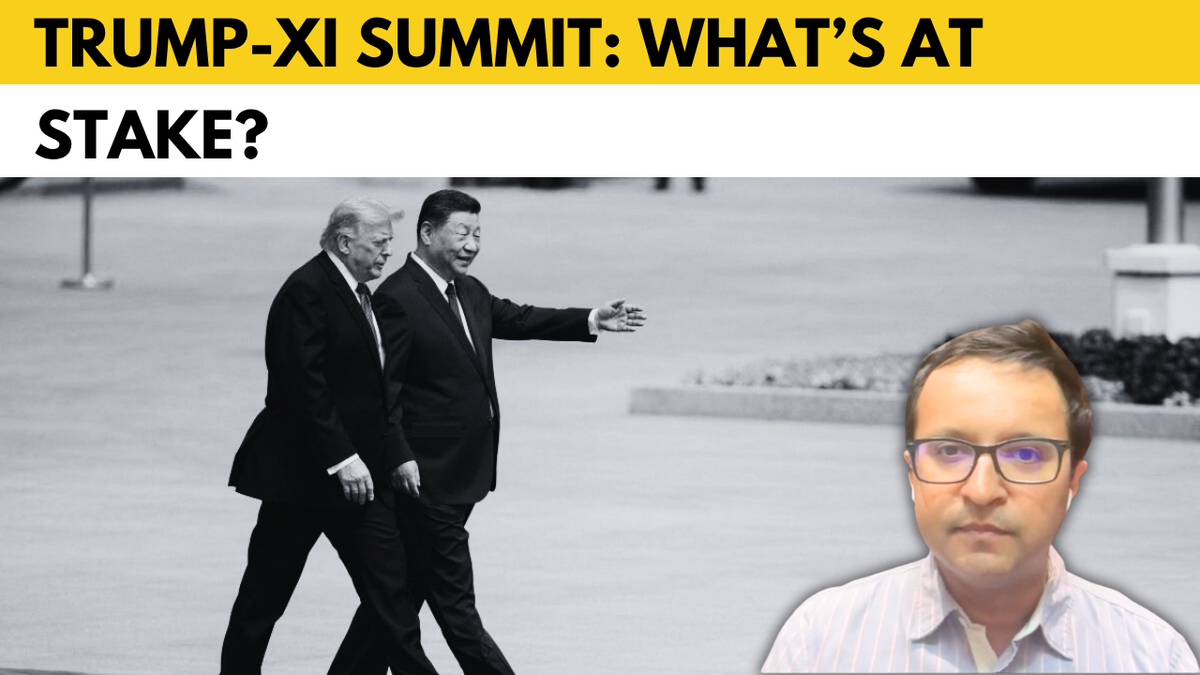
The air inside the ballroom always feels heavy, regardless of how high they crank the climate control. It is a specific kind of stillness. It’s the silence that precedes a tectonic shift, the kind of quiet that settles over a room when two men, representing nearly forty percent of the entire world’s economic output, sit down to decide which version of the future we are all allowed to live in.
When Donald Trump and Xi Jinping meet, the cameras catch the handshakes and the choreographed smiles. They capture the long tables and the translator earpieces. But the real story isn't in the press release. It is in the tension between two fundamentally different ways of existing. One man views the world as a series of deals to be won or lost; the other views it as a long, inevitable march toward a historical destiny.
We are not just talking about soybeans and semiconductors. We are talking about the price of your next phone, the stability of your retirement fund, and whether the 21st century will be defined by cooperation or a slow, grinding divorce.
The Ghost in the Supply Chain
Think of a small business owner in Ohio. Let's call him Jim. Jim doesn't care about the geopolitical nuances of the South China Sea. He cares about the specialized steel valves he needs for his assembly line. For twenty years, those valves have arrived like clockwork from a factory outside Shanghai.
To Jim, the "summit" isn't a political event. It’s a survival metric. If the two leaders leave the room with a scowl, Jim’s margins evaporate. A twenty-five percent tariff isn't a line item on a government ledger; it is the reason Jim has to tell his floor manager that there won't be bonuses this year.
This is the human element often lost in the "dry" reporting of trade wars. We treat "trade" as an abstraction. It isn't. It is a web of millions of Jims, all connected by invisible threads of commerce that are currently being pulled taut. When Trump talks about "America First" and Xi talks about "The Chinese Dream," they are both pulling on opposite ends of Jim’s livelihood.
The stakes are centered on this friction. Trump’s strategy has always been the blunt instrument—using access to the American consumer market as a lever to force structural changes in how China operates. Xi’s strategy is the long game—weathering the storm while building a self-sufficient internal ecosystem that no longer needs that American access.
The Battle for the Invisible
The most significant conflict isn't over things we can touch. It’s over things we can’t see.
Data. Algorithms. Intellectual property.
For decades, the West viewed China as the world’s factory. You sent a blueprint; they sent back a product. But the blueprint stayed yours. That era is dead. Today, the summit is about who owns the "brain" of the future. If you control the standards for artificial intelligence, 6G telecommunications, and green energy, you don't just win a trade deal. You win the century.
Consider the "forced technology transfer" issue. To a diplomat, it’s a talking point. To a Silicon Valley engineer, it’s the terrifying realization that to sell your software in a market of 1.4 billion people, you might have to hand over the keys to your most precious secrets.
Trump approaches this with the mindset of a litigator. He wants protections, guarantees, and enforcement mechanisms. He wants to stop the "bleeding" of American innovation. Xi, however, sees these demands as a direct assault on China’s right to develop. In his view, the West had its industrial revolution; now it is China’s turn, and they won't be held back by rules written by their competitors.
The Psychology of the Table
There is a profound cultural mismatch at the heart of these meetings.
Trump operates on a short-term cycle. He needs a "win" he can project to his base. He needs a headline that screams Victory. This makes him unpredictable, prone to walking away from the table to see if the other side flinches. It’s the "Art of the Deal" played out on a global stage.
Xi Jinping operates on a cycle of decades. He is not worried about the next election. He is worried about the Mandate of Heaven—the historical legitimacy of the Communist Party. For Xi, a "win" is maintaining stability and avoiding any appearance of weakness. In Chinese political culture, "saving face" isn't a polite suggestion; it is a structural necessity.
When Trump pushes, he expects a counter-offer. When Xi is pushed, his instinct is to dig in. This is how trade wars turn into "forever wars." It’s two different languages being shouted across a very expensive table.
The Splinternet and the Great Decoupling
We are currently witnessing the beginning of what experts call "decoupling."
For thirty years, the world moved toward a single, unified global economy. We all used the same internet, bought the same brands, and relied on the same financial systems. That dream is fracturing.
We are moving toward a world with two "internets"—one controlled by Western democratic values (and corporate interests) and another controlled by the Chinese state’s security apparatus. We are seeing two different sets of standards for everything from banking to satellite navigation.
This isn't just a technical shift. It’s a shift in how humans interact. If you can’t talk to someone on the other side of the world because your apps aren't compatible, or if you can't buy their products because of a "national security" ban, the world becomes a smaller, colder, and more suspicious place.
The summit is an attempt to manage this divorce. Both sides realize that a total break would be catastrophic. The "Gilded Cage" of mutual economic dependence is the only thing keeping the peace. They are like a couple that hates each other but can't afford to sell the house.
The Weight of the Unspoken
If you listen to the official briefings, you will hear about "positive steps" and "frank discussions." These are code words for "we didn't agree on much, but we’re still talking."
But watch the body language. Look at the distance between them in the photos.
The true fear among the global elite—the CEOs, the bankers, the policy wonks—is that we are drifting toward a point of no return. A point where a single misunderstanding in the Taiwan Strait or a botched trade negotiation triggers a cascade of events that no one can stop.
History is full of leaders who thought they could control the fires they started.
The summit is about more than just numbers on a spreadsheet. It is about whether two superpowers can find a way to coexist in a world that is shrinking every day. It is about whether the "deal" is even possible anymore, or if we have entered an era where "winning" simply means losing less than the other guy.
The cameras will eventually turn off. The black motorcades will speed away. The ballroom will be emptied, and the heavy silence will return. But for the Jims of the world, and for everyone who relies on the stability of a global order they never asked to be part of, the wait continues. We are all passengers on a ship being steered by two captains who can’t agree on where the horizon is, let alone how to get there.
The lights in the Great Hall of the People stay on late into the night, but the shadows they cast reach across every border, into every home, and onto every screen in the world.