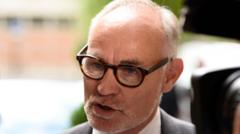
The mahogany doors of Westminster don't just keep the public out. They keep the silence in. For twenty-six years, Crispin Blunt walked those corridors with the practiced ease of a man who belonged to the stones themselves. He was a fixture. A veteran. A former minister who had navigated the choppy waters of the Foreign Office and the Ministry of Justice. But the halls of power have a way of echoing, and eventually, the echoes find their way to the street.
On a Tuesday that felt like any other, the weight of a quarter-century career met the cold reality of a charge sheet. The headlines were clinical: "Ex-MP Crispin Blunt charged with drugs offences." To the casual scroller, it was another data point in a perceived era of political decay. To those who understand the human cost of the public eye, it was the final snap of a long-frayed wire.
The Crown Prosecution Service doesn't deal in metaphors. They deal in specifics. Blunt, now 65, stands accused of possessing a Class A drug—cocaine—and the possession of a Class B drug with intent to supply. It is that second part, that "intent to supply," that turns a personal crisis into a systemic shockwave. He also faces a charge of possession of a Class B drug. These are not the kind of stains that wash out with a well-timed apology or a quiet retreat to the backbenches.
The Weight of the Green Benches
Being an MP is a strange, bifurcated existence. You are simultaneously a powerful architect of national law and a servant to the mundane grievances of your constituents. In Reigate, the leafy, affluent Surrey seat Blunt held since 1997, he was the face of the establishment. He was the man you wrote to about planning permissions or rail strikes.
Imagine the psychological tax of that duality. By day, you are voting on the very laws that govern the substances found in your home. By night, the door closes, and the man behind the title remains. We often forget that politicians are not just voting machines in suits; they are biological entities subject to the same pressures, temptations, and lapses in judgment as the people they represent. This isn't an excuse. It’s a diagnosis of the human condition under the spotlight.
The investigation began in October 2023. Think about that timeline. For months, while the world moved on through wars, elections, and economic shifts, a man who once helped run the country was living under the shadow of a police probe. He was suspended by the Conservative party. He became an independent. He vanished from the front pages, but the legal machinery never stopped grinding.
The Geography of a Fall
The charges stem from an incident in Horley. It’s a town that sits in the shadow of Gatwick Airport, a place of transitions and runways. It is a long way from the grand, neo-Gothic splendor of the Palace of Westminster.
When a high-profile figure is charged with "intent to supply," the public imagination immediately goes to the cinematic—shadowy corners, large sums of money, a deliberate commercial enterprise. But the law is often more granular. Intent to supply can cover a vast spectrum of behaviors, some far less "professional" than the phrase suggests but no less illegal. It implies a distribution, a sharing, a movement of substances from one hand to another.
For a man whose career was built on the concepts of justice and reform, the irony is thick enough to choke on. Blunt wasn't just any MP; he was a former prisons minister. He had seen the sharp end of the justice system from the top down. He knew the statistics. He knew the faces of the people who ended up behind bars for the very things he is now accused of.
The Invisible Stakes
Why does this matter more than a standard celebrity bust? Because it punctures the illusion of the "lawmaker."
We operate on a social contract that suggests those who write the rules are, at the very least, committed to the spirit of them. When that contract is breached, the damage isn't just to the individual’s reputation. It’s a hairline fracture in the foundation of public trust. Every time a figure of Blunt’s stature faces the magistrates, the cynical voice in the back of the public mind grows louder. It whispers that the rules are for the ruled, not the rulers.
But look closer at the man. In 2010, Blunt came out as gay, a move that required significant courage within the traditionalist wings of his party. He has never been a stranger to breaking the mold or facing the consequences of his personal truth. Yet, there is a profound difference between personal liberation and legal transgression.
The charges—possession of cocaine, possession of a Class B drug, and possession with intent to supply—carry the potential for significant prison time. At 65, the stakes are not just professional. They are existential. He is scheduled to appear at Crawley Magistrates' Court on April 14.
The Mechanics of the Prosecution
The CPS doesn't move on cases like this unless they believe there is a "realistic prospect of conviction." This isn't a speculative swing. It is a calculated legal move based on evidence gathered over months of forensic and witness work.
- The Class A Charge: Cocaine. In the UK, this is the highest tier of controlled substances. The law views it with zero leniency because of the violence and exploitation baked into its supply chain.
- The Class B Charge: Often involving substances like ketamine or cannabis. While viewed as "lesser" than Class A, the charges still carry heavy social and legal weight.
- The Intent to Supply: This is the pivot point. It elevates the case from a personal health or lifestyle issue to a criminal act against the community.
Consider the atmosphere in that courtroom in April. There will be no special treatment, no velvet ropes. There will be a bench, a clerk, and a prosecutor reading out facts that contrast sharply with the biography of a man who once stood at the dispatch box.
The Ghost in the Room
There is a ghost that haunts every story of a fallen public figure: the "What If."
What if the pressures of the job are actually incompatible with a healthy private life? What if the culture of Westminster, with its late nights and high-octane stress, creates an environment where people seek out the most dangerous exits? We talk about "Westminster bubbles," but we rarely talk about the pressure inside them. It’s a pressure cooker that either hardens you into a careerist or cracks you wide open.
Blunt’s situation is a reminder that the "Great Offices of State" are held by fragile hands. We demand our leaders be superhuman, then act shocked when they prove to be all too human in the worst possible ways.
The news cycle will eventually chew this up and spit it out. There will be a trial, a verdict, and perhaps a sentence. But the image that remains is not of the MP in his prime, arguing for prison reform or foreign policy shifts. It is of a man in his mid-sixties, standing in a local magistrate’s court, listening to a list of charges that represent the total dismantling of a life’s work.
Justice is often described as blind, but it is also incredibly heavy. It doesn't care about your past titles or the people you knew. It only cares about what was in the room when the police arrived.
The mahogany doors are closed. The silence is over. The law is waiting.
The walk from the backbenches to the dock is shorter than anyone thinks.