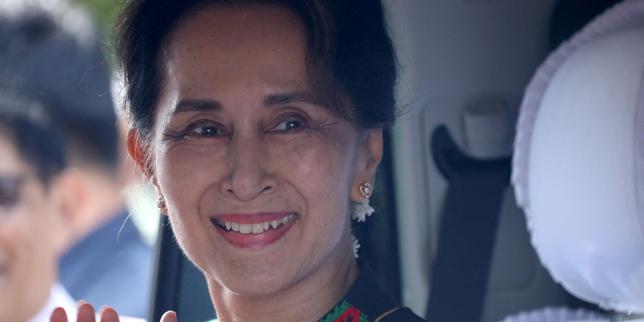
The transfer of Aung San Suu Kyi from a cramped Naypyidaw prison cell to house arrest is not the humanitarian victory the Myanmar military junta wants the world to believe it is. It is a calculated, desperate chess move. By shifting the 78-year-old Nobel laureate to a private residence—citing "extreme heat" as the primary justification—the State Administration Council (SAC) is attempting to blunt international sanctions while simultaneously using the former leader as a high-stakes human shield.
This transition marks a cynical pivot in the junta’s survival strategy. Facing unprecedented losses on the battlefield against ethnic armed organizations and People’s Defence Forces (PDF), Senior General Min Aung Hlaing is reaching for the only lever he has left: the physical custody of the "Lady." For another look, consider: this related article.
The Logistics of Political Hostage Taking
Suu Kyi’s relocation is less about health and more about optics. For decades, the Burmese military, or Tatmadaw, has followed a predictable cycle of incarceration followed by strategic "lenience" whenever the economy teeters on the brink of collapse or diplomatic pressure becomes unbearable.
The current conditions in Myanmar are dire. The kyat has plummeted in value, and the military has lost control of key trade routes on the borders of China, Thailand, and India. By moving Suu Kyi to house arrest, the junta creates a veneer of de-escalation. They want the Association of Southeast Asian Nations (ASEAN) and Western powers to see this as a "concession" that warrants a seat back at the table. Similar insight on the subject has been provided by USA Today.
However, the reality of house arrest in Naypyidaw is often more isolating than a standard prison. In a prison, there is a paper trail and a known location. In "protective custody" at an undisclosed government residence, the military controls every scrap of information she receives and every person she speaks to. This is not freedom; it is the refinement of her role as a political prisoner.
The Heatwave Narrative as a Smoke Screen
The official line from the military spokesperson, Zaw Min Tun, emphasized the need to protect elderly prisoners from the record-breaking heat sweeping Southeast Asia. It is a convenient excuse. While the heat is indeed lethal, the junta has shown zero concern for the thousands of other elderly political prisoners currently languishing in Insein Prison or the remote labor camps of the north.
The sudden concern for Suu Kyi’s well-being is a reaction to her fading health and the nightmare scenario she represents for the generals. If she were to die in a prison cell, she would become an eternal martyr, sparking an uprising that even the Tatmadaw's air force could not suppress. By keeping her in a villa, they manage the risk of her death while maintaining her as a bargaining chip.
A History of Broken Promises
To understand the current situation, one must look at the 2010 release of Suu Kyi. At that time, the military believed they could control a transition to "disciplined democracy." They were wrong. Suu Kyi’s National League for Democracy (NLD) won in a landslide, eventually forcing the military’s hand in the 2021 coup.
The generals have learned from that "mistake." They will not release her to her lakeside home in Yangon, which served as a rallying point for the 8888 Uprising and subsequent pro-democracy movements. Instead, she remains in the sterile, military-constructed capital of Naypyidaw—a city built specifically to be protest-proof.
The Failure of the Five-Point Consensus
The international community, particularly ASEAN, has pinned its hopes on a "Five-Point Consensus" that calls for an immediate end to violence and a dialogue between all parties. The military has ignored every point. This move to house arrest is a direct attempt to provide "proof of progress" without actually stopping the airstrikes on villages or releasing the thousands of other detainees.
The "why" behind this timing is linked to the upcoming regional summits. The junta needs a win. They need to show that the situation is "normalizing." But you cannot normalize a civil war. The resistance forces, now better armed and coordinated than ever, have already dismissed the move as a distraction. For the young fighters in the jungle, Suu Kyi remains a symbol, but she is no longer the sole commander of their movement. The struggle has evolved beyond a single personality.
The Economic Engine of the Coup
The junta’s grip on power is fueled by two things: jet fuel and foreign currency. Despite sanctions, the military continues to access the revenue from state-owned enterprises in the gemstone and timber industries.
- Myanma Oil and Gas Enterprise (MOGE): The primary source of foreign exchange for the military.
- Gemstone Auctions: Used to bypass traditional banking systems through private sales in neighboring markets.
- Aviation Fuel Supply Chains: Sophisticated networks that continue to deliver the fuel needed for the military's scorched-earth aerial campaigns.
Moving Suu Kyi to a house does nothing to address these underlying drivers of the conflict. It is a cosmetic change to a structural catastrophe.
The Fracturing of the Tatmadaw
Perhaps the most overlooked factor in this story is the internal pressure within the military itself. There are credible reports of growing resentment among mid-level officers who are tired of fighting a war against their own people that they are no longer winning.
By bringing Suu Kyi out of the shadows of the prison system, Min Aung Hlaing may be trying to signal to his own ranks that a political solution—one that keeps the military in power but ends the active fighting—is still possible. It is a desperate attempt to maintain internal cohesion in a force that is seeing record numbers of defections.
The Resistance Response
The National Unity Government (NUG), the shadow administration formed by ousted lawmakers, has been clear. They demand the unconditional release of all political prisoners and a complete exit of the military from politics. For them, moving the Lady from a cell to a villa is a change of scenery, not a change of heart.
The younger generation of activists, often referred to as Gen Z, has a different relationship with Suu Kyi than their parents. While they respect her legacy, they are not waiting for her to negotiate their future. They have seen the "dialogue" of the past decade fail, and they are committed to a federal democracy that strips the military of its economic and political autonomy entirely.
The Impossible Choice for the West
Western governments now face a dilemma. Do they acknowledge the move as a positive step and risk legitimizing the junta, or do they dismiss it and risk appearing indifferent to the health of a democracy icon?
History suggests the latter is the only viable path. Every time the international community has accepted a "half-measure" from the Burmese military, the generals have used the breathing room to regroup and crush the opposition. The sanctions must remain. The pressure must increase.
Suu Kyi is now a prisoner in a gilded cage, located in a city that is effectively a fortress. She cannot see her lawyers regularly. She cannot speak to her family. She has no access to the internet or outside news. The "rest of her sentence"—which totals 27 years on trumped-up charges ranging from walkie-talkie possession to election fraud—remains a death sentence given her age.
The move to house arrest is the ultimate admission of weakness from a regime that has run out of ideas. They are holding a 78-year-old woman hostage because they are terrified of the people she represents. As long as she is in their custody, regardless of the quality of the furniture in her room, the revolution remains unfinished.
The international community should not be fooled by the change of address. A cage, no matter how well-ventilated, is still a cage. The only metric of success in Myanmar is the total removal of the military from the halls of power and the restoration of a government that does not rule by fear.
Anything less is a victory for the generals.