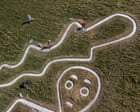
The chalk underfoot doesn't feel like stone. When it’s wet, it feels like slick, heavy grease. It clings to your boots, adding pounds to every step as you climb the steep, emerald ribs of Trendle Hill.
For the people of Dorset, the Cerne Abbas Giant is more than a quirk of the map. He is a 180-foot enigma carved into the side of a mountain, a club-wielding figure who has watched over the village for centuries. But look closely at his outlines today, and you’ll see something unsettling. The crisp, bone-white lines are blurring. He is melting into the grass.
Every few years, a group of volunteers and National Trust rangers performs a ritual known as "rechalking." It is a grueling, physical act of devotion. They haul tons of fresh, crushed chalk up the incline and pack it by hand into the trenches that form the Giant’s anatomy. It should be a straightforward task of maintenance.
It isn't.
The Weight of a Shadow
Imagine standing on the Giant's shoulder. To your left, the rolling hills of the Blackmore Vale stretch out in a patchwork of greens and browns. Beneath your feet, you are trying to wedge a fresh layer of white stone into a groove that is currently the consistency of porridge.
In the past, the process was predictable. You waited for a dry spell, you cleared the weeds, and you hammered in the new chalk. But the weather in the south of England has stopped playing by the rules. The summers are now punctuated by "washout" events—sudden, violent deluges that turn the hillside into a vertical river.
When it rains like that, the chalk doesn't stay put. It liquefies. It runs down the hill in milky streaks, a phenomenon the locals call "bleeding." The Giant looks like he is dissolving into the earth, his sharp edges softening until he becomes a ghost of himself.
The stakes are higher than just aesthetics. This isn't a statue in a museum; it’s a living part of the ecosystem and a primary driver of the local economy. If the Giant fades, a piece of British identity goes with him.
A Battle Against the Sky
The climate crisis is often discussed in terms of rising sea levels or distant melting glaciers. We talk about it in the future tense. But on Trendle Hill, the crisis is happening in the present, measured in the number of buckets of stone lost to a single afternoon thunderstorm.
The National Trust rangers face a paradox. To keep the Giant white, they need to pack the chalk tight. But the tighter they pack it, the more it resists natural drainage. If the water can’t soak through, it sits on top, creating a lubricant that allows entire sections of the chalk to slide right out of the trench.
Think of it like trying to tile a bathroom floor while someone is spraying you with a fire hose.
The volunteers are exhausted. Many of them are locals who have done this for decades. They remember a time when a rechalking would last a good ten years before the weeds even started to peek through. Now, the warmer, wetter winters act like a shot of adrenaline for the grass. The greenery grows faster, more aggressively, its roots prying the chalk apart like tiny, slow-motion crowbars.
The Human Toll of Preservation
There is a specific kind of silence that falls over a work crew when they realize the work they did yesterday has been undone by the clouds overnight. It’s a quiet, heavy frustration. You see it in the slumped shoulders of a ranger looking at a collapsed section of the Giant’s club.
Metaphorically, the Giant is a mirror. He reflects our own struggle to hold onto the past while the environment shifts beneath our feet. We are trying to keep things exactly as they were in a world that refuses to stay still.
Consider the logistical nightmare: seventeen tons of chalk. That is the weight of nearly three African elephants. Every bit of it has to be moved, spread, and tamped down. When the weather turns "sticky," the physical toll on the human body doubles. The ground becomes a skating rink. A slip doesn't just mean a bruised ego; it means a tumble down a 45-degree slope.
The cost of maintenance is skyrocketing, too. It’s not just about the price of the stone. It’s the man-hours, the specialized equipment, and the constant monitoring. We are paying a premium to fight a war of attrition against the atmosphere.
The Mystery in the Dirt
Why do we bother? Why not let the grass take him?
The answer lies in the deep, irrational connection humans have with their landscape. For centuries, the Giant was a mystery. Some thought he was an ancient fertility god; others argued he was a 17th-century political caricature of Oliver Cromwell. Recent sediment testing suggests he might be Saxon, dating back to the 10th century.
That means for over a thousand years, generations of people—people who survived plagues, wars, and famines—found the time to climb this hill and keep the lines white. They didn't have hydraulic lifts or weather apps. They had shovels and a sense of duty.
To let the Giant fade now would be to break a chain that has remained unbroken for a millennium. It would be an admission that we, with all our technology and wealth, are less capable of preserving our heritage than the medieval farmers who preceded us.
Adaptation or Loss
The strategy is changing. Rangers are experimenting with different grades of chalk—larger chunks that might lock together better, or "fines" that create a smoother surface. They are looking at the way water flows off the hill, trying to divert the runoff before it hits the Giant’s sensitive areas.
But even the best engineering has its limits.
We are entering an era where preservation requires more than just muscle; it requires a fundamental shift in how we view "permanence." The Giant is a reminder that nothing is truly static. Even the hills are moving. Even the stones are breathing.
The next time you see a photo of that massive, white figure standing bold against the green Dorset turf, don't just see a monument. See the sweat of the people who hauled the stone. See the anxiety of the ranger watching the weather radar. See the fragility of a giant made of dust.
The clouds are gathering over Trendle Hill again. The wind is picking up, smelling of salt and impending rain. Somewhere in a shed nearby, a volunteer is checking their boots and wondering if the work they do tomorrow will still be there by Sunday.
He stands there, club raised, defiant against the sky. But the sky always has the last word.
The white lines are slick. The earth is thirsty. The hill is waiting.
The Giant isn't just a landmark; he is a timer, and the sand is running out.