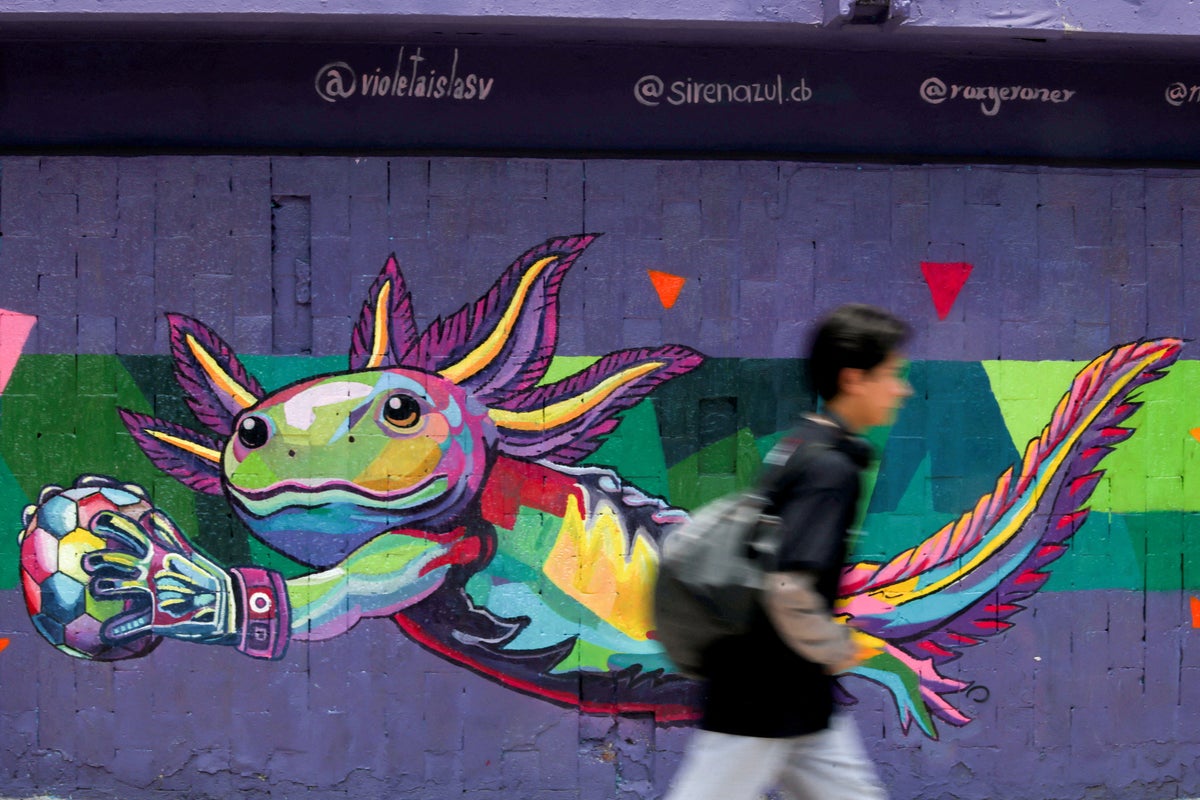
The stadium lights in Mexico City cast a blinding, artificial noon over eighty thousand screaming voices. Red, white, and green flags cut through the humid air. Horns blared. The ground shook with the rhythmic, thumping chant of a nation pulling its collective weight behind eleven men on a patch of grass. In the middle of this chaos stood a creature that looked like it had been dreamed up by a child, or perhaps an ancient Aztec god with a sense of humor.
It was pink. It had a permanent, slightly vacant smile. Feathery, coral-colored gills flared out from its head like a regal crown.
This was the axolotl, selected as the unofficial mascot for Mexico’s World Cup campaigns. Its likeness was everywhere—plush toys gripped by sticky-fingered toddlers, t-shirts stretched over beer bellies, and digital avatars flashing on giant stadium screens. The little amphibian was chosen because it represents something fundamental about the Mexican spirit: resilience. Chop off an axolotl’s leg, and it grows back. Damage its heart, and it repairs itself. It is a creature that refuses to die.
But outside the stadium, away from the roaring crowds and the cheap plastic merchandise, a quiet tragedy was unfolding in the dark, murky waters of Xochimilco.
While the mascot cheered for victories on the pitch, its real-world counter-parts were playing a game they had already lost. The ultimate survivor, the creature that could regenerate its own brain tissue, was vanishing. In fact, by the time the latest tournament cycle kicked off, scientists checking the muddy canals of its native habitat came back with an empty net.
The mascot of Mexico's sporting pride might already be extinct in the wild.
The Water That Once Was
To understand how we lost a creature that survived the collapse of empires, you have to look at what we did to its home.
Luis Zambrano, a leading ecologist at the National Autonomous University of Mexico (UNAM), knows the mud of Xochimilco better than almost anyone. For decades, researchers like him have dropped traps into the ancient network of canals on the southern edge of Mexico City. Xochimilco is a relic of a bygone world, a remnant of the vast lake system that existed when the Aztecs built their capital, Tenochtitlan, on an island.
In the 1980s, if you dropped a net into those waters, you would pull up hundreds of axolotls per square kilometer. They were the apex predators of their tiny, dark world, feasting on insects, small fish, and freshwater shrimp.
By the early 2000s, that number plummeted to less than a hundred.
A few years later, it was down to single digits.
Then came the recent surveys. The nets were raised. The mud was rinsed away. Nothing. Only the slow, heavy drip of polluted water breaking the silence.
The tragedy of the axolotl is intertwined with the tragedy of Mexico City’s growth. As the metropolis swelled into a concrete mega-city of over twenty million people, it choked out its own geography. The lakes were drained. The natural springs that fed Xochimilco were diverted to quench the thirst of a soaring human population. In their place, the city began pumping treated wastewater back into the canals.
Water that keeps a canal from drying out is not the same as water that sustains life. It is a chemical soup, heavy with heavy metals, runoff from urban streets, and the waste of a bustling metropolis.
But pollution was only the first wave of the assault.
The Unintended Executioners
Consider what happens next when an ecosystem is destabilized. In an effort to combat poverty and create local fisheries in the mid-twentieth century, the government introduced non-native fish to Xochimilco: carp and tilapia.
It seemed like a good idea at the time. A cheap source of protein for a growing population.
But ecology rarely respects human intentions. Carp are bottom-feeders. They root through the mud, tearing up the aquatic vegetation where axolotls lay their eggs. Tilapia are aggressive predators. To a hungry tilapia, a soft-bodied, slow-moving axolotl lamb or a cluster of jelly-like eggs is not an exotic evolutionary marvel. It is lunch.
The axolotl never evolved to fight these invaders. For thousands of years, they were the kings of the lake bed. They had no defense mechanisms against the snapping jaws of introduced African tilapia.
The lake bed became a slaughterhouse.
Today, Xochimilco is a bizarre contradiction. By day, it is a tourist hotspot. Brightly painted wooden boats called trajineras glide down the canals, packed with revelers drinking beer, eating tacos, and listening to mariachi bands. The water looks green, picturesque from a distance. But if you dip your hand beneath the surface, you feel the slime of an ecosystem on life support.
The tourists laugh and take selfies, completely unaware that inches beneath their colorful boats, a biological erasure is reaching its final chapter.
The Irony of Abundance
Here lies the paradox that confuses almost everyone who hears this story: how can an animal be extinct if you can buy one at a pet store down the street?
If you walk into a boutique aquarium shop in Tokyo, Paris, or Los Angeles, there is a good chance you will see an axolotl staring back at you through the glass. They have become darling fixtures of the global pet trade and internet culture. Their round faces and blank stares make them perfect for viral videos. Minecraft added them as a playable companion, introducing millions of children to the "water monster."
Furthermore, laboratories across the globe house tens of thousands of them. Scientists are obsessed with them. If an axolotl loses a limb, it doesn't heal with scar tissue; it perfectly replicates the bone, muscle, nerves, and skin. Researchers study their DNA in hopes of unlocking the secrets to human tissue regeneration, spinal cord repair, and even cancer resistance.
But the axolotls in the labs and the pet shops are not the axolotls of Xochimilco.
Almost every captive axolotl in the world traces its lineage back to a handful of specimens brought to Paris in the 19th century. They have been inbred for generations. They are genetically fragile, highly susceptible to disease, and heavily mixed with tiger salamander DNA due to laboratory cross-breeding. They are mutants of the original strain.
More importantly, a creature in a plastic tank is no longer a wild animal. It is an artifact.
When an animal goes extinct in the wild, the intricate web of evolutionary pressure breaks. The wild axolotl possessed genetic diversity built over millennia, a toolkit for survival honed by the unique pressures of the valley of Mexico. Once that wild population hits zero, that genetic library burns to the ground. You cannot simply dump a bucket of pet-store axolotls back into Xochimilco and call it a day. They would be dead within a week, killed by the water quality or eaten by the tilapia.
The captive axolotls are ghosts living in glass houses, while the true species has vanished from the earth.
The Last Line of Defense
If there is any hope left, it rests in the hands of a few stubborn people who refuse to let the mascot die in the dark.
Local farmers, known as chinamperos, are trying to resurrect ancient Aztec farming techniques to save the creature. The Aztecs farmed on chinampas—artificial islands built from layers of mud and vegetation, separated by narrow canals. It was one of the most sustainable agricultural systems ever devised.
A small group of these farmers, working alongside scientists from UNAM, have begun isolating sections of the canals. They build rustic blockades out of native wood and reeds. These barriers act as filters, keeping out the ravenous carp and tilapia while allowing water to pass through. They plant native aquatic vegetation to clean the water naturally.
They call these sanctuaries "Chinampa-Refugia."
It is grueling, unglamorous work. It requires digging through black mud under a scorching sun, monitoring water quality with cheap equipment, and begging for international donations because government funding for conservation is notoriously fickle.
The goal is to create tiny, clean oases within the toxic desert of the modern canals. A place where the wild axolotl can be reintroduced, away from the jaws of the tilapia.
But it is a race against time and space. The refuges cover only a tiny fraction of Xochimilco. Meanwhile, the city keeps growing, the water table keeps sinking, and the illegal construction of houses along the canal edges continues unabated.
The Mask We Wear
There is something profoundly unsettling about our relationship with the natural world in the twenty-first century. We love the idea of nature, but we loathe the reality of its demands.
We plaster the axolotl on soccer jerseys, buy its plush likeness for our children, and celebrate its image as a symbol of national pride and endurance. We turn it into a cartoon character because cartoons are easy to love. They don't require clean water. They don't demand that we fix our broken sewage systems or rethink how our cities consume resources.
The stadium lights will turn on again. The crowds will wear the shirts. The mascot will dance on the big screen, smiling its eternal, unbothered smile.
But out in the dark water, beneath the floating gardens where gods once walked, the real miracle is gone. The water is quiet. The nets come up light, holding nothing but black mud and the memory of a creature that knew how to heal everything except what we did to it.