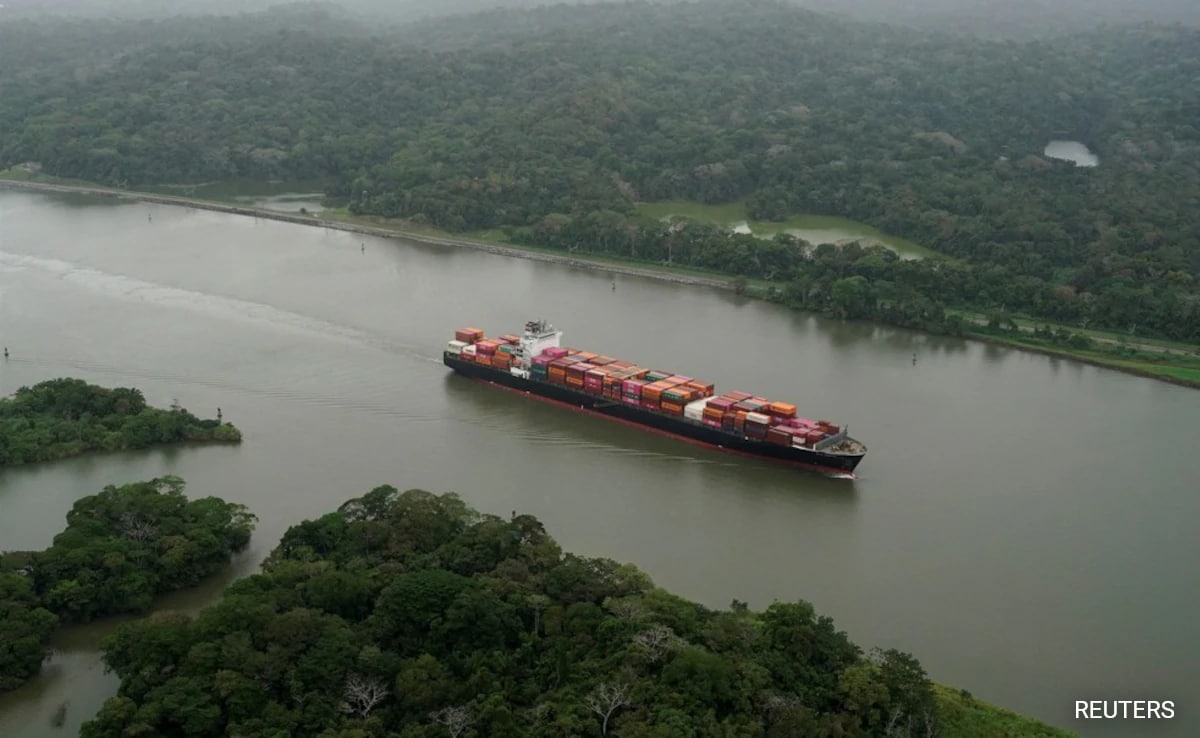
The coffee in the captain’s mug doesn’t ripple. That is the first thing you notice when you are idling in the Gatun Lake. The water is a flat, unblinking eye of turquoise, trapped between the high concrete walls of the Panama Canal. For Captain Elias—a hypothetical veteran of the merchant marines who has spent thirty years watching the world through a reinforced glass bridge—this stillness used to be a scheduled relief. It was a predictable pause in a life defined by the rhythmic slamming of North Atlantic swells.
Now, the stillness feels like a fever.
Thousands of miles to the east, the Red Sea is a gauntlet of fire. The Bab el-Mandeb strait, the "Gate of Tears," has reclaimed its ancient, bloody name. Missiles and drones have turned the Suez Canal route into a high-stakes gamble that most commercial shipping boards are no longer willing to take. So, the giants of the sea turn around. They bank into the long, grueling detour around the Cape of Good Hope, or they set their sights on a thin ribbon of water in Central America.
The world is shrinking, but not in the way the Silicon Valley prophets promised. It is shrinking because the veins of global commerce are clogging.
The Weight of a Diverted World
Shipping is the invisible heartbeat of your living room. The sneakers in your closet, the grain in your bread, and the semiconductors in your phone are all travelers. When the Suez Canal becomes a no-go zone due to geopolitical volatility in the Middle East, the Panama Canal isn't just a secondary option. It becomes the only oxygen tank left for a drowning supply chain.
But Panama is tired.
In late 2023 and throughout 2024, the canal faced a historic drought. To understand the gravity of this, you have to realize that the Panama Canal does not run on seawater. It runs on rain. Every time a ship passes through the locks, 50 million gallons of fresh water from Gatun Lake are flushed into the sea. When the clouds fail to break, the canal slows down. It rations its breath.
Then came the rockets in the Levant.
Suddenly, the traffic jam at the Isthmus of Panama wasn't just a weather story. It became a war story. Imagine a highway where half the lanes are closed for construction, and then, a massive pileup on the only other turnpike in the state forces every single car onto that same crumbling asphalt. That is the current state of global maritime logistics.
The Auction for Time
In the shipping world, time is more than money. It is survival. When vessel traffic spikes because the Middle East is too dangerous to navigate, the Panama Canal Authority has to manage a mathematical nightmare. They have a limited number of "slots" for ships to pass.
Think of Elias again. His ship, a Neo-Panamax carrier loaded with thousands of containers, arrives at the mouth of the canal. In a normal year, he might wait a day or two. But now, the queue is a graveyard of steel. Because the demand has surged while the water levels remain precarious, a shadow market has emerged.
The "Slot Auction" is a brutal exercise in capitalism. To jump the line—to avoid the massive fuel costs of idling for weeks or the catastrophic delay of sailing around the tip of South America—companies are paying premiums that sound like lottery winnings. In recent months, some carriers have paid nearly $4 million just for the right to move to the front of the line. That $4 million doesn't go toward the cargo or the crew. It is a "fast pass" for a world that can't wait for its stuff.
Who pays for that? You do.
The extra zero on the shipping invoice eventually finds its way to the price tag of the dishwasher you bought on credit. This is the human element of a "spike in vessel traffic." It isn't just a line on a graph; it is the slow, creeping inflation of daily life, driven by a drone strike in the Gulf of Aden and a lack of rain in the Panamanian jungle.
The Irony of the Map
There is a profound irony in watching the world's most advanced vessels—ships the size of horizontal skyscrapers, guided by satellite and powered by massive engines—huddle together in the tropics because of 19th-century geography.
We spent the last century believing we had conquered distance. We thought the internet had rendered the physical world a mere formality. But geography is a jealous god. It demands its due. When the Suez route is threatened, we are forced to remember that the Earth is a very large, very wet place with only a few narrow doors.
The Panama Canal is currently the most crowded door on the planet.
The engineers there are doing the impossible. They are recycling water, using cross-filling basins to save every drop of the Gatun Lake. They are squeezing more ships through the locks than the original architects ever dreamed possible. But you can't engineer your way out of a global pincer movement. On one side, you have the unpredictability of climate; on the other, the unpredictability of human conflict.
The Ghost in the Machine
If you stood on the Bridge of the Americas today, looking down at the procession of vessels, you would see a cross-section of human necessity.
- The LNG Carriers: Massive, rounded domes holding liquefied natural gas. They are the heat for European homes, diverted from the Suez because the risk of a missile hitting a floating bomb is a risk no insurer will touch.
- The Bulk Carriers: Low-slung and heavy, carrying the iron ore and grain that build and feed nations. They are the slow-moving casualties of the traffic spike, often the last to be granted a slot.
- The Car Carriers: Strange, boxy monoliths. Your next vehicle is currently sitting in a tropical sun, waiting for its turn to be lifted 85 feet above sea level by a series of concrete steps.
There is a tension in the air that the data points don't capture. It’s the tension of a crew that has been at sea three weeks longer than planned. It’s the tension of a logistics manager in Memphis who has to explain why the inventory is missing. It’s the tension of a canal pilot who knows that one wrong move in a crowded waterway could paralyze the global economy for a month.
The Fragility of the "Normal"
We have lived in an era of unprecedented maritime ease. For decades, the path from East to West was a frictionless slide. The spike in Panama’s traffic is a signal that the era of "just-in-time" delivery is colliding with the reality of "just-in-case" geopolitics.
Companies are now forced to choose between the "Long Way" (the Cape of Good Hope) and the "Expensive Way" (Panama). The Cape adds 10 to 14 days of travel and millions in fuel. Panama adds uncertainty and auction fees. There is no "Cheap Way" anymore.
This shift is forcing a re-evaluation of how we live. If it takes twice as long and costs twice as much to move a container from Shanghai to New York, the very logic of globalized manufacturing begins to fray. We are seeing the beginning of a "near-shoring" revolution, not because of a sudden burst of patriotism, but because the sea is becoming too temperamental to trust.
The Quiet Pulse
Late at night, the Panama Canal is a symphony of industrial noise. The hum of the "mules"—the powerful locomotives that pull the ships through the locks—echoes off the jungle walls. The lights of the transit are so bright they blot out the stars.
It is a marvel of human will. We took a mountain and cut it in half so we wouldn't have to sail around a continent. We mastered the water. But the current spike in traffic reminds us that our mastery is a fragile thing. We are dependent on a tiny strip of land and the stability of distant regions.
When the Suez shuts down, Panama becomes the world's bottleneck. It is the point where all our modern complexities—energy needs, consumer appetites, and political failures—are compressed into a single, narrow channel.
Captain Elias looks out from his bridge. He sees the lights of forty other ships reflecting off the still water of the lake. Each light is a story of a diverted journey, a missed deadline, or a calculated risk. He knows the lock will eventually open. He knows the water will rise. But he also knows that the world outside this quiet lake is getting louder, and the doors are getting narrower.
The stillness of the coffee in his mug is a lie. Beneath the surface, the whole world is vibrating with the strain of trying to fit through the eye of a needle.